

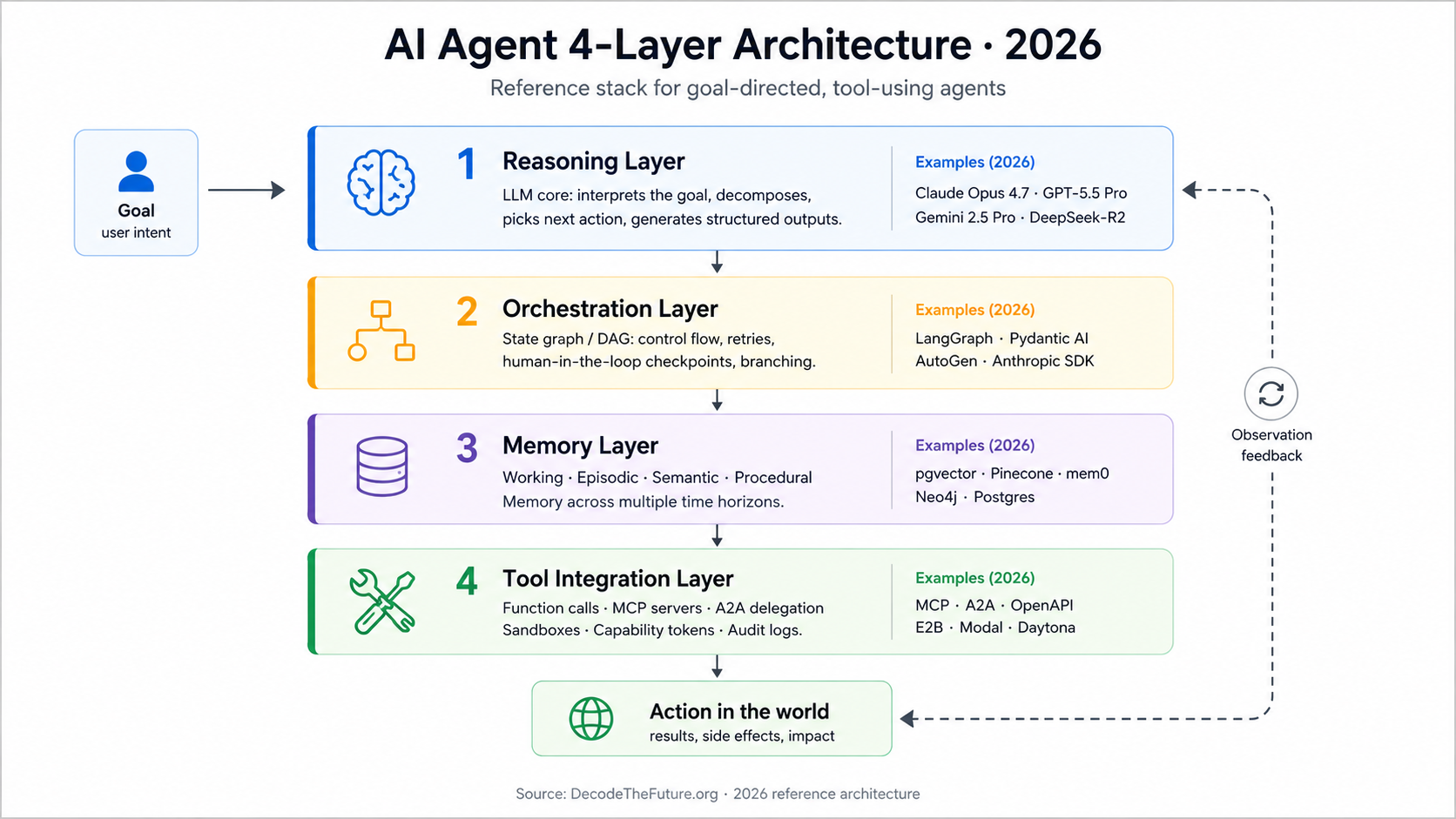

AI agent architecture in 2026 is built on four functional layers — reasoning (the LLM core), orchestration (control flow over a state graph), memory (working / episodic / semantic / procedural), and tool integration (function calls, MCP servers, sandboxes). Five design patterns dominate: ReAct (think-act-observe loops), Plan-and-Execute (decompose then run), Reflexion (self-critique retry), ReWOO (plan once, fewer LLM calls), and Tree-of-Thoughts (search over candidate plans). The two-protocol interop stack — MCP for tool access (Anthropic, donated to Linux Foundation in December 2025) plus A2A for agent-to-agent coordination (Google, April 2025) — is becoming the architectural default for enterprise deployments.
What is AI agent architecture?
AI agent architecture is the structured set of components and design patterns that turn a stateless large language model into a goal-directed system capable of planning actions, calling tools, observing results, and iterating until a task is complete. In 2026, the field has converged on a four-layer reference stack — reasoning, orchestration, memory, tool integration — that frames almost every production deployment, from Claude Code to Devin to enterprise customer-service agents.
The single most important shift since 2023 is that memory and orchestration are now first-class architectural concerns, not afterthoughts. Early agents were a single ReAct loop with a context window for memory and the framework’s hidden state for orchestration. By 2026, production teams treat them as separable systems with their own benchmarks, storage tiers, and failure modes. Agents that “remember” across sessions, devices, and tools are the new baseline; agents that don’t are demos.
This article goes deep on the architecture itself — what each layer does, which design patterns to choose, how memory actually works, and what the 2026 protocol stack (MCP + A2A) lets you build. For the broader question of what an AI agent is, see our hub article What is an AI Agent? Complete Guide for 2026; this piece assumes you know the basics and want to build or evaluate the system underneath.
What are the 4 layers of AI agent architecture?
Most production agents in 2026 separate four interconnected layers. They map cleanly to the responsibilities a software engineer would draw on a whiteboard: think, plan, remember, act.
Layer 1: Reasoning
The reasoning layer is the LLM call itself — the part that reads the current state, decides what to do next, and generates either a tool call or a final answer. This is where most token spend lives. In 2026, four reasoning-class models dominate production agents: Claude Opus 4.7 (highest SWE-Bench Verified, deepest agentic reliability), GPT-5.5 Pro (strongest at multi-tool coordination), Gemini 2.5 Pro (longest context, native multimodal), and DeepSeek-R2 (open-weight reasoning leader for self-hosted stacks).
The key architectural decision at this layer is whether to use one model for everything or to mix tiers. A common 2026 pattern: a cheap model (Haiku 4.5, GPT-5.5 Mini) handles routing and tool selection; a frontier model handles the hard reasoning steps; a verifier model checks outputs. Splitting tiers cuts cost by 4–10× without proportional capability loss, but adds orchestration complexity.
Layer 2: Orchestration
The orchestration layer is the control flow around the reasoning calls — what runs, in what order, with what retry behaviour, and where humans need to approve. Early agents wired this up imperatively in Python. By 2026, three patterns dominate.
- State graphs (LangGraph, Mastra) — explicit nodes and edges; the agent moves between named states; debuggable, replayable, durable.
- Type-safe pipelines (Pydantic AI, Anthropic Agent SDK) — Python functions with typed inputs and outputs; the framework wires the loop with minimal magic.
- Conversational topologies (AutoGen, CrewAI) — agents talk to each other in defined roles; orchestration emerges from the conversation pattern.
The honest production answer: most teams start without a framework and adopt one only when the boilerplate hurts — typically around 5+ tools, multiple agent roles, or durable state requirements. Our review of AI coding assistants goes deeper on which orchestration choices ship in real products.
Layer 3: Memory
Memory is the layer that changed most between 2023 and 2026. The earlier section gave it a single sentence; production teams now design four distinct memory subsystems, drawn from cognitive science. The next major section of this article unpacks them in detail.
Layer 4: Tool integration
The tool layer is how the agent reaches the outside world: file systems, APIs, code execution, browsers, databases, third-party SaaS. Through 2024, every framework reinvented its own tool-description format. The breakthrough of 2025–26 was the Model Context Protocol (MCP) — Anthropic’s open standard for tool registration, donated to the Linux Foundation’s Agentic AI Foundation in December 2025. MCP is now the de-facto vertical interop layer; Claude Code’s memory system is one of the most heavily-instrumented MCP deployments in the wild.
What are the 5 dominant AI agent design patterns in 2026?
Five orchestration patterns now cover the vast majority of production agents. Each is a different answer to the same question: how do you sequence reasoning, action, and observation?
| Pattern | How it sequences work | Best for | Cost & latency profile |
|---|---|---|---|
| ReAct | Think → Act → Observe, loop until done | Exploratory tasks; unknown structure | 3–5 LLM calls/task · ~$0.06–0.09 (Claude Sonnet 4.6 baseline) |
| Plan-and-Execute | Plan once → execute steps → replan on failure | Well-decomposable goals; cost-sensitive | 1 plan + N executions · 30–50% cheaper than ReAct on long tasks |
| Reflexion | Run task → critique → retry with critique in memory | Repeated failure modes; quality-critical outputs | +30% latency · +10–30% quality on the failure subset |
| ReWOO | Plan with placeholders → execute tools in parallel → fill in | Tool-heavy, parallelizable workflows | ~5× fewer LLM calls than ReAct on the same task |
| Tree-of-Thoughts | Branch into candidate plans → score → pick best | Hard reasoning (math, planning, games) | 10–50× ReAct cost · pays off only on hard problems |
ReAct: the default single-agent pattern
Yao et al. introduced ReAct (Reasoning + Acting) in 2022, and it remains the foundational design pattern for single-agent systems in 2026. The agent alternates explicit “thought” tokens and “action” tokens: it reasons about what to do next, takes an action (a tool call), reads the observation, and reasons again. Concretely:
from anthropic import Anthropic
client = Anthropic()

def run_react(goal, tools, max_steps=20):
    history = [{"role": "user", "content": goal}]
    for step in range(max_steps):
        response = client.messages.create(
            model="claude-sonnet-4-6",
            tools=tools,
            messages=history,
            max_tokens=2000,
        )
        history.append({"role": "assistant", "content": response.content})
        if response.stop_reason == "end_turn":
            return response  # done
        if response.stop_reason == "tool_use":
            tool_results = []
            for block in response.content:
                if block.type == "tool_use":
                    result = TOOL_REGISTRY[block.name](**block.input)
                    tool_results.append({
                        "type": "tool_result",
                        "tool_use_id": block.id,
                        "content": str(result),
                    })
            history.append({"role": "user", "content": tool_results})
    return "max_steps_exceeded"
That’s the entire pattern. Everything else — observability, retries, cost guards, memory hydration — sits around this loop. In a 2026 LangChain benchmark across 200 tasks, ReAct on Claude Sonnet 4.6 averaged 3.8 LLM calls per task at $0.07 average cost. The pattern is overwhelmingly the right starting point.
Plan-and-Execute: when planning is the bottleneck
Plan-and-Execute splits the work in two: a planner LLM produces an explicit ordered plan; an executor LLM walks the plan, calling tools step by step. If a step fails or yields surprising results, the planner is re-invoked.
The architectural payoff is that the executor can run on a cheaper model — it doesn’t need to do strategic reasoning, just follow instructions. Production teams often pair Claude Opus 4.7 as planner with Sonnet 4.6 or Haiku 4.5 as executor and cut cost 30–50% on long tasks without quality loss. The risk: rigid plans don’t adapt well to surprises. Mitigation: short plans (3–5 steps) plus aggressive replanning on any unexpected observation.
Reflexion: the right addition when failures repeat
Shinn et al.’s Reflexion (2023) adds verbal self-criticism: after a task ends, the agent writes a short reflection on what went wrong and stores it; on the next attempt, the reflection is in the prompt. Reflexion shines when your eval shows the same failure mode recurring across runs — the agent literally learns from its own mistakes inside the prompt context. Latency rises ~30%; quality on the failure-mode subset typically rises 10–30%. Combine with ReAct: ReAct + Reflexion is the production-grade single-agent stack.
ReWOO: parallelism for tool-heavy workflows
Xu et al.’s ReWOO (Reasoning WithOut Observation, 2023) precomputes a plan with placeholders for tool outputs, then runs tools in parallel and substitutes results. The advantage is dramatic for parallelizable work: a research agent that fetches five sources can hit them concurrently instead of waiting on each ReAct step. The Anthropic engineering team’s Building Effective Agents writeup calls this the orchestrator-workers pattern.
Tree-of-Thoughts: when ReAct isn’t smart enough
Yao et al.’s Tree-of-Thoughts (2023) generalizes chain-of-thought into a tree search: the agent generates multiple candidate plans, scores them, expands the promising branches, and prunes the rest. It crushes ReAct on hard reasoning benchmarks (Game of 24, creative writing, mini Sudoku) but is 10–50× more expensive. Use it only when ReAct + Reflexion provably plateaus on your task.
Start with ReAct on the strongest reasoning model you can afford. If you see repeated failure patterns across runs, add Reflexion. If a single agent struggles to track the whole task, split into Plan-and-Execute. If tools are parallelizable, switch the executor to ReWOO. Reach for Tree-of-Thoughts only on tasks where ReAct + Reflexion has measurably plateaued — most production agents never need it.
How does AI agent memory architecture work?
The biggest architectural difference between a 2024 agent and a 2026 agent is memory. Early agents had only a context window; teams that built around them quickly learned that production agents need four distinct memory subsystems, mapped from cognitive science.
| Memory type | What it stores | Time horizon | Typical storage |
|---|---|---|---|
| Working | Current conversation, recent tool results | Single task / session | Context window (in-prompt) |
| Episodic | Time-stamped events (“on 5 May, user asked X”) | Days to months | Vector DB + metadata (pgvector, Pinecone) |
| Semantic | Distilled facts (“user prefers TypeScript”) | Indefinite | Structured DB / KV store + embeddings |
| Procedural | Workflows and tool-use patterns | Indefinite | Code, prompts, learned policies |
Working memory: the live context window
Working memory is what the LLM literally reads on the current call. With 200K-token contexts on Claude and 1M-token contexts on Gemini 2.5 Pro, working memory feels infinite — until it’s not. Three failure modes still dominate: context degradation (models attend to early/late tokens better than middle), cost (every token is paid for on every call), and recency bias (the model overweights what’s near the end). Architectural answer: aggressively summarize, don’t dump.
Episodic memory: time-stamped events
Episodic memory captures specific events: “On 3 April, the user asked me to convert their JavaScript file to TypeScript and accepted the result.” It’s the closest analogue to human autobiographical memory and the foundation of any agent that meaningfully remembers across sessions. The standard 2026 implementation is a vector database (pgvector, Pinecone, Weaviate, mem0) where each event is embedded; on each new task, the agent retrieves the top-K most similar past events into working memory.
The four-stage lifecycle that production teams now plan for: encoding (capturing the event with full context), retrieval (pulling relevant episodes back), consolidation (transforming accumulated episodes into durable semantic facts), and eviction (managing what gets dropped when storage fills). Anthropic’s Claude Code Auto Dream feature is essentially the consolidation phase implemented as an explicit pipeline — it runs after long sessions to compress episodic memory into semantic facts.
Semantic memory: distilled facts
Semantic memory stores generalized knowledge: “the user prefers TypeScript over JavaScript”, “this codebase uses pytest”, “the customer’s billing address is Berlin”. These are produced by consolidating episodic memory or by direct user assertions. Storage is typically a structured database (Postgres, SQLite) for auditability plus an embedding for semantic search. The 2026 production pattern is graph-augmented semantic memory: facts are nodes, relationships are edges (Neo4j, Memgraph), enabling multi-hop retrieval that pure vector search can’t do.
Procedural memory: how to do things
Procedural memory is workflow knowledge: “to ship a DTF article, run the crawler, draft, validate SEO, update sources, append to log”. It’s stored not as data but as code, prompts, and learned policies. The Skills mechanism in Claude Code, the system-prompt scaffolding in Cursor, and the role definitions in CrewAI are all procedural-memory implementations. Procedural memory is what makes an agent feel like it has expertise rather than raw intelligence.
The most common 2026 mistake is treating all memory as one big vector database. Vector search is great for semantic similarity but poor at multi-hop retrieval, recency, and exact recall. A real production stack mixes: pgvector for episodic, Postgres for semantic facts, Neo4j or graph layer for relationships, plus a small fast cache for working memory hydration. mem0’s 2026 State of Agent Memory report documents this convergence across the field.
How do agents talk to tools and to each other? The MCP + A2A protocol stack
Two protocols converged in 2025–26 to form the architectural default for enterprise agent deployments. MCP handles how an agent talks to tools (vertical interop). A2A handles how agents talk to each other (horizontal interop). They are complementary, not competing.
MCP — Model Context Protocol
Anthropic published the Model Context Protocol in November 2024 as an open standard for connecting LLMs to external tools, data, and prompts. Through 2025 it became the de-facto tool-integration standard across Anthropic, OpenAI, Google, Cursor, Continue, and countless internal builds. In December 2025, Anthropic donated MCP to the Linux Foundation’s Agentic AI Foundation — making it vendor-neutral infrastructure rather than a single-company protocol. Adoption from “developer experiment” to “enterprise infrastructure” took roughly 15 months, one of the fastest protocol uptakes in software history.
The architectural value is dead simple: instead of every framework defining its own JSON schema for tools, every tool exposes itself via MCP and every agent consumes that interface. Result: write a tool once, use it from any agent. For background see our MCP explainer (PL).
A2A — Agent-to-Agent protocol
Google announced the Agent2Agent (A2A) protocol in April 2025 to solve the orchestration problem MCP doesn’t address: when you have multiple specialized agents, how do they discover each other, delegate tasks, and share state safely? A2A defines agent cards (capabilities, endpoints), task lifecycle messages, authentication, and structured task transfer. It’s the horizontal counterpart to MCP’s vertical layer.
The two-protocol stack — MCP for tool access, A2A for agent coordination — is rapidly becoming the default architecture for enterprise multi-agent deployments. Confusing the two is one of the most common mistakes in 2026 AI engineering: MCP is not for agent-to-agent communication, A2A is not for tool calls.
What does a production-ready AI agent architecture include?
Demos run on the four layers and one design pattern. Production agents need five additional concerns wired in from day one. Skipping these is the single biggest cause of agent projects that work in pilot and break in production.
Observability and tracing
Every LLM call, every tool invocation, every state transition needs a trace. Standards have converged on OpenTelemetry GenAI semantic conventions; vendor implementations include LangSmith, Langfuse, Helicone, Arize Phoenix, and Datadog LLM Observability. Without a trace, debugging a 30-step agent failure is impossible — you can’t see what the model thought, why it picked the wrong tool, or where the loop went off the rails.
Eval harnesses
Unit tests pass or fail; agent behaviour is probabilistic. The architectural answer is an eval set: 50–500 representative tasks with reference outcomes, scored by a combination of deterministic checks (assertions on tool output) and LLM-as-judge graders. You run the eval on every prompt change. Sources covered in our coding-assistants review show how SWE-Bench Verified became the public version of this for code agents.
Cost and latency guardrails
A “stuck” agent can chew through thousands of tokens per minute. Production guardrails: hard token caps per task, hard wall-clock limits, circuit breakers on consecutive tool failures, alerting on token-velocity anomalies. Build the guardrail as part of the orchestration layer — never as an afterthought in monitoring.
Sandboxing and capability scoping
An agent with unrestricted shell access is a security incident waiting to happen. Production agents run inside sandboxes (E2B, Modal, Daytona, Firecracker microVMs) with capability tokens that grant the minimum permissions for the current task. The OWASP LLM Top 10 ranks excessive agency and prompt injection as dominant agentic risks; the architectural answer is least-privilege capability tokens rotated per task.
Human-in-the-loop checkpoints
For consequential actions — sending email, executing trades, modifying production data — the orchestration graph should pause for human approval. LangGraph’s interrupt() primitive, AutoGen’s UserProxyAgent, and Anthropic Agent SDK’s permission callbacks all express the same architectural idea: a human is a node in the graph. EU AI Act Article 14 mandates effective human oversight for high-risk systems; this is its concrete implementation.
How do real production agents implement this stack?
Four well-known systems, mapped onto the four-layer model. Each makes different bets — comparing them sharpens what “AI agent architecture” means in practice.
| System | Reasoning model | Orchestration | Memory | Tool layer |
|---|---|---|---|---|
| Claude Code | Claude Opus 4.7 / Sonnet 4.6 | Built-in agent loop + Skills | CLAUDE.md + Auto Memory + Auto Dream consolidation | Native MCP servers |
| Cursor Composer | User-selected (GPT-5.5, Claude, Gemini) | Cursor’s internal agent runtime | Project context + indexed codebase + chat history | Tool plugins + MCP (added 2025) |
| Devin | Cognition’s tuned model stack | Long-running task graph with replays | Per-task workspace memory + persistent learnings | Browser, terminal, code, custom APIs |
| OpenAI Operator | GPT-5.5 Pro (browser-tuned variant) | Browser-loop runtime | Session memory + saved tasks | Browser + sanctioned tool surface |
Two patterns stand out. First, memory architecture is where systems differentiate — Claude Code’s Auto Dream, Devin’s persistent learnings, and Cursor’s codebase indexing are all attempts to solve the same problem (cross-session continuity) with very different storage strategies. Second, everyone converged on MCP for tools — even Cursor, which initially had its own tool-plugin format, now supports MCP natively. The protocol bet looks decisively right.
What does the EU AI Act require of agent architectures?
Regulation (EU) 2024/1689 doesn’t name “agents” as a category — but it shapes their architecture through three concrete requirements that every 2026 deployment in scope must address.
Article 14 (human oversight) requires high-risk systems to be designed for effective human oversight. Architecturally this translates to: a kill switch the operator can hit, the ability to pause and resume mid-task, an audit log sufficient to reconstruct what the agent did, and human approval gates before consequential actions. The orchestration layer is where these live; bolting them on later is rarely possible.
Article 13 (transparency) requires that the system’s logic, intended purpose, and limitations be accessible to deployers. For an agent, this means published prompts, tool descriptions, and at minimum a model-selection rationale. The procedural-memory layer is where this documentation belongs.
Article 26 (deployer obligations), in conjunction with Annex III high-risk categories (credit scoring, employment, education, critical infrastructure, law enforcement, migration, justice administration), requires risk management, logging, conformity assessment, and post-market monitoring. The observability layer is what makes this evidenceable; without it, compliance is unprovable. Our explainer on AI credit scoring walks the credit-scoring case in detail.
What are the most common AI agent architecture mistakes in 2026?
Six pitfalls account for the majority of failed agent projects. Each is architectural — design-time decisions, not implementation bugs.
- One vector DB for everything. Vector search solves semantic similarity, not recency, exact match, or relationships. A working memory architecture mixes vector, graph, and structured stores. See the warning callout above.
- No eval set before launch. Without 50–500 reference tasks, you cannot tell whether a prompt change improved or regressed behaviour. You will ship regressions.
- Tools described inconsistently. If two tools have overlapping descriptions, the model will pick the wrong one half the time. Mutually exclusive descriptions and a small eval over tool selection are non-negotiable.
- Excessive agency. Giving the agent broad write access (delete files, run arbitrary shell, send arbitrary email) before you trust it. OWASP LLM-08. Mitigation: capability tokens scoped per task, human approval for destructive actions.
- No cost guards. An infinite loop on a frontier model can rack up four-figure bills in minutes. Hard caps in the orchestration layer, with circuit breakers on consecutive failures, are part of the architecture — not a finance-team afterthought.
- Building multi-agent before single-agent works. Adding more agents is rarely the answer to a brittle single agent. Multi-agent systems multiply orchestration overhead, debugging surface, and failure modes. Get the single-agent loop reliable before splitting.
Personal note: how I architect the agent that ships this article
Every article on DTF — including the one you’re reading — ships through a single Claude Code agent with a custom dtf-article skill. Mapped onto the four-layer model: the reasoning layer is Claude Opus 4.7 with Sonnet 4.6 fallback. The orchestration layer is Claude Code’s built-in agent loop plus the Skill, which acts as procedural memory encoding the editorial standards. The memory layer is CLAUDE.md for project-level context, MEMORY.md for per-conversation auto-memory, and the dtf-brain repo (sources, articles, log) as durable episodic and semantic store. The tool layer is native MCP — file tools, web fetch, web search, the SEO validator script.
The non-obvious architectural choice: I do not treat the LLM as the only intelligence. The SEO validator (check_seo.py) is a deterministic verifier that fires before any article is considered done. If the validator fails — meta description too long, bibliography wrapper missing, SVG metadata incomplete — the agent reads the failure and fixes it. That’s the production-grade pattern: LLM for decisions, deterministic checks for verification. It’s also the same architecture I’d use for any production agent that has to ship work to humans.
The non-negotiable rule for any reader following along, especially in finance: do not connect an LLM agent to a brokerage execution API on retail capital. The architectural failure modes covered above — drift, prompt injection, cost blow-ups, verification gaps — are not theoretical, and trading capital is the worst possible place to learn that an agent went off the rails. Use agents for research and monitoring; keep humans in the execution loop.
Where is AI agent architecture going next?
Three directions visible in early-2026 product roadmaps and research.
First, memory becomes the new model frontier. As reasoning quality flattens at the top of the SWE-Bench Verified ladder, the new differentiation is what an agent can remember across days, weeks, and months. Expect benchmarks for cross-session continuity to displace single-task benchmarks as the meaningful agent measure.
Second, orchestration moves to durable execution engines. Temporal, Inngest, and DBOS are already pitching agent-orchestration positioning; LangGraph’s persistence layer is moving in the same direction. Production agents will run on top of workflow engines that survive crashes, replays, and human pauses — turning agent runs into resumable workflows, not one-shot processes.
Third, regulatory architecture catches up. EU AI Act enforcement against autonomous agents will produce concrete reference implementations of Article 14 oversight; expect kill-switch standards, capability-token specs, and audit-log schemas to converge by 2027. The teams that already built observability, sandboxing, and human checkpoints into the architecture will breeze through; the teams that didn’t will rebuild under deadline.
FAQ — AI agent architecture in 2026
What are the 4 layers of AI agent architecture?
Reasoning (the LLM core that decides what to do), orchestration (the control flow over a state graph), memory (working / episodic / semantic / procedural), and tool integration (function calls, MCP servers, sandboxed execution). Most production agents in 2026 separate these explicitly; treating them as one monolithic system is the most common architectural mistake.
What is the difference between ReAct and Plan-and-Execute?
ReAct interleaves reasoning and action at every step — the agent thinks, acts, observes, and decides the next step on the fly. Plan-and-Execute separates the phases: a planner produces a complete ordered plan, then an executor walks it. ReAct is more adaptive and slightly more expensive; Plan-and-Execute is cheaper for well-decomposable tasks but rigid in the face of surprises. The 2026 production default is ReAct on a strong reasoning model, with Plan-and-Execute reserved for cost-sensitive long tasks.
What memory architecture do AI agents use in 2026?
Four memory types mapped from cognitive science: working memory (the live context window), episodic memory (time-stamped events stored in a vector DB like pgvector or mem0), semantic memory (distilled facts in a structured DB plus embeddings, often graph-augmented), and procedural memory (workflows encoded as code, prompts, or skills). The biggest 2026 mistake is using one vector database for everything; production stacks mix vector, graph, and structured stores.
What is the difference between MCP and A2A?
MCP (Model Context Protocol, Anthropic, donated to the Linux Foundation in December 2025) is the vertical interop layer — how an agent talks to tools, data, and external services. A2A (Agent2Agent, Google, April 2025) is the horizontal layer — how agents discover each other, delegate, and coordinate. They are complementary; the two-protocol stack is the architectural default for enterprise multi-agent deployments in 2026.
Do I need a framework like LangGraph to build an agent?
No. Most production agents in 2026 start with the provider SDK (Anthropic, OpenAI, Google) and a hand-rolled ReAct loop — typically 50–150 lines of Python. Frameworks pay for themselves once you have 5+ tools, multiple agent roles, durable state requirements, or human-in-the-loop checkpoints. Picking a framework before that point typically costs more abstraction tax than it saves.
What does the EU AI Act require for AI agent architecture?
Article 14 (human oversight) requires kill switches, pause-resume, and human approval gates — orchestration-layer concerns. Article 13 (transparency) requires documented prompts, tool descriptions, and limitations — procedural-memory concerns. Article 26 deployer obligations (when the agent operates in Annex III high-risk domains: credit scoring, employment, education, critical infrastructure, law enforcement, migration, justice) require logging, risk management, and post-market monitoring — observability-layer concerns. Article 5 banned practices (social scoring, exploitation of cognitive vulnerabilities) apply regardless of architecture.
What is Reflexion and when should I add it to my agent?
Reflexion (Shinn et al., 2023) is a self-critique pattern: after a task ends, the agent writes a short reflection on what went wrong and stores it; on the next attempt, the reflection is included in the prompt. Add it when your eval shows the same failure modes recurring across runs. Latency rises about 30%; quality on the failure-mode subset typically rises 10–30%. ReAct + Reflexion is the production-grade single-agent stack for 2026.
Bibliography & sources
- Yao, S., Zhao, J., Yu, D., Du, N., Shafran, I., Narasimhan, K., & Cao, Y. — ReAct: Synergizing Reasoning and Acting in Language Models (NeurIPS 2022). Foundational pattern for modern single-agent loops.
- Shinn, N., Cassano, F., Berman, E., Gopinath, A., Narasimhan, K., & Yao, S. — Reflexion: Language Agents with Verbal Reinforcement Learning (NeurIPS 2023). Self-critique with verbal memory.
- Xu, B., Peng, Z., Lei, B., Mukherjee, S., Liu, Y., & Xu, D. — ReWOO: Decoupling Reasoning from Observations for Efficient Augmented Language Models (2023). Plan-with-placeholders pattern for parallel tool use.
- Yao, S., Yu, D., Zhao, J., Shafran, I., Griffiths, T. L., Cao, Y., & Narasimhan, K. — Tree of Thoughts: Deliberate Problem Solving with Large Language Models (NeurIPS 2023). Tree search over candidate plans.
- Wang, L., Xu, W., Lan, Y., Hu, Z., Lan, Y., Lee, R. K., & Lim, E. — Plan-and-Solve Prompting (ACL 2023). Foundational reference for plan-then-execute prompting.
- Anthropic — Building Effective Agents (engineering blog). Workflow vs agent, orchestrator-workers, evaluator-optimizer patterns.
- Anthropic — Introducing the Model Context Protocol (November 2024). Original MCP announcement.
- Linux Foundation — Agentic AI Foundation launch (December 2025). MCP donation and vendor-neutral governance.
- Google Developers — A2A: A new era of agent interoperability (April 2025). Agent2Agent protocol announcement.
- LangChain — LangGraph documentation. Graph-based agent orchestration with persistence.
- Pydantic — Pydantic AI documentation. Type-safe agent framework with minimal magic.
- Microsoft Research — AutoGen framework. Conversational multi-agent topology.
- CrewAI — CrewAI documentation. Role-based multi-agent simulations.
- mem0 — State of AI Agent Memory 2026. Empirical survey of production memory architectures.
- Atlan — Types of AI Agent Memory. Episodic / semantic / procedural breakdown.
- IBM — What Is AI Agent Memory?. Vendor-neutral overview of memory types.
- OpenAI — Computer-Using Agent / Operator (January 2025). Browser-control agent design and architecture.
- Cognition — Devin product page and engineering writeups. Long-running autonomous coding agent architecture.
- OWASP — Top 10 for Large Language Model Applications (2025). LLM-01 Prompt Injection, LLM-08 Excessive Agency.
- European Union — Regulation (EU) 2024/1689 (AI Act). Articles 5, 13, 14, 26, 51–55, Annex III, Recital 12.
- OpenTelemetry — GenAI semantic conventions. Standardized tracing for LLM applications and agents.