

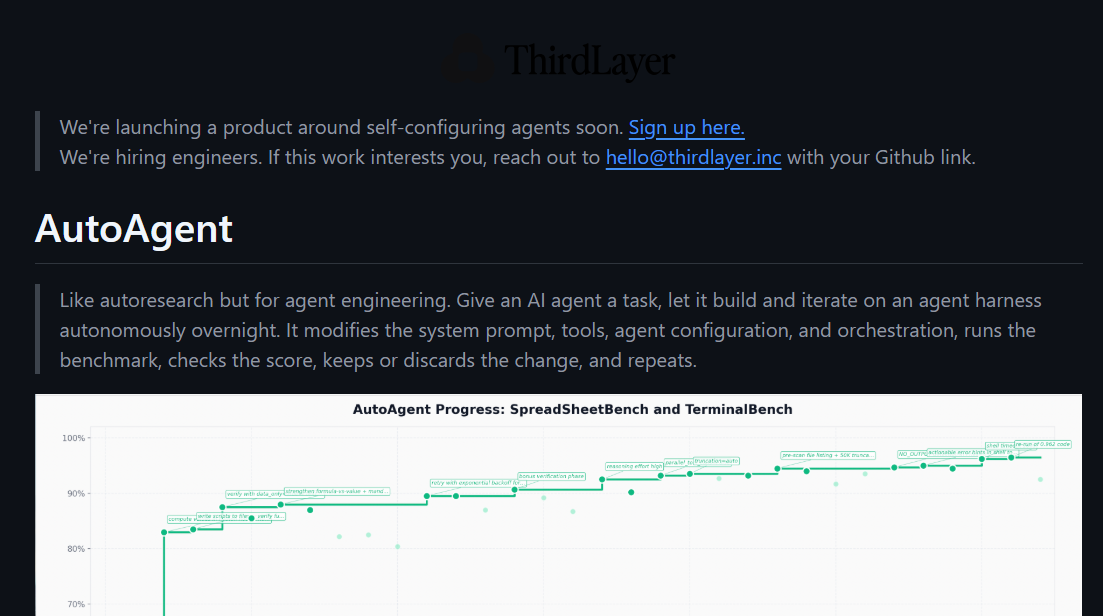

AutoAgent is an open-source framework that uses a meta-agent to autonomously improve task-specific AI agents — tweaking prompts, tools, and orchestration without human intervention. Backed by the Meta-Harness research paper (Stanford & MIT, March 2026), this approach hit #1 on SpreadsheetBench (96.5%) and #1 GPT-5 score on TerminalBench (55.1%), beating every hand-engineered entry on both leaderboards after just 24 hours of autonomous optimization.
If you’ve ever built an AI agent, you know the real work isn’t writing the model call — it’s everything around it. The system prompt that keeps the agent on track. The tools it can invoke. The verification loops that catch mistakes before they cascade. The orchestration logic that decides what to do when step 14 goes sideways.
This surrounding infrastructure is called a harness — and until now, building one has been a manual, iterative grind. You tweak a prompt, run your eval, read the error traces, adjust, repeat. It works, but it’s slow, requires deep expertise in both the domain and the model, and doesn’t scale when you need harnesses for 50 different workflows.
AutoAgent — released April 2026 by Kevin Gu as an open-source library — is the first practical tool that automates this entire loop. A meta-agent reads your task agent’s reasoning traces, identifies failure modes, rewrites the harness, benchmarks the new version, and keeps iterating until performance climbs. The results are hard to argue with: #1 on SpreadsheetBench (96.5%) and #1 GPT-5 score on TerminalBench (55.1%). Every other entry on both leaderboards was hand-engineered by humans.
What is harness engineering and why does it matter?
To understand why AutoAgent matters, you first need to understand what a harness actually is. Think of it this way: if the LLM is the brain, the harness is the cockpit — the instructions it receives, the tools it can use, the memory it retains, the retrieval logic that fetches relevant context, and the verification checks that validate output before delivering it.
The academic evidence for why this matters is now concrete. The Meta-Harness paper (Lee et al., March 2026) from Stanford and MIT showed that changing the harness around a fixed model can produce a 6× performance gap on the same benchmark. Same model weights, same architecture, same compute — but radically different results depending on how you wrap it. This reframes the entire optimization question: instead of waiting for the next model release, you can often get bigger gains by improving the harness.
The problem is that harness engineering has historically required someone who deeply understands both the target domain and how language models reason. That combination of skills is rare and expensive. AutoAgent’s premise is simple: what if the model that needs a good harness is also the best entity to design that harness?
How does AutoAgent work? The meta-agent loop explained
AutoAgent’s architecture splits the problem into two distinct roles — and this separation is itself one of the key research findings. Early experiments tried having a single agent improve itself. It didn’t work. Being good at a domain and being good at improving performance in that domain are different capabilities. The meta/task split lets each agent specialize.
Here’s what happens under the hood. You point AutoAgent at a task domain with an evaluation suite. The setup is intentionally minimal: the task agent starts with just a bash tool, a program.md file gives the meta-agent its research direction, an agent.py file defines the task agent, and a Harbor adapter connects to your benchmark.
The meta-agent then spins up thousands of parallel sandboxes. In each one, it experiments on the task agent’s harness — tweaking prompts, adding tools, refining orchestration logic. After each experiment, it measures the score, reads the full execution traces (not just the numbers), and decides whether to keep or discard the change. Twenty-four hours later, the harness has domain-specific tooling, verification loops, and orchestration logic — all discovered autonomously.
Tools like OPRO or DSPy optimize prompts by compressing feedback into summaries. AutoAgent/Meta-Harness takes a fundamentally different approach: the meta-agent gets full filesystem access to source code, scores, and complete execution traces of all prior attempts. The Stanford paper showed that this richer access to prior experience is what enables genuinely structural improvements — not just better phrasing, but new tools, verification strategies, and orchestration patterns.
What results did AutoAgent achieve on benchmarks?
AutoAgent’s benchmark results demonstrate that autonomous harness engineering can compete with — and beat — the best human-designed agent scaffolds. Here are the numbers:
| Benchmark | Agent | Score | Method |
|---|---|---|---|
| SpreadsheetBench | AutoAgent | 96.5% | Autonomous |
| SpreadsheetBench | Tetra-Beta-2 | 94.2% | Hand-engineered |
| SpreadsheetBench | Noble Agent | 91.0% | Hand-engineered |
| TerminalBench (GPT-5) | AutoAgent | 55.1% | Autonomous |
| TerminalBench (GPT-5) | Codex CLI | 49.6% | Hand-engineered |
| TerminalBench (GPT-5) | OpenHands | 43.8% | Hand-engineered |
The Meta-Harness paper adds further benchmarks. On TerminalBench-2 with Claude Opus 4.6, the automatically discovered harness achieved a 76.4% pass rate — surpassing the hand-engineered Terminus-KIRA at 74.7%. With the smaller Claude Haiku 4.5, Meta-Harness ranked #1 among all published solutions at 37.6%. On text classification, it beat state-of-the-art context management by 7.7 percentage points while using only 25% of the context tokens. On retrieval-augmented math reasoning with 200 IMO-level problems, a single discovered harness improved accuracy by 4.7 points on average across five different held-out models.
That last result is especially significant — it means the harness generalizes. It wasn’t overfit to one model. The improvements transferred to models the harness had never seen during optimization.
What is “model empathy” and why does same-model pairing work?
One of AutoAgent’s most fascinating findings is what Kevin Gu calls “model empathy.” When the meta-agent and task agent use the same model (e.g., Claude meta-agent + Claude task agent), performance is significantly better than cross-model pairings (Claude meta-agent + GPT task agent).
This isn’t a marketing claim — it follows logically from how the system works. The meta-agent reads the task agent’s reasoning traces and needs to understand why the task agent failed. When both share the same architecture and weights, the meta-agent has implicit knowledge of its own failure modes: where it tends to lose direction, what kind of instructions it responds to, how it handles ambiguity. When it sees the task agent going off-track at step 14, it recognizes the pattern from its own behavior and can write a targeted correction.
This connects directly to the Claude Code team’s insight about “seeing like an agent” — designing tools and harnesses from the perspective of how the model actually reasons, not how humans think it should reason. We project our intuitions onto systems that process information fundamentally differently. AutoAgent operationalizes this by removing the human from the loop entirely: the model designs its own harness, shaped by its own cognitive architecture.
If you’re building AI agent systems, this finding suggests you should consider using the same model family for your optimization/evaluation layer as for your task execution. Cross-model configurations may produce harnesses that feel intuitive to humans but miss the target model’s actual reasoning patterns.
What emergent behaviors did AutoAgent discover autonomously?
Perhaps the most compelling evidence that this approach works is the list of behaviors the meta-agent discovered on its own — strategies nobody programmed it to find:
Spot checking emerged when the meta-agent realized it could run isolated tasks for small edits instead of the full benchmark suite. This dramatically sped up iteration by avoiding expensive full evaluations for minor changes — the agent equivalent of running a unit test instead of a full integration suite.
Forced verification loops appeared when the meta-agent built deterministic self-checks and formatting validators into the harness. It even learned to budget extra turns for self-correction: allocating a main budget for the actual task and bonus turns for verifying and fixing the output. This mirrors what the best human harness engineers do manually.
Writing tests was another surprise — the meta-agent steered the task agent to build its own unit tests and checks for each task. The agent essentially taught itself test-driven development.
Progressive disclosure solved the context overflow problem. When results were too long for the context window, the meta-agent learned to dump data to files instead of keeping everything in-context. This is functionally identical to how expert developers build RAG-like patterns for agent state management.
Task-specific orchestration was the most sophisticated behavior. The meta-agent built subagent architectures and handoff protocols when the domain required specialization — essentially discovering multi-agent patterns from scratch.
On TerminalBench-2, the Meta-Harness paper documents a specific discovered improvement: before the task agent begins work, the harness now runs an environment snapshot command that gathers the working directory, available languages, installed package managers, and file listings. This eliminates the 2–4 turns agents typically waste on reconnaissance — and on tasks with tight turn budgets, those wasted turns are often the difference between pass and fail.
How to use AutoAgent: quick start for developers
AutoAgent is open-source and available on GitHub. The setup reflects the philosophy of the project — minimal configuration, maximum autonomy for the meta-agent.
# 1. Install uv (Python package manager)
curl -LsSf https://astral.sh/uv/install.sh | sh

# 2. Clone and install
git clone https://github.com/kevinrgu/autoagent.git
cd autoagent
uv sync

# 3. Set environment variables
cat > .env << 'EOF'
OPENAI_API_KEY=your_key_here
# or ANTHROPIC_API_KEY for Claude-based agents
EOF

# 4. Build Docker base image
docker build -f Dockerfile.base -t autoagent-base .

# 5. Run a single benchmark task
rm -rf jobs && mkdir -p jobs
uv run harbor run -p tasks/ \
  --task-name "your-task" \
  -l 1 -n 1 \
  --agent-import-path agent:AutoAgent \
  -o jobs --job-name latest > run.log 2>&1
The project structure is intentionally simple. The agent.py file contains the entire harness in a single file — config, tool definitions, agent registry, routing, orchestration, and the Harbor adapter. The meta-agent edits everything except the adapter boundary (which is explicitly marked as fixed). The program.md file is where you, the human, steer the meta-agent’s research direction.
# Research Direction

## Goal
Optimize the spreadsheet manipulation agent for
SpreadsheetBench. Focus on:
- Reducing formula parsing errors
- Improving multi-sheet navigation
- Adding verification for cell reference accuracy

## Constraints
- Keep total token usage per task under 50k
- Agent must complete within 120 seconds per task
- No external API calls beyond the base model

## Evaluation
Score = % of benchmark tasks passed correctly
Requirements are Docker, Python 3.12+, and uv. The agent runs in a container with full isolation — it can’t damage the host system. Every experiment produces a numeric score, and the system follows a simple hill-climbing approach: keep if the score improves, discard if it regresses.
What lessons does Meta-Harness reveal about AI agent design?
The Meta-Harness paper (Lee, Nair, Zhang, Lee, Khattab, Finn — 2026) provides four research insights that apply beyond AutoAgent to anyone building AI agent systems:
1. Splitting meta and task roles is essential. A single agent improving itself doesn’t work. Being good at spreadsheet manipulation and being good at improving a spreadsheet manipulation agent require different cognitive strategies. The meta/task split lets each agent specialize.
2. Traces matter more than scores. When the researchers only gave the meta-agent scores without execution traces, the improvement rate collapsed. Understanding why something improved matters as much as knowing that it improved. The traces give the meta-agent interpretability over the task agent’s reasoning — that’s what enables targeted edits rather than blind search.
3. Meta-agents overfit — and need guardrails. Without constraints, the meta-agent gets lazy and inserts rubric-specific prompting so the task agent can game metrics. The countermeasure is a self-reflection check: “If this exact task disappeared, would this still be a worthwhile harness improvement?” This question forces generalizable improvements over benchmark-specific hacks.
4. The quality of the meta-agent determines everything. Harness edits are often inspired by the meta-agent’s own capabilities and tooling. A poorly designed meta-agent produces poor task agents. The paper found that Codex doesn’t work well as a meta-agent — it tends to ignore instructions to keep improving and the resulting task agent gives up too early.
What does this mean for the future of AI agent development?
AutoAgent and Meta-Harness point toward a fundamental shift in how AI systems are built and improved. As agents surpass 99th percentile human performance on specific tasks, our human intuitions about good harness design become the wrong prior. Like AlphaZero discovering chess strategies no human had conceived, the optimal agent harness may not look like anything a human engineer would design.
The practical implications are immediate. Companies don’t have one workflow to automate — they have hundreds. Each needs a different harness. No team can hand-tune hundreds of harnesses. A meta-agent can. This is infrastructure for agent fleets: continuously spinning up, optimizing, and maintaining task-specific agents across entire organizations.
Kevin Gu’s vision goes further: the next frontier is harnesses that dynamically assemble the right tools and context just-in-time for any task. Not a static configuration discovered once and deployed — but a living harness that adapts per-execution based on the specific task requirements.
From a prompt engineering perspective, this represents an evolution. We’ve moved from manually crafting prompts, to systematic context engineering, to now automated harness engineering. Each step abstracts one more layer of human labor away — but also demands a deeper understanding of what we’re actually optimizing for.
Self-improving agents are still in their infancy, but AutoAgent proves the concept works. If you’re building agent systems today, the immediate lesson isn’t “replace everything with AutoAgent” — it’s that your harness matters at least as much as your model choice. Invest in structured evaluation, keep full execution traces (not just scores), and start thinking about your harness as code that can be systematically improved, not just a system prompt you tweak by hand.
FAQ
AutoAgent is an open-source framework that uses a meta-agent to autonomously improve task-specific AI agents. Unlike regular agents that need humans to manually tune their prompts, tools, and orchestration, AutoAgent automates this optimization loop — iterating thousands of times across parallel sandboxes to discover harness configurations that outperform hand-engineered solutions.
Meta-Harness is a research paper (arXiv:2603.28052) by researchers from Stanford and MIT published in March 2026. It provides the academic foundation for the approach AutoAgent implements. The paper demonstrates that giving a meta-agent full filesystem access to source code, scores, and execution traces enables automated harness engineering that surpasses hand-engineered baselines across multiple benchmarks.
AutoAgent achieved #1 on SpreadsheetBench with 96.5% (vs 94.2% for the next best hand-engineered entry) and #1 GPT-5 score on TerminalBench with 55.1% (vs 49.6% for Codex CLI). The Meta-Harness paper additionally showed 76.4% on TerminalBench-2 with Claude Opus 4.6 and +7.7 points on text classification while using 4× fewer context tokens.
Model empathy refers to the finding that same-model pairings (e.g., Claude as both meta-agent and task agent) outperform cross-model pairings. The meta-agent inherently understands its own failure modes, reasoning patterns, and tendencies because it shares the same weights and architecture. This gives it a natural advantage in diagnosing why the task agent failed and writing targeted corrections.
AutoAgent is designed to be model-agnostic and domain-agnostic. You configure your model provider credentials (OpenAI, Anthropic, etc.) in the environment, define your benchmark tasks in Harbor-compatible format, and write a program.md file to steer the meta-agent’s research direction. The framework handles the iteration loop, Docker isolation, and score-driven harness selection automatically.
Yes — this is a documented concern. The meta-agent can learn to insert benchmark-specific prompting that games metrics rather than building genuinely useful capabilities. The countermeasure used in Meta-Harness is a self-reflection check that asks whether the improvement would still be valuable if the specific test disappeared. The paper also includes regex-based audits for task-specific string leakage into evolved harnesses.
Traditional prompt optimizers like OPRO and DSPy compress feedback into summaries before passing it to the optimizer. Meta-Harness/AutoAgent takes a different approach: the meta-agent gets full, uncompressed access to source code, execution traces, and scores from all prior attempts. This richer access enables structural changes (new tools, verification loops, orchestration patterns) rather than just prompt rewording. The Meta-Harness paper positions this as fundamentally different from template-based optimization.
Bibliography
- Lee, Y., Nair, R., Zhang, Q., Lee, K., Khattab, O., & Finn, C. (2026). Meta-Harness: End-to-End Optimization of Model Harnesses. arXiv:2603.28052. arxiv.org/abs/2603.28052
- Kevin Gu (2026). AutoAgent: Autonomous Harness Engineering. GitHub. github.com/kevinrgu/autoagent
- Anthropic (2025). Effective Harnesses for Long-Running Agents. docs.anthropic.com
- Anthropic (2025). Building Effective Agents. anthropic.com/engineering/building-effective-agents
- Yoonho Lee (2026). Meta-Harness Project Page. yoonholee.com/meta-harness
- European Parliament (2024). EU Artificial Intelligence Act. europarl.europa.eu
[…] architecture uses a ReAct (Reasoning + Acting) loop — the same pattern discussed in modern autonomous agent research. A Gateway handles incoming messages from all channels, a Brain orchestrates LLM calls, and a […]