

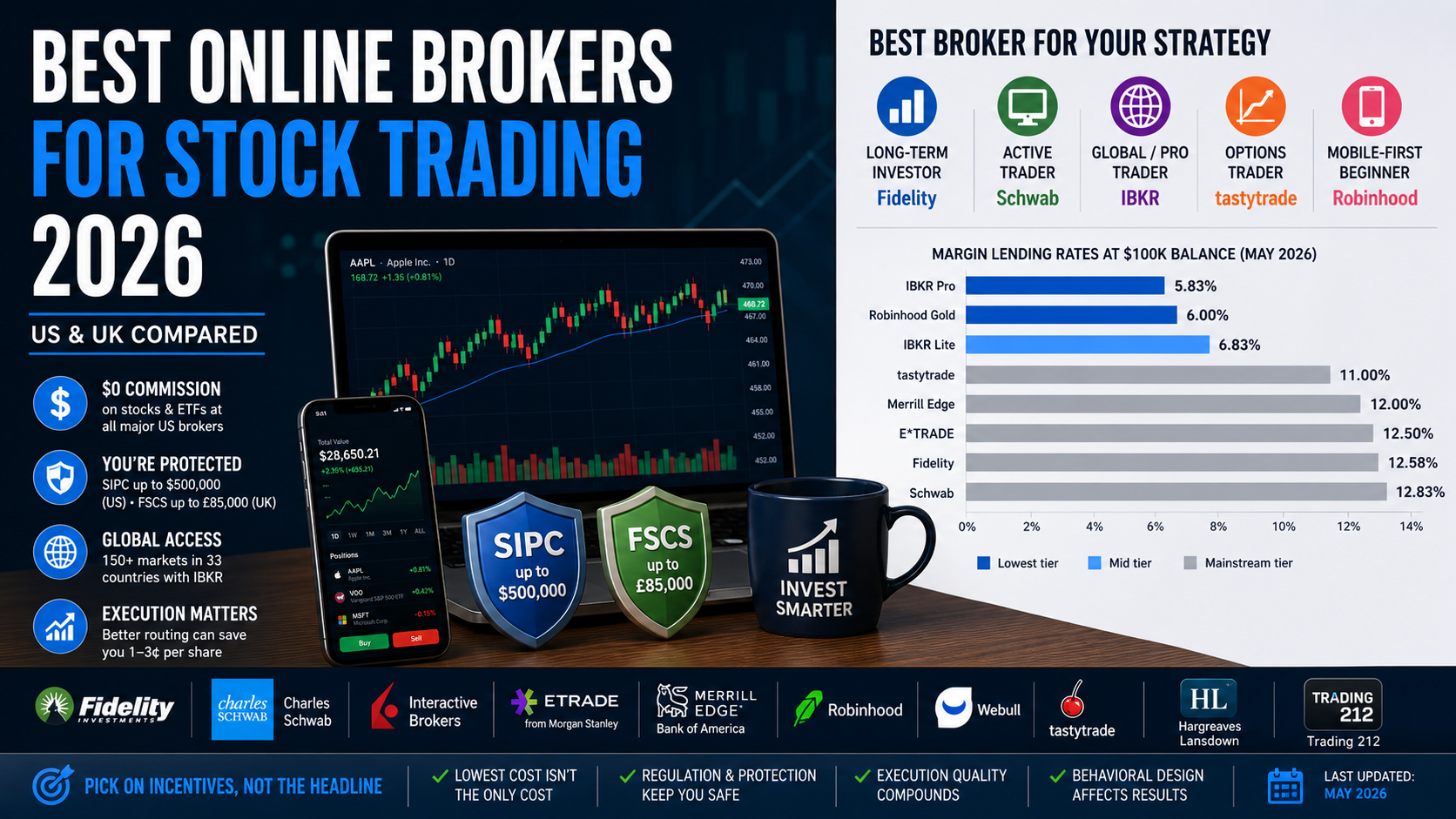

Last updated: May 2026
The best online brokers for stock trading in 2026 are Fidelity (best overall — research, fractional shares, $0 commission), Charles Schwab (best for long-term investors — Thinkorswim, banking, ETFs), Interactive Brokers (best for active and global traders — lowest margin rates, 150+ markets), tastytrade (best for options) and Robinhood (best mobile UX). All major US brokers charge $0 commission on stocks and ETFs since the 2019 price war, so the real differences are execution quality, margin rates, product breadth and protections (SIPC in the US, FSCS in the UK). For UK readers, Hargreaves Lansdown and Trading 212 remain the dominant retail venues.
Quick verdict — which broker wins which use case?
If you only have thirty seconds, here is the short version of who should pick what. The first column is the trader profile, the second is the broker we would recommend, the third is why.
| Trader profile | Best broker | Why |
|---|---|---|
| Long-term US investor (buy-and-hold ETFs, dividends) | Fidelity | $0 commission, four zero-expense-ratio index funds, fractional shares from $1, deep research |
| Active US trader (charts, scanners, options) | Charles Schwab | Inherits Thinkorswim from TD Ameritrade — still the strongest desktop platform on the retail side |
| Global / pro trader (FX, futures, foreign markets) | Interactive Brokers | 150+ markets in 33 countries, margin rates ~5–6% (half of competitors), API for algos |
| Options-heavy trader | tastytrade | $1 to open, $0 to close, capped at $10/leg; UI built around options Greeks and probability of profit |
| Mobile-first beginner | Robinhood | Cleanest mobile UI, fractional crypto, 4% IRA match on Robinhood Gold — but watch the gamification |
| Bank-of-America customer | Merrill Edge | Preferred Rewards integration unlocks free trades and cashback tiers |
| UK long-term investor (ISA, SIPP) | Hargreaves Lansdown | FTSE 100 firm, deepest fund universe, FSCS protected |
| UK low-cost / fractional shares | Trading 212 | £0 commission, fractional Pies, ISA, 5%+ on uninvested cash |
Why broker choice matters more than the headline fee
For most retail investors the question stops at “is it free?”. Since October 2019, when Charles Schwab cut commissions to zero and the rest of the US industry followed within a fortnight, every major US broker has charged $0 on stocks and ETFs. That makes “lowest commission” a useless tiebreaker — Fidelity, Schwab, E*TRADE, Robinhood and Webull all sit at the same headline number.
What separates them now sits one layer below the price tag, and it is more consequential than the commission ever was:
- Order routing and price improvement. A “free” trade can still cost you 1–3 cents per share in execution slippage if the broker routes for payment-for-order-flow (PFOF) revenue rather than best execution. Fidelity publishes price improvement statistics; Robinhood and Webull’s PFOF model has been investigated repeatedly by the SEC.
- Margin rates. If you ever borrow against the portfolio, the gap between Interactive Brokers (~5%) and Fidelity (~12%) is bigger than most ETF expense ratios — by orders of magnitude.
- Behavioural design. A broker is also a user-experience surface. Brad Barber and Terrance Odean’s work (1999, 2000) showed that retail investors who trade most underperform those who trade least by 5–7 percentage points per year, and most of that gap is attributable to overtrading driven by overconfidence — which the UI either amplifies or dampens. Robinhood’s confetti animation, push-notification cadence and free-stock referrals are explicit dopamine triggers; Fidelity’s interface is, by comparison, deliberately boring.
- Protection regime. SIPC ($500k US), FSCS (£85k UK) and the regulator behind the broker (FINRA + SEC vs FCA) decide what happens if the broker collapses — a non-trivial scenario after MF Global (2011), Robinhood’s GameStop episode (2021) and several smaller failures since.
The right way to read this article: pick the broker whose incentives, products and UX match your actual trading style — not the one whose ad you saw last.
How we ranked these brokers
We weighted six factors. None of them are subjective “feel” — each maps to disclosed data from the broker, the regulator (SEC Form 606 for routing, FINRA BrokerCheck for disciplinary record), or independent reviews from Investor’s Business Daily, Forbes Advisor and Boring Money (UK).
- Costs (25%): commissions, options per-contract, margin rates, FX conversion fee, idle-cash interest.
- Product breadth (20%): stocks, ETFs, options, futures, bonds, mutual funds, crypto, fractional, international.
- Platform quality (15%): mobile, desktop, charting, scanners, paper-trading, API.
- Regulation & protection (15%): SIPC/FSCS coverage, FINRA/FCA standing, complaint-rate data, capital adequacy.
- Research & education (15%): in-house research, third-party feeds, learning content, paper money.
- Customer service (10%): 24/7 availability, live human escalation, branch network.
Our 2026 ranking reflects the post-Schwab/TD-Ameritrade migration (completed 2024), Robinhood’s UK launch (2024), and the SEC’s renewed scrutiny of PFOF following the December 2025 enforcement bulletin.
Best US online brokers for stock trading 2026
1. Fidelity Investments — best overall
Fidelity is the broker most other brokers measure themselves against, and the one our editor would default to for a US investor with no specific niche need. Stocks and ETFs trade at $0 commission, options at $0.65 per contract, and the firm operates four zero-expense-ratio index funds (FZROX total market, FZILX international, FNILX large cap, FZIPX extended market) that no competitor has been willing to match for six years running.
The substance underneath: Fidelity routes a large share of orders to its own internalisation engine and to wholesalers that pay zero or low PFOF, which is why its SEC Rule 605/606 price improvement reports consistently lead the industry — about $20 of additional execution value on a 1,000-share order versus PFOF-heavy peers, by the broker’s own published numbers. Fidelity Go offers a no-fee robo under $25k, fractional shares (“Stocks by the Slice”) trade from $1, and the cash sweep yields ~4–5% in money-market funds rather than the near-zero rates at most peers.
2. Charles Schwab — best for active investors
The 2020 acquisition of TD Ameritrade — and the 2023–24 client migration — gave Schwab control of Thinkorswim, the desktop platform that active US traders had been using for fifteen years. Thinkorswim survived the merger intact, and its options chain, custom studies, scanner and paper-trading remain the strongest free desktop experience on the retail side. Stocks and ETFs are $0, options $0.65, and Schwab’s bond desk and treasury auctions are deeper than any retail competitor’s.
Schwab also runs a fully-fledged bank, which means a checking account, debit card and unlimited ATM-fee rebates worldwide — the latter a small detail that compounds for anyone who travels. Margin rates run 11–13%, broadly in line with Fidelity. The flip side: Schwab famously sweeps idle cash to a low-yield bank account by default (around 0.45%), and you have to opt in to a money-market fund to get a market rate. The 2023 banking turbulence put a temporary spotlight on this design, but the underlying balance sheet is investment-grade.
3. Interactive Brokers — best for active and global traders
If your trading is multi-asset, multi-currency or sensitive to financing costs, Interactive Brokers wins on cost arithmetic alone. Margin rates begin around 5.83% benchmark + spread and decline with balance — roughly half what Fidelity or Schwab charge. The platform routes to over 150 venues globally and supports stocks, options, futures, FX, bonds, mutual funds, ETFs and crypto across 33 countries and 23 currencies — there is no other retail broker close.
The two products to know: IBKR Lite is $0 commission on US stocks/ETFs but routes via PFOF; IBKR Pro charges tiered commissions (about $0.0035/share, $1 minimum) but routes for best execution and unlocks the lower margin rates and SmartRouting algo. Active traders should always pick Pro — the fee saving is rounding error against the execution improvement on size. The Trader Workstation (TWS) and the API (Python, Java, C++) are professional-grade and have been the standard for retail-quant builders for two decades.
4. E*TRADE (from Morgan Stanley) — solid all-rounder
Acquired by Morgan Stanley in October 2020 for $13bn, E*TRADE retains its retail brand and its two platforms — the standard E*TRADE web/app for buy-and-hold and Power E*TRADE for active traders. Stocks/ETFs are $0; options are $0.65 per contract, dropping to $0.50 for clients who place 30+ trades per quarter. Power E*TRADE’s options chain and risk graphs are competitive with Thinkorswim for a clean modern UI, and the integration with Morgan Stanley’s research is a quiet upgrade — institutional-grade reports show up inside a retail account.
Where E*TRADE underperforms is fractional shares (limited compared to Fidelity and Schwab) and idle-cash yields (the default sweep is low; you opt into the higher-yield money-market sweep manually). For a retail investor who wants one account that handles 401(k) rollovers, options, mutual funds and a bank — without diving into IBKR’s complexity — E*TRADE is the boring, correct answer.
5. Merrill Edge — best for Bank of America customers
Merrill Edge is the self-directed retail arm of Bank of America’s Merrill Lynch, and its case rests almost entirely on Preferred Rewards integration. If you keep $20k–$100k+ in combined BofA/Merrill balances, you unlock cashback multipliers on the BofA credit card (up to 75%), interest-rate boosts on savings, mortgage discounts and unlimited free trades inside the brokerage. For a BofA customer, that bundle dominates anything a standalone broker can offer.
Standalone — without the BofA tie-in — Merrill Edge is a competent but unremarkable broker: $0 stocks/ETFs, $0.65 options, decent research from Merrill’s institutional side, no fractional shares, no futures, no crypto. The mobile app is functional. If you don’t bank with BofA, there is no reason to choose Merrill Edge over Fidelity or Schwab.
6. Robinhood — best mobile UX (with caveats)
Robinhood pioneered the $0-commission model in 2014 and forced the rest of the industry to follow. The mobile app remains the cleanest in the category — every flow is fewer taps, every animation is faster. Robinhood Gold ($5/month) adds margin (rates ~5.5–6.75%, near IBKR territory), instant deposits, level II quotes and a 4% match on IRA contributions — the latter is unique in US retail and effectively free money for retirement savers willing to put up with the brand.
The caveats are well-documented and they are the reason this broker sits sixth, not first. Robinhood’s revenue model is dominated by PFOF: in 2020 the SEC fined the firm $65m for misleading clients about routing quality, and the GameStop episode of January 2021 exposed how thinly capitalised the firm was relative to clearing demands. The UI’s cognitive-bias profile — confetti, push notifications, free-stock lottery — is gamification-by-design, and the Gabriel v. Robinhood wrongful-death case (Alex Kearns, 2020) pushed the firm to remove some of its more aggressive elements. None of that makes Robinhood unsafe for a careful user, but it explains why we recommend it for a beginner who already understands their own behavioural pitfalls.
7. Webull — Robinhood’s better-charts cousin
Webull occupies the same niche as Robinhood — mobile-first, $0 commission on stocks/options, fractional shares, crypto via Webull Pay — but built for a slightly more analytical user. The desktop and mobile charting is genuinely superior: 50+ indicators, drawing tools, multi-chart layouts and level II quotes (free for US-listed stocks) are all standard. Paper trading, often hidden behind a paywall elsewhere, is free.
Like Robinhood, Webull is PFOF-funded and lacks bonds, mutual funds and a real research department. Its parent company is Hong Kong–based Fumi Technology, which has periodically attracted regulatory attention in non-US jurisdictions (notably Singapore’s MAS in 2022). For a US user the SIPC-protected, FINRA-supervised entity is what matters, and the operational record on the broker-dealer side has been clean. Webull is the right pick for an active-but-cost-conscious trader who finds Robinhood too sparse and IBKR too steep.
8. tastytrade — best for options traders
If you trade options seriously — selling premium, multi-leg spreads, defined-risk strategies — tastytrade was built for you in a way no general-purpose broker is. The fee structure is the tell: $1 per contract to open, $0 to close, capped at $10 per leg. That asymmetry rewards closing positions early and limits cost on large spreads, both of which are first-order requirements for premium-selling strategies.
The platform is options-native: probability of profit, theta, delta and IV rank are first-class citizens on the order ticket; equity is the secondary surface. tastytrade is owned by IG Group (the FTSE 250 UK CFD broker), which gives it a regulated parent without diluting the retail-options identity. The educational content from co-founder Tom Sosnoff is opinionated and well-produced — though predictably biased toward selling volatility, which is the firm’s editorial line.
Best UK online brokers for stock trading 2026
The UK retail market is structurally different from the US: commissions are not $0 (most brokers still charge per-trade), the protection scheme is FSCS at £85k per institution rather than SIPC, ISAs and SIPPs are the dominant tax wrappers, and PFOF has been effectively banned by the FCA since 2012. Two firms cover the vast majority of UK retail flow.
9. Hargreaves Lansdown — UK long-term investor default
Hargreaves Lansdown is the FTSE 100 incumbent of UK retail investing — over 1.8 million clients, the deepest fund supermarket on the British market, and the strongest brand recognition for ISAs and SIPPs. Stock trades cost £11.95, dropping to £8.95 (10–19 trades the previous month) and £5.95 (20+) — meaningfully higher than US zero-commission, but in line with UK norms. The fund custody fee is capped at £45/year per ISA on share holdings, which makes HL competitive once a portfolio exceeds about £30k.
The case for HL is reliability and breadth: every UK fund manager is on the platform, the research team is large, and the firm has navigated multiple market events without operational failure. The case against is cost — Trading 212 charges nothing on shares — and the legacy IT footprint, which shows up as occasional friction on the app. For an investor whose allocation is heavy in UK funds and ITs, HL is hard to beat; for a pure ETF-and-shares portfolio, it is overpriced.
10. Trading 212 — UK low-cost / fractional default
Trading 212 is the UK’s $0-commission entrant. Stocks, ETFs and ISAs trade at zero commission; the firm makes money on FX conversion (0.15%), interest on uninvested cash (a slice of the rate it pays you) and a small securities-lending programme. Pies — pre-built or user-created baskets of fractional shares with AutoInvest scheduling — are the product feature competitors have spent years failing to copy cleanly.
Since 2023 the firm has paid 4–5% interest on uninvested GBP and 4–4.5% on USD/EUR, which is competitive with money-market funds. The Stocks & Shares ISA wrapper is included at no cost. CFDs are also offered via a separate entity (Trading 212 Markets, FCA-regulated under UK CFD rules), so the brand straddles both retail-investing and CFD-trading audiences — keep the two accounts separate in your head.
Regulation, protection and PFOF — what actually keeps your money safe
The phrase “safe broker” is shorthand for two distinct things: conduct supervision (does the firm have to follow rules and is it being checked?) and recovery scheme (if the firm fails, what gets reimbursed?). The two regimes that matter for English-speaking retail investors are the US (SEC + FINRA + SIPC) and the UK (FCA + FSCS).
SIPC vs FSCS — the protection schemes
The Securities Investor Protection Corporation (SIPC) covers up to $500,000 per separate account type at a US broker, of which up to $250,000 may be cash. Many brokers buy excess insurance on top — Fidelity’s coverage runs into hundreds of millions per account through Lloyd’s of London. SIPC does not cover market losses, fraud against you (only against the broker’s misuse of your assets), or crypto held outside SIPC-eligible structures.
The UK Financial Services Compensation Scheme (FSCS) covers up to £85,000 per institution, applied to investments and cash held with FCA-regulated firms. The cap is per legal entity — if HL and Trading 212 each fail on the same day, you are protected up to £85k at each. As with SIPC, FSCS does not insure against falling markets.
FINRA vs FCA — the regulators
FINRA is the US self-regulatory organisation supervising broker-dealers under the SEC’s authority. Its public BrokerCheck register lists every disciplinary action against a firm or registered person — a free five-minute due-diligence step we would run on any broker before funding it. The FCA is the UK statutory regulator, with its own Financial Services Register and a markedly more interventionist style on retail-product design (CFD leverage caps, ISA rules, complaints data publication).
Payment for order flow (PFOF) — legal in US, banned in UK
PFOF is the practice of routing retail orders to wholesale market-makers (Citadel Securities, Virtu, Two Sigma) in exchange for a per-share rebate. Robinhood, Webull and IBKR Lite rely on it; Fidelity uses it sparingly; the UK FCA banned PFOF in 2012 as incompatible with best-execution duty under MiFID. The substantive question is not whether PFOF is illegal — in the US it is not — but whether it produces measurable execution drag for the client. Independent studies and the SEC’s own December 2025 enforcement bulletin suggest that for marketable orders under 1,000 shares the difference is negligible; for larger or more complex orders it is not.
Representative margin lending rates at $100,000 balance, May 2026. Source: each broker’s published rate schedule. Rates change with the Fed funds rate; verify before use.
How to choose your broker — a five-question checklist
- What do you actually trade? If the answer includes futures, FX or non-US stocks, the choice collapses to Interactive Brokers. If it includes options as a primary strategy, tastytrade. If it is mainly buy-and-hold US ETFs, Fidelity or Schwab.
- How big is your account, and will you ever use margin? Below $25k, the gap between brokers is small; above $100k the spread between IBKR’s ~5% margin and Fidelity’s ~12% is the equivalent of an extra ETF expense ratio every year you carry a balance.
- Where do you bank? If it is Bank of America, Merrill Edge unlocks Preferred Rewards. If you want a bank inside the broker, Schwab.
- What is your regulatory home? US residents — SIPC-protected US brokers. UK residents — FCA-regulated firms with FSCS cover. Holding a brokerage account in a country where you do not reside creates tax-reporting complexity that almost always exceeds any cost saving.
- How is your behavioural discipline? If you check positions hourly and feel the dopamine, pick the broker whose UI does the least to encourage that. If you trade twice a quarter, the gamification is irrelevant.
Personal note — moving from CFDs on Plus500 to US stocks
I have written elsewhere about two years of CFD trading on Plus500. The choice we are discussing here — picking a broker for stock trading — is in a different league of difficulty, and I want to flag the bits that surprised me. First, $0 commission is genuinely free in a way CFD spreads are not — once you have moved capital into IBKR Pro or Fidelity, the per-trade cost stops mattering and the conversation moves to taxation and execution slippage instead. Second, the behavioural temperature drops considerably. Stocks do not move 1% on a 30-second candle the way EUR/USD on 1:30 leverage does, and the absence of overnight financing changes the psychology of holding a position into a Monday open. Third, the brokers themselves take the conduct-supervision side seriously in a way the CFD industry’s marketing-led culture does not. Even Robinhood, our most criticised pick, is operating under a regime that the offshore CFD shops most retail traders end up at could not survive a fortnight in.
If you are coming from leveraged FX or CFDs and looking to move some capital to long-dated stocks, my own choice has been Interactive Brokers Pro for the asset breadth and Fidelity for the sit-and-forget retirement bucket — split because I distrust single-broker concentration after watching MF Global and FTX. That is one trader’s preference, not a recommendation; the checklist above is the part to take seriously.
Summary — pick on incentives, not on the headline
The “best online broker for stock trading 2026” is not a single answer. It is the firm whose incentives, products and UX match your specific style. For 80% of US investors, that firm is Fidelity; for active traders, Schwab (Thinkorswim) or Interactive Brokers (everything else); for options, tastytrade; for mobile-first beginners, Robinhood with eyes open. UK readers default to Hargreaves Lansdown for funds and Trading 212 for low-cost shares.
For broader context see our pieces on loss aversion, the disposition effect, practical CFD trading and market equilibrium.
Frequently asked questions
Which is the best online broker for stock trading in 2026?
For most US retail investors the default answer is Fidelity, on the strength of $0 stock/ETF commissions, four zero-expense-ratio index funds, fractional shares from $1, deep research, money-market cash sweep and SEC Form 605/606 price-improvement statistics that lead the industry. Active traders typically prefer Charles Schwab (Thinkorswim) or Interactive Brokers (lowest margin, 150+ markets); options traders prefer tastytrade. For UK residents the equivalent default is Hargreaves Lansdown for funds, Trading 212 for low-cost shares.
Are zero-commission brokers actually free?
Headline commission is genuinely zero on stocks and ETFs at all major US brokers since October 2019, but the broker still earns money — through payment for order flow (PFOF) on Robinhood, Webull and IBKR Lite, FX conversion margins, idle-cash sweep spreads, options per-contract fees and securities lending. The economic question is whether those revenues create execution drag against your orders. Fidelity publishes price-improvement data showing it does not; PFOF-heavy brokers have produced measurable underperformance on larger orders in independent studies and in the SEC’s December 2025 enforcement review.
SIPC vs FSCS — what is the practical difference?
SIPC (United States) covers up to $500,000 per separate account type at a US broker, of which up to $250,000 may be cash, and many brokers carry excess insurance through Lloyd’s of London. FSCS (United Kingdom) covers up to £85,000 per institution at FCA-regulated firms. Both schemes protect against broker failure or misappropriation, neither covers market losses or fraud committed against you personally outside the broker’s records.
Is Robinhood safe to use?
Robinhood is a SIPC-protected, FINRA-supervised US broker-dealer, listed on NASDAQ as HOOD, and now operates an FCA-regulated UK arm (launched 2024). The firm’s safety profile is comparable to peers on a broker-dealer basis. The frequent criticisms — gamified UI, PFOF revenue concentration, GameStop trading restrictions in January 2021 and a $65m SEC fine in 2020 for misleading routing disclosures — relate to product design and incentive alignment, not to immediate counterparty risk. For a disciplined user the platform is operationally safe; for a beginner who is susceptible to behavioural triggers, the UI is not neutral.
Can a US resident open an Interactive Brokers account in the UK or vice versa?
Interactive Brokers operates separately regulated entities in the US (IBKR LLC, FINRA), UK (IBKR UK Ltd, FCA), Ireland (IBKR Ireland, CBI), Australia, India and Hong Kong. You open an account with the entity in your country of residence, not your country of citizenship. Trying to open with a foreign IBKR entity to access a different fee schedule is treated as a compliance violation under know-your-customer rules and is not worth pursuing; it also creates tax-reporting complexity that exceeds any cost saving.
Why are brokers like Plus500, eToro CFD or IG not in this list?
This article ranks brokers for stock trading — long-dated equity ownership through SIPC- or FSCS-protected accounts. Plus500, eToro and IG offer CFDs, which are over-the-counter leveraged contracts that do not confer ownership of the underlying share, are restricted by ESMA/FCA leverage rules in Europe and are banned outright for US retail clients by the SEC and CFTC. They sit in a different product category and they operate under different protections; we cover them separately under our trading cluster.
What are the lowest margin rates for stock trading in 2026?
As of May 2026 the floor sits at Interactive Brokers Pro, with margin rates beginning around 5.83% benchmark plus a small spread and dropping to roughly 4.8% on balances over $1m. Robinhood Gold sits next at ~5.5–6.75% on tiered balances ($5/month subscription required). Mainstream brokers — Fidelity, Schwab, E*TRADE, Merrill Edge — quote 11–13%, broadly clustered. For any trader who carries a margin balance through the year, the IBKR vs mainstream gap is the single largest cost difference in the broker landscape.
Bibliography & sources
- Securities Investor Protection Corporation — coverage limits and how SIPC works. sipc.org
- Financial Services Compensation Scheme — investments & cash protection up to £85,000. fscs.org.uk
- FINRA — BrokerCheck firm and individual disciplinary register. brokercheck.finra.org
- FCA — Financial Services Register. register.fca.org.uk
- SEC Rule 606 — quarterly order routing public reports (every US broker publishes). sec.gov
- SEC enforcement action against Robinhood Financial LLC (2020) — $65 million civil penalty for misleading customers about its largest revenue source. sec.gov
- FCA — Dear CEO letter on payment for order flow (2012); Conduct of Business Sourcebook COBS 11.2A on best execution. handbook.fca.org.uk
- Barber, B. M. & Odean, T. (2000). Trading is hazardous to your wealth: The common stock investment performance of individual investors. Journal of Finance, 55(2), 773–806.
- Barber, B. M. & Odean, T. (2001). Boys will be boys: Gender, overconfidence, and common stock investment. Quarterly Journal of Economics, 116(1), 261–292.
- Odean, T. (1998). Are investors reluctant to realize their losses? Journal of Finance, 53(5), 1775–1798.
- US Senate Committee on Banking, Housing, and Urban Affairs — Hearings on the GameStop trading episode and PFOF (Feb–Mar 2021). banking.senate.gov
- Fidelity Investments — Order routing and execution quality reports (Rule 605/606). fidelity.com
- Charles Schwab — completion of TD Ameritrade integration, client transition disclosures (2023–24). aboutschwab.com
- Interactive Brokers Group — annual report and tiered margin schedule. interactivebrokers.com
- Hargreaves Lansdown plc — fees & charges schedule and ISA/SIPP terms. hl.co.uk
- Trading 212 UK Ltd — terms of business, ISA rules, FX/cash interest disclosure. trading212.com
- Forbes Advisor — Best Online Brokers (industry ranking). forbes.com
- Bankrate — Best Online Brokers For Stock Trading. bankrate.com