
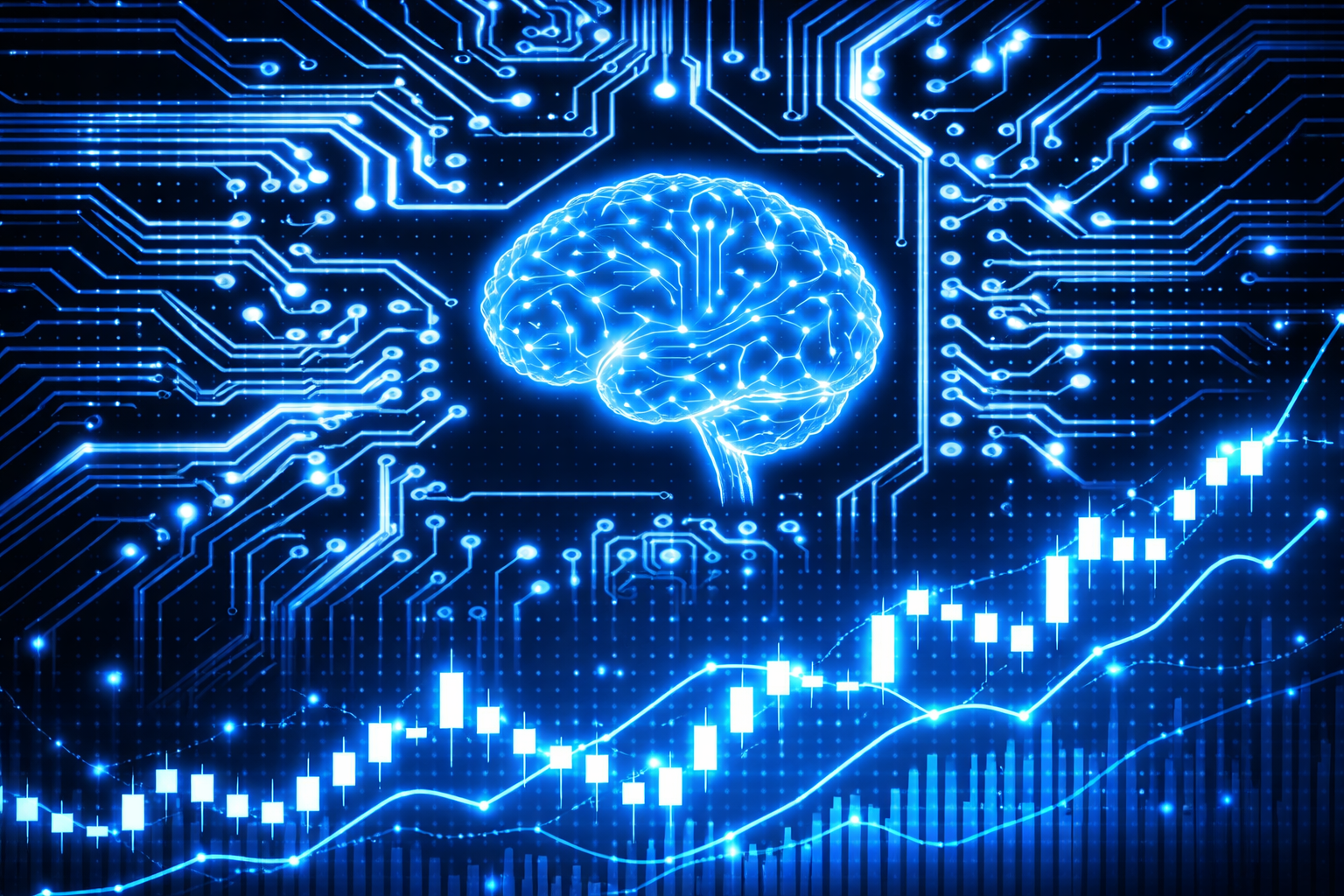

AI in trading refers to using machine learning, natural language processing, and reinforcement learning to analyze financial market data, generate trading signals, and optimize execution. Unlike traditional algorithmic trading that follows static rules, AI trading systems learn from data and adapt to changing market conditions — but they are not crystal balls. In 2026, AI-driven algorithms facilitate the majority of global trading volume at the institutional level, while retail traders gain access to tools like Trade Ideas, TrendSpider, and open-source frameworks like FinRL.
What Is AI in Trading?
AI in trading is the application of artificial intelligence techniques — primarily machine learning, natural language processing, and reinforcement learning — to analyze financial markets, generate trade signals, and automate execution decisions. The term covers everything from hedge fund quantitative models processing petabytes of alternative data to a retail trader using a chatbot to summarize Federal Reserve transcripts.
The critical distinction that most articles gloss over: AI trading is not the same as algorithmic trading. Traditional algo trading uses pre-programmed rules — “if RSI drops below 30 and price touches the lower Bollinger Band, buy.” Those rules never change unless a human rewrites them. AI trading systems, by contrast, learn from data. A deep learning model trained on five years of price data can discover non-linear relationships between volume spikes, order flow imbalances, and short-term price movements that no human would explicitly code. It adapts as market regimes shift — at least in theory.
In practice, the lines blur. Many “AI trading” products marketed to retail traders are just algo systems with a thin ML layer on top. And the most sophisticated hedge fund AI systems still rely heavily on human-designed features and risk constraints. Understanding where the genuine AI begins and the marketing ends is half the battle — and it’s a battle most content on this topic ignores entirely.
The global hedge fund industry reached a record $5.7 trillion in assets under management by the end of 2025, according to Nasdaq eVestment data — crossing the $5 trillion mark faster than most forecasts predicted. AI-driven and quantitative strategies have been growing faster than the industry average, but true ML-driven strategy generation remains concentrated at the top — firms like Renaissance Technologies, Two Sigma, Citadel, D.E. Shaw, and QRT, which collectively manage hundreds of billions in assets.
How Do AI Trading Systems Actually Work?
Behind the buzzwords, every AI trading system follows the same fundamental architecture — a pipeline with three layers: data ingestion, model inference, and execution. What differs between a $50/month retail tool and a hedge fund managing over $70 billion is the depth, speed, and sophistication at each layer.
Layer 1: Data Ingestion
The foundation of any AI trading system is data — and the competitive advantage increasingly comes from alternative data that traditional analysts don’t have. At the basic level, this means price data, volume, and order book snapshots. But the quant hedge funds that consistently outperform (like QRT, which returned ~30% in 2025 on approximately $38 billion in assets) ingest satellite imagery of parking lots, credit card transaction data, shipping container manifests, and even weather patterns.
For retail traders, the data layer is simpler but still matters: real-time price feeds, economic calendar events, and natural language data from financial news and social media are the most accessible inputs.
Layer 2: Model Inference
This is where the AI actually lives. Raw data flows into models that produce predictions, classifications, or scores. A supervised machine learning model might predict the probability of an upward move in the next 5 minutes. An NLP model might score a Fed press conference transcript as hawkish vs. dovish in real time. A deep learning network (LSTM or Transformer-based) might identify complex temporal patterns across multiple correlated assets simultaneously.
Most institutional systems use model ensembles — combinations of several different models whose outputs are weighted to produce a single signal. No single model consistently outperforms in all market regimes, so diversification at the model level mirrors diversification at the portfolio level.
Layer 3: Signal Generation
Model outputs are translated into actionable signals: buy, sell, or hold, typically with a confidence score. The highest-confidence signals get the largest position allocations. In practice, most signals are small edge — a 51-52% probability of a directional move — but when executed thousands of times per day with proper risk management, even tiny edges compound into substantial returns.
Layer 4: Risk Controls
This is the layer most retail “AI trading” products get wrong — or skip entirely. Institutional systems enforce position limits, maximum drawdown thresholds, value-at-risk (VaR) constraints, correlation checks between positions, and automatic kill switches that halt trading if losses exceed predefined thresholds. Renaissance Technologies’ Medallion Fund, widely regarded as the most successful quant fund in history, is famous for its risk management discipline as much as its alpha generation.
Layer 5: Execution
Once a risk-approved signal exists, the execution layer routes orders optimally — using algorithms like TWAP (time-weighted average price) or VWAP (volume-weighted average price) to minimize market impact and slippage. At the institutional level, execution is handled by autonomous AI agents that break large orders into smaller pieces and route them across multiple venues. This is where reinforcement learning shines — the AI learns to optimize execution quality over thousands of trades.
What Types of AI Are Used in Trading?
Not all AI is created equal when it comes to financial markets. Different subfields of AI solve different parts of the trading problem. Here’s a practical breakdown of what each type actually does — and where its limits are.
| AI Type | What It Does in Trading | Real-World Example | Key Limitation |
|---|---|---|---|
| Supervised ML | Predicts price direction, classifies market regimes (trending vs. ranging), estimates volatility | Random forests predicting next-day S&P 500 returns using 200+ features | Overfitting to historical data; model degradation as market regimes shift |
| NLP / Sentiment | Scores news, social media, earnings calls as bullish/bearish; extracts key information from SEC filings | LLM-based systems parsing Fed minutes for hawkish/dovish signals within milliseconds of release | Sarcasm, irony, and context-dependent language; adversarial content designed to mislead algorithms |
| Reinforcement Learning | Optimizes trade execution timing, position sizing, and market-making strategies through trial-and-error learning | RL agents at JPMorgan learning optimal order splitting strategies to minimize market impact | Needs enormous training data; unstable in non-stationary environments; reward function design is hard |
| Deep Learning (LSTM/Transformer) | Captures long-range dependencies in time series; multi-asset pattern recognition; generates trading signals from raw data | Transformer models processing tick-level data across 50+ correlated instruments for cross-asset momentum | Computationally expensive; requires large datasets; “black box” — hard to explain why a specific trade was made |
| Generative AI / LLMs | Research synthesis, strategy ideation, code generation for backtesting, conversational analysis of market events | Traders using Claude or GPT-4 to analyze earnings transcripts, generate Python backtesting code, and summarize macro data | Hallucination risk; no real-time market connection by default; cannot replace quantitative rigor |
In practice, the most effective AI trading systems combine multiple types. A hedge fund might use NLP to score news sentiment, feed those scores into a supervised ML model alongside price data, use deep learning for pattern detection, and deploy RL for execution optimization — all running simultaneously. The context engineering challenge of feeding the right data to the right model at the right time is what separates a research paper from a profitable system.
Who Uses AI in Trading — and How?
AI adoption in trading operates on three distinct tiers, each with radically different resources, time horizons, and expectations.
Tier 1: Quantitative Hedge Funds
The top quant funds are the heaviest users of AI in trading. The global hedge fund industry hit a record $5.7 trillion in AUM by the end of 2025, according to Nasdaq eVestment, and the quantitative segment is growing faster than the industry average. Key players include:
Two Sigma manages approximately $70 billion in assets as of late 2025, making it one of the largest quant-focused hedge funds by AUM. The firm employs over 1,700 people, including more than 250 PhDs, treating trading as a technology problem. Renaissance Technologies‘ Medallion Fund remains the gold standard — its internal returns (before fees) have averaged roughly 66% annually over decades, a track record unmatched in the industry. Citadel, D.E. Shaw (over $85 billion in investment and committed capital as of December 2025, with its Composite fund returning 18.5% and Oculus 28.2% in 2025), and QRT (~$38 billion AUM with ~30% flagship returns in 2025) round out the top tier.
These firms don’t just use AI — they are AI companies that happen to trade. Their competitive moat isn’t the algorithm itself (which degrades as others discover similar signals) but the infrastructure: petabyte-scale data pipelines, thousands of GPUs, proprietary execution systems with microsecond latency, and the talent to keep iterating.
Tier 2: Investment Banks and Asset Managers
Goldman Sachs, JP Morgan, and Morgan Stanley all deploy AI across their trading desks — primarily for execution optimization, risk management, and client analytics. JP Morgan’s LOXM execution algorithm uses reinforcement learning to minimize market impact on large orders. Goldman Sachs has been building LLM-based tools for its research division. But unlike quant hedge funds, banks rarely use AI for directional alpha generation — regulations and capital requirements make that a different game.
Tier 3: Retail Traders
For individual traders, AI access has exploded in 2024-2026. The main tools available today:
Trade Ideas — Holly AI runs 70+ algorithms nightly, producing 3-5 high-conviction trade ideas each morning. Best for intraday equity traders. Subscription runs $100-200/month. TrendSpider — Automated technical analysis with multi-timeframe pattern detection, Raindrop Charts incorporating volume data into price action, and an AI assistant (Sidekick) for strategy building. Tickeron — Pattern recognition and AI-generated predictions with confidence scores. FinRL — Open-source Python library for reinforcement learning in finance; free but requires programming skills.
I trade CFD instruments (gold, silver, forex pairs) on Plus500, and I’ve tested several AI-assisted approaches. Here’s what I’ve found: AI tools are genuinely useful for analysis — scanning for setups across multiple instruments, scoring sentiment from news, and backtesting ideas faster than you could manually. But the moment you hand over execution decisions to any automated system without deep understanding of its logic, you’re gambling with a black box. The biggest edge AI gave me wasn’t a magic signal — it was faster screening and elimination of bad setups before I even opened a chart. The actual decision to enter a trade still comes down to risk management discipline, which no AI can enforce if you override it.
The honest truth about retail AI trading in 2026: the tools that add real value are the ones that augment your decision-making (faster research, automated pattern detection, backtest generation) rather than the ones that promise to trade for you. Fully autonomous AI trading bots marketed to retail traders have a poor track record — the edge degrades quickly once widely accessible, and most lack the risk infrastructure that institutional systems have.
What Can AI in Trading Actually Do Well — and What Are Its Limits?
This is the section most articles about AI in trading either skip entirely or fill with vague platitudes. AI has real, measurable strengths in financial markets. It also has hard limits that no amount of compute can currently fix. Understanding both is what separates an informed trader from someone buying hype.
✅ What AI Does Well
- Speed: Processes millions of data points per second — no human can scan 50 markets simultaneously
- Pattern detection: Identifies statistical regularities in high-dimensional data that humans miss
- Emotion removal: Executes according to model output without fear, greed, or FOMO
- Execution optimization: Minimizes slippage and market impact on large orders via RL algorithms
- Sentiment aggregation: Reads and scores thousands of news articles, tweets, and filings in seconds
- Backtesting at scale: Tests thousands of strategy variants in hours vs. months manually
❌ What AI Cannot Do
- Black swans: Cannot predict unprecedented events (COVID crash, Lehman collapse, geopolitical shocks)
- Regime changes: Models trained in one market regime break down when the regime shifts
- Fed surprises: Central bank policy decisions are fundamentally unpredictable by historical data
- Liquidity crises: When everyone runs for the exit, correlations go to 1 and models fail together
- Reflexivity: AI signals change the market, which invalidates the signal — a self-defeating loop
- Behavioral biases of the user: AI can’t stop you from overriding its recommendations due to loss aversion
The Flash Crash of May 2010 demonstrated how AI and algorithmic systems can amplify market instability — the Dow dropped nearly 1,000 points in minutes as automated systems cascaded selling into a liquidity vacuum. March 2020 provided another stress test: when COVID-19 triggered the fastest bear market in history, many quant funds suffered heavy drawdowns. Bridgewater’s Pure Alpha fund lost approximately 20% in the first quarter. Renaissance Technologies’ institutional funds (not Medallion) also drew down significantly. The models had never “seen” a global pandemic in their training data.
The lesson is consistent: AI in trading works best in normal market conditions with sufficient liquidity and historical precedent. In exactly the moments when you most need an edge — extreme volatility, crises, paradigm shifts — AI systems tend to fail together, because they’re all trained on similar data and follow similar statistical logic.
Can Retail Traders Use AI? A Practical Guide
Yes — but with realistic expectations. Here’s what actually works for individual traders in 2026, based on the tools and frameworks available right now.
Approach 1: AI-Assisted Analysis (Best for Most Traders)
Use LLMs and NLP tools to accelerate your research. Feed earnings call transcripts into Claude or GPT-4 and ask for a sentiment summary with key metrics extracted. Use TrendSpider for automated multi-timeframe technical analysis. The key: AI does the scanning, you make the decision.
Approach 2: Quantitative Backtesting with Python
If you have basic Python skills, you can build simple ML-assisted strategies and backtest them before risking real capital. Here’s a minimal example — a headline sentiment scorer using VADER that you could integrate into a trading workflow:
"""
Simple headline sentiment scorer for trading research.
Uses VADER (Valence Aware Dictionary and sEntiment Reasoner)
— fast, no GPU required, surprisingly effective on financial news.
pip install vaderSentiment pandas
"""
from vaderSentiment.vaderSentiment import SentimentIntensityAnalyzer
import pandas as pd

analyzer = SentimentIntensityAnalyzer()

# Example: batch-score a list of financial headlines
headlines = [
    "Fed holds rates steady, signals no cuts until Q4 2026",
    "NVIDIA beats earnings estimates by 22%, raises guidance",
    "Oil prices crash 8% as OPEC deal collapses",
    "Gold hits all-time high amid rising geopolitical tensions",
    "JPMorgan warns of credit deterioration in commercial real estate",
]

results = []
for h in headlines:
    scores = analyzer.polarity_scores(h)
    results.append({
        "headline": h,
        "positive": scores["pos"],
        "negative": scores["neg"],
        "neutral": scores["neu"],
        "compound": scores["compound"],  # -1 (bearish) to +1 (bullish)
        "signal": "BULLISH" if scores["compound"] > 0.15
                  else "BEARISH" if scores["compound"] < -0.15
                  else "NEUTRAL"
    })

df = pd.DataFrame(results)
print(df[["headline", "compound", "signal"]].to_string(index=False))

# Next steps for a real workflow:
# 1. Pull live headlines via a news API (NewsAPI, Benzinga, etc.)
# 2. Aggregate sentiment scores over a rolling window (e.g., 24h)
# 3. Combine with technical signals (RSI, moving averages)
# 4. ALWAYS backtest before deploying with real capitalVADER is a rule-based sentiment tool, not a deep learning model. It handles straightforward financial headlines well, but it will misread sarcasm, complex implications ("the company denied rumors of bankruptcy"), and context-dependent language. For production-grade sentiment, financial-specific models like FinBERT or an LLM with RAG over your own document corpus will perform significantly better — but at higher cost and complexity.
Approach 3: Open-Source RL Frameworks
For the technically adventurous, FinRL (built on top of OpenAI Gym) provides a complete environment for training reinforcement learning agents on historical market data. You can pair it with Alpaca for commission-free execution and LangChain for context-engineered LLM integration. But be warned: RL in trading is research-grade, not plug-and-play. Expect months of iteration before anything resembles a viable strategy.
What Actually Works for Retail in 2026?
Here's my honest assessment after testing multiple approaches and trading CFDs with real capital: the retail traders who benefit most from AI are the ones who use it for idea generation and filtering — not autonomous execution. Specifically:
High value: Using LLMs to summarize macro data, running automated technical scans across multiple instruments, sentiment scoring of news flow, and generating backtesting code. Medium value: ML-based pattern detection tools like TrendSpider's Sidekick AI, especially for traders who already have a methodology. Low value (often negative): Fully autonomous trading bots, "copy AI trades" services, and any tool that promises consistent returns without your active oversight.
AI in Trading and the EU AI Act: What Changes in 2026?
August 2, 2026 is a critical date for AI in financial services in Europe. That's when the EU AI Act's high-risk system requirements become fully enforceable — and AI systems used in financial infrastructure, credit scoring, and automated decision-making that affects access to financial services are explicitly classified as high-risk under the Act.
What this means in practice for trading:
Explainability requirements: AI systems making decisions that affect consumers must be able to explain why a specific output was produced. For a deep learning model generating trading signals, this is technically difficult — neural networks are inherently opaque. Firms will need to invest in explainable AI (XAI) overlays, SHAP values, and audit trails showing the reasoning chain from data to decision.
Human oversight: The Act mandates that high-risk AI systems must be designed for effective human oversight. A fully autonomous AI trading system with no human intervention — which is the dream sold by many retail platforms — is harder to deploy in the EU without compliance infrastructure. Systems must include mechanisms for a human to intervene, override, or halt the AI's decisions.
Audit trails and logging: Financial institutions must maintain at least six months of system-generated logs for high-risk AI systems. Every trade decision, every signal, every risk override — documented and traceable for regulators.
Penalties: Non-compliance can result in fines up to €35 million or 7% of global annual turnover — whichever is greater. These are designed to be dissuasive, not symbolic.
For retail traders, the impact is mostly indirect: brokers and platforms operating in the EU will need to ensure their AI tools comply, which may affect feature availability. For institutional players, compliance is a significant cost — but also a potential competitive moat, as smaller firms that can't afford compliance infrastructure will exit the market. For a deeper dive into the regulation, see our upcoming article on EU AI Act Explained.
FAQ
Sources
- HFR. (2025). Global Hedge Fund Industry Capital Surges, Nears Historic $5 Trillion Milestone. hfr.com
- Pensions & Investments. (2026). Hedge fund industry AUM hits all-time high of $5.7 trillion — Nasdaq eVestment. pionline.com
- D.E. Shaw & Co. (2025). What We Do — Investment Management. deshaw.com
- Fortune. (2026). Bridgewater, D.E. Shaw among top hedge fund gainers of 2025. fortune.com
- Disruption Banking. (2026). From $23B to $38B AUM + 30% Returns: QRT's 2025 Quant Takeover. disruptionbanking.com
- Wikipedia. (2026). Two Sigma. en.wikipedia.org
- European Parliament & Council. (2024). Regulation (EU) 2024/1689 — EU Artificial Intelligence Act. eur-lex.europa.eu
- IMF. (2024). Global Financial Stability Report — Chapter 3: AI and Financial Stability. imf.org
- Hutto, C. J., & Gilbert, E. (2014). VADER: A Parsimonious Rule-based Model for Sentiment Analysis of Social Media Text. Proceedings of the International AAAI Conference on Web and Social Media. aaai.org
- Liu, X.-Y., et al. (2022). FinRL: Deep Reinforcement Learning Framework to Automate Trading in Quantitative Finance. Journal of Machine Learning Research. github.com/AI4Finance-Foundation
[…] edge. For more on how these cognitive patterns affect financial decisions, see our guide to AI in trading and the Polish deep-dive into teoria […]
[…] someone who builds and trades with AI systems and closely tracks the intersection of AI architecture and regulation, my assessment is that the […]
[…] pomaga neutralizować te błędy w praktyce tradingowej, znajdziesz w naszym artykule o AI in trading. Algorytmy nie mają emocji — nie podlegają zakotwiczeniu ani awersji do strat — i to jest ich […]