

Last updated: April 2026
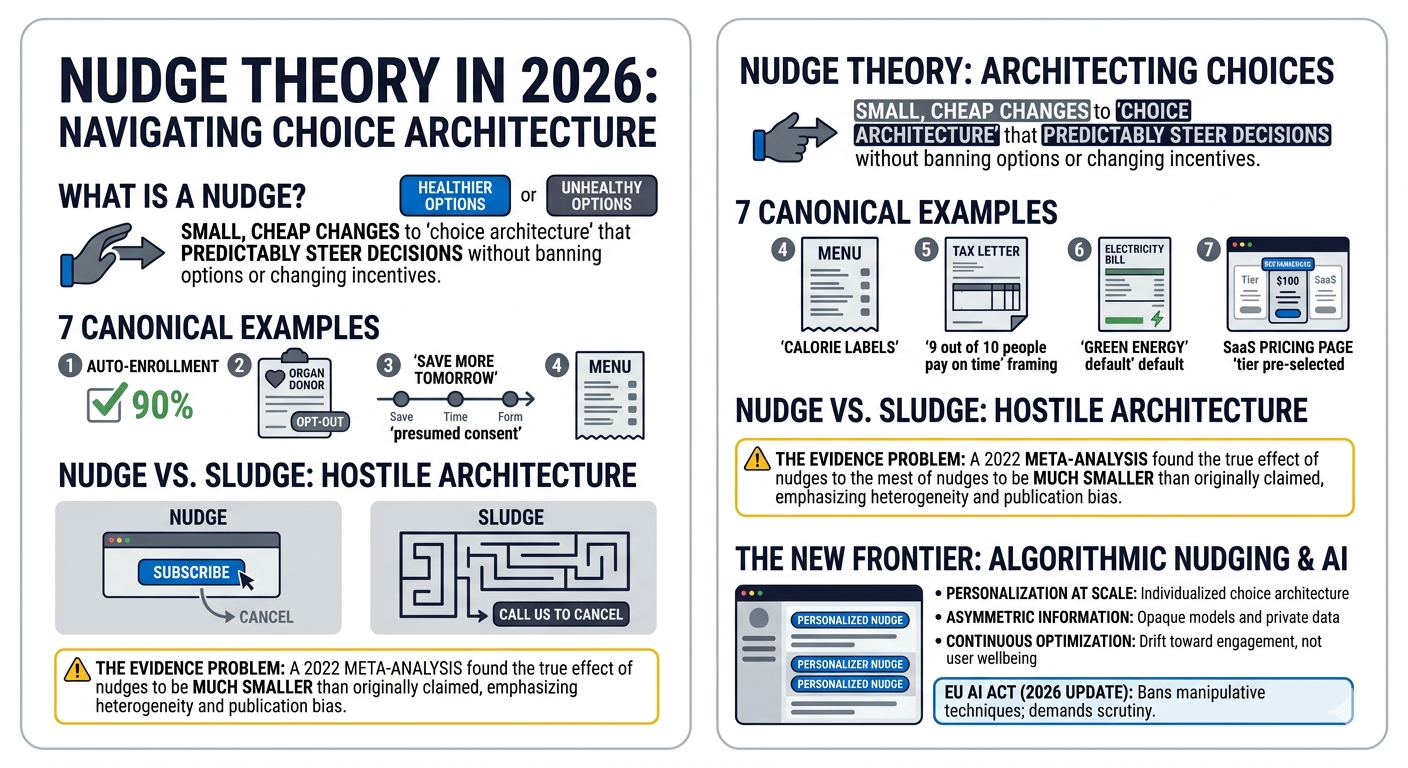
Nudge theory is a behavioral economics framework introduced by Richard Thaler and Cass Sunstein in 2008. It claims that small changes to choice architecture — the way options are presented — can predictably steer decisions without banning anything or changing economic incentives. Default enrollment, calorie labels and organ-donor opt-out systems are textbook examples. A 2022 meta-analysis correcting for publication bias found the average true effect of nudges is much smaller than originally claimed, which is why the field is now moving toward algorithmic nudging powered by AI personalization.
If you have ever been auto-enrolled into a workplace pension, seen calories printed next to a menu item, or found a “recommended” plan pre-selected on a SaaS pricing page, you have been nudged. None of those design choices removed your freedom. None of them changed the price. And yet they reliably shifted what most people end up doing — sometimes by tens of percentage points.
That is the central claim of nudge theory, the most politically influential idea to come out of behavioral economics in the last two decades. It powered government “nudge units” in the UK, Germany, Australia, Singapore and the European Commission, won Richard Thaler the 2017 Nobel Prize in Economics, and quietly rewired how product designers, regulators and AI engineers think about defaults.
This article unpacks what nudge theory actually says, the seven canonical examples that made it famous, the uncomfortable 2022 evidence that punctured the hype, and why the next generation of nudges — driven by machine learning — raises a completely new set of ethical problems we did not have to worry about in 2008.
What is nudge theory in plain language?
The official definition Thaler and Sunstein give in their 2008 book Nudge: Improving Decisions About Health, Wealth, and Happiness is this: a nudge is any aspect of the choice architecture that alters people’s behavior in a predictable way without forbidding any options or significantly changing their economic incentives. To count as a nudge, the intervention has to be cheap and easy to avoid. Putting fruit at eye level in a school cafeteria is a nudge. Banning soda is not.
That definition does a lot of work. It carves out a third category of policy that sits between two extremes most people are familiar with: pure libertarianism (let people do whatever they want, the market sorts it out) and traditional paternalism (the government decides what is good for you and forces it). Thaler and Sunstein call their middle path libertarian paternalism — a phrase they admit sounds like an oxymoron but defend across roughly 300 pages.
The intellectual foundation underneath all of this is the same body of research we cover in our pieces on cognitive biases and behavioral finance: humans are not the perfectly rational homo economicus of textbook models. We use shortcuts, we are loss-averse, we follow defaults, we get tired and distracted, and we often choose the option that is in front of us rather than the option that is best for us. If that is true — and forty years of experimental evidence say it mostly is — then how the choice is presented matters as much as what the choice contains.
System 1 and System 2: why nudges work at all
Nudge theory borrows its underlying psychology from Daniel Kahneman’s two-system model of cognition. System 1 is fast, automatic, intuitive and runs almost everything we do on a normal day. System 2 is slow, effortful, analytical and only kicks in when something forces us to concentrate. The problem, as Kahneman demonstrated experimentally for decades, is that System 1 is also where most of our predictable mistakes live: anchoring, availability bias, framing effects, loss aversion. We covered the full mechanism in our article on cognitive biases.
Nudges are designed to either work with System 1 (making the desired option the path of least resistance) or to wake System 2 up (forcing a brief moment of reflection at exactly the point a costly mistake would otherwise happen). A default checkbox works on System 1. A pop-up that says “are you sure you want to withdraw your retirement savings 20 years early?” works on System 2.
Choice architecture: the engineering layer beneath every nudge
Thaler and Sunstein’s most useful contribution is probably not the word “nudge” itself but the concept of the choice architect. A choice architect is anyone who designs the environment in which other people make decisions. The cafeteria manager is a choice architect. So is the HR director who picks default 401(k) contribution rates, the urban planner who positions crosswalks, the iOS designer who decides which permissions are requested first, and the policy analyst who drafts the form people fill out to renew a driver’s license.
The point that gets missed in casual readings of the book is that there is no neutral design. Every form has to have a default. Every menu has to have an order. Every webpage has to put one button somewhere. The choice architect cannot opt out of having influence — they can only choose whether to wield that influence thoughtfully or by accident. Once you accept that premise, the question stops being “should we nudge?” and starts being “in which direction, and for whose benefit?”
Figure 1. The default-effect study that became the foundational evidence for nudge theory.
7 real-world examples of nudges that actually shipped
Nudge theory would be just another academic framework if it had not already been deployed by governments and companies on hundreds of millions of people. Here are seven of the most well-documented real-world implementations.
1. Automatic enrollment in workplace pensions
The single most cited piece of evidence for nudge theory comes from a 2001 study by Brigitte Madrian and Dennis Shea. A large US company switched its 401(k) plan from opt-in (employees had to actively sign up) to opt-out (employees were enrolled by default and had to actively quit). Participation jumped from around 37% to around 86% within months, with the biggest gains among young, low-income and minority workers — exactly the groups who tend to under-save. The UK adopted automatic enrollment nationally in 2012, and by 2026 over 10 million additional UK workers had been brought into workplace pensions through this mechanism.
2. Organ donor opt-out systems
Countries with presumed-consent organ donation (you are a donor unless you say otherwise) have donor rates dramatically higher than countries with explicit-consent systems. Austria’s opt-out rate is around 99%; neighboring Germany, with an opt-in system, sits closer to 12%. Cultural factors matter, but the gap is too large to be cultural alone — the form of the question is doing most of the work.
3. Save More Tomorrow
Co-designed by Thaler and Shlomo Benartzi, this program asks employees to commit now to increasing their savings rate later — specifically, every time they get a raise. It exploits the fact that people are loss-averse about cuts to their current take-home pay but feel no loss when a future raise is partially redirected. Pilot studies showed average saving rates roughly tripling over four pay cycles among participants who would otherwise have stayed flat.
4. Calorie labels on menus
Mandatory calorie disclosure on chain-restaurant menus in the US (federalized in 2018) and the UK (2022) is a textbook informational nudge. It does not ban anything, but it forces the customer’s System 2 to briefly process the cost. The measured effect on individual orders is small — typically a 4–8% reduction in calories ordered — but at population scale and across years, that becomes meaningful.
5. Tax-letter framing in the UK
The UK Behavioural Insights Team famously rewrote letters sent to people who were late paying their taxes. Adding a single sentence — “9 out of 10 people in your area pay their tax on time” — increased on-time payment rates by around 5 percentage points and reportedly recovered hundreds of millions of pounds for HMRC. The intervention cost essentially nothing because the letters were being sent anyway.
6. Default green energy
When German municipalities switched their default electricity contract to a slightly more expensive renewable option (with one click to switch back to cheaper fossil-mix), retention of the green plan stayed above 90% for years. When the same option was offered as opt-in, take-up was below 10%. Identical price, identical product, opposite outcome.
7. Pre-selected pricing tiers on SaaS pages
Every “Most Popular” badge on a SaaS pricing page is a commercial nudge. So is the middle tier being slightly visually larger, the recommended option being pre-checked at checkout, and the annual-billing toggle being the default. These are not regulated, they are not always benign, and they exploit exactly the same default-effect and anchoring biases that the academic nudges do — which brings us to the dark side.
Nudges vs sludge: when choice architecture turns hostile
In the 2021 revised edition of Nudge, subtitled The Final Edition, Thaler and Sunstein introduced a new term to describe the abuse of their own framework: sludge. Sludge is choice architecture that adds friction in order to prevent people from doing something that would be in their own interest — but against the interest of whoever designed the system.
The textbook example is a newspaper that lets you subscribe with one click but forces you to call during office hours to cancel. Or a gym that requires a notarized letter to end a membership. Or a free trial that auto-renews unless you remember to dig through three menus on day 13. None of these technically remove your freedom to leave. All of them rely on the same psychological machinery as benign nudges, just pointed in the opposite direction.
| Dimension | Nudge | Sludge |
|---|---|---|
| Goal | Help the chooser | Help the architect at the chooser’s expense |
| Direction of friction | Removes friction from the good path | Adds friction to the exit path |
| Transparency | Should survive being made public | Usually depends on staying invisible |
| Examples | Auto-enrollment, calorie labels, organ-donor opt-out | Cancel-by-phone-only, dark patterns, pre-checked add-ons |
| Regulatory status (EU 2026) | Encouraged via Behavioural Insights units | Several patterns banned under the Digital Services Act |
Do nudges actually work? The 2022 meta-analysis that changed the conversation
For about a decade, the answer most people gave to “do nudges work?” was “obviously, look at the auto-enrollment numbers.” Then in 2022 a team led by Stephanie Mertens published a meta-analysis in PNAS aggregating roughly 450 effect sizes from 200+ nudge studies. The headline result was encouraging: nudges produced a moderate, statistically significant average effect.
A few months later, a second team led by Maximilian Maier reanalyzed the same dataset using methods that correct for publication bias — the well-known tendency for journals to publish positive results and quietly ignore null findings. After the correction, the average effect of a nudge collapsed to essentially zero. Their reading was that the apparent effectiveness of nudging in the literature is mostly an artifact of which studies got published, not of which interventions actually changed behavior.
The truth is somewhere more uncomfortable than either extreme. Nudges do work — but the effect is highly heterogeneous. Defaults around financial products and organ donation seem to produce real, large, replicable shifts. Informational nudges (calorie labels, energy-use disclosures) produce small, sometimes vanishing effects. Social-proof nudges (the “9 out of 10 of your neighbors” trick) work in some contexts and fail in others. The honest 2026 picture is that nudge theory was oversold during the 2010s and is now in a long, healthy correction phase where researchers are figuring out which subtypes actually move the needle and which were always wishful thinking.
The collapse of average effect sizes after correcting for publication bias is something behavioral science has seen across many subfields since the broader replication crisis began in 2011. The lesson is not that nudges are useless — it is that anyone selling you a behavioral intervention should be able to point to a pre-registered, well-powered field trial, not just a nice-sounding 2014 paper.
Algorithmic nudging: what changes when AI picks the nudge for you
The nudges Thaler and Sunstein wrote about in 2008 were one-size-fits-all. The cafeteria manager picked one layout for every student. The HR director picked one default contribution rate for every employee. The form was the same form for everyone who walked into the DMV.
That assumption is no longer true. Algorithmic nudging — a term that started appearing in the management literature around 2021 — uses machine learning to personalize the choice architecture in real time, per user, based on data the platform already collects about them. The recommendation engine on a streaming service is doing it. So is the timing of push notifications on a fitness app, the order in which products appear in a marketplace search, and the specific wording an AI customer-support agent uses when you ask to cancel a subscription.
This is structurally different from a 2008 nudge in three ways that matter for ethics, regulation and design:
- Personalization at scale. A classical nudge is the same for everyone. An algorithmic nudge can be tuned to each individual based on hundreds of behavioral signals. The same retirement-plan page might show one default rate to a 25-year-old and a different one to a 55-year-old who clicked the FAQ twice last month.
- Asymmetric information. A choice architect in 2008 had to publish their default rule somewhere, and a researcher could write about it. An algorithmic nudge lives inside a model whose weights and training data are usually private. Even the engineers who built it often cannot say exactly why it picked the configuration it picked for a given user.
- Continuous optimization. A 2008 nudge was set once and measured against a baseline. An algorithmic nudge is A/B-tested against itself thousands of times per day, drifting toward whatever maximizes a target metric — which is rarely the user’s wellbeing and almost always engagement, retention or revenue.
The techniques powering all of this — the recommendation engines, the personalization models, the reinforcement-learning loops — are the same ones we cover in our pieces on machine learning and AI agents. The behavioral economics is the easy part. The hard part is that the entity doing the nudging is now an opaque optimizer rather than a human policy designer who can be cross-examined.
What the EU AI Act says about algorithmic nudging
The EU AI Act, in force since August 2024 and now substantially applied through 2026, explicitly prohibits AI systems that deploy “subliminal techniques beyond a person’s consciousness or purposefully manipulative or deceptive techniques” with the objective of materially distorting behavior in a way likely to cause significant harm. This is the first piece of major legislation anywhere in the world that draws a regulatory line directly through Thaler and Sunstein’s framework — it does not ban nudging, but it does ban a specific category of algorithmically-targeted nudging that crosses into manipulation. The boundary is still being litigated and the test cases are only just beginning to appear, but the direction of travel is clear: as nudges get more personalized and more opaque, regulators will demand more scrutiny.
The three serious objections to nudge theory
Even setting aside the effectiveness debate, nudge theory has three critiques that are worth taking seriously.
Who decides what is “good” for me?
Libertarian paternalism rests on a quietly enormous assumption: that the choice architect knows what the chooser would want if they were thinking clearly. For some cases that is uncontroversial — almost nobody actively wants to under-save for retirement. For other cases it is contested — calorie labels assume that lower calories are better, which is not always true for everyone. And for political cases it gets dangerous fast: a government that nudges you toward outcomes a current administration prefers has a much harder time justifying itself than a cafeteria manager nudging you toward broccoli.
Nudges can crowd out real reform
Critics on both the left and the right have pointed out that a fascination with cheap behavioral interventions can become an excuse not to tackle harder structural problems. Thaler himself has made this point about climate policy, arguing that you cannot nudge your way out of a carbon-pricing problem and that nudges are not a substitute for legislation. The risk is that policymakers reach for the cheap, politically painless intervention and call the work done.
The Doer-vs-Planner problem
The deepest philosophical objection comes from Tom Schelling’s old observation that the “you” who makes a decision now and the “you” who has to live with it later are not always the same person, and they rarely agree. When a nudge overrides Doer-you in favor of Planner-you, the paternalist has to pick a side. The framework gives surprisingly little guidance about which side to pick when the two selves have genuinely opposed preferences — and that is most of the interesting cases.
What this means in practice in 2026
Nudge theory in 2026 is in a more honest place than it was in 2014. The hype has cooled, the meta-analyses have done their work, and the field is converging on a more modest claim: certain kinds of choice architecture (especially defaults around irreversible, infrequent, high-stakes decisions) reliably move behavior, while many other kinds of nudges have small or context-dependent effects. The framework remains genuinely useful — but as a design lens, not as a policy panacea.
For anyone designing a product, drafting a form, writing a user flow or shipping an AI feature, three practical takeaways survive intact:
- You are a choice architect whether you want to be or not. Every default you ship is a behavioral intervention. Pick it consciously.
- Test your design against the publicity rule. If your nudge would embarrass you when explained on stage, it is probably sludge. The test Thaler proposes is whether the choice architect would be willing to defend the design publicly to the people being nudged.
- Watch the boundary between nudge and manipulation tighten. The combination of personalized algorithmic nudging and the EU AI Act’s anti-manipulation provisions means the gap between “good UX” and “prohibited behavioral targeting” is going to be where a lot of compliance work happens over the next five years.
The deeper lesson of nudge theory is the one Thaler and Sunstein opened the book with: there is no such thing as a neutral presentation of a choice. Every form, every menu, every default is already nudging somebody. The only real question is whether the person doing the nudging is paying attention.
FAQ
Who invented nudge theory?
Nudge theory was popularized by behavioral economist Richard Thaler and legal scholar Cass Sunstein in their 2008 book Nudge: Improving Decisions About Health, Wealth, and Happiness. The intellectual foundations come from earlier work by Daniel Kahneman and Amos Tversky on cognitive biases and heuristics. Thaler received the Nobel Prize in Economics in 2017 partly for this body of work.
What is the difference between a nudge and a mandate?
A nudge changes the choice architecture without removing options or significantly changing economic incentives — you can always pick something else, easily and at no cost. A mandate forces a specific outcome by law or by removing alternatives. Auto-enrolling employees in a pension plan with one-click opt-out is a nudge; making pension contributions legally compulsory is a mandate.
Are nudges manipulative?
The line is contested. Thaler and Sunstein argue that a nudge is acceptable if it would survive being made fully transparent to the people being nudged — what they call the “publicity test.” Critics argue that exploiting predictable cognitive biases is manipulation by definition, even when the nudger has good intentions. The EU AI Act now draws a legal line: nudges are allowed, but AI-driven techniques that materially distort behavior in harmful ways are prohibited.
What is “sludge”?
Sludge is the term Thaler and Sunstein introduced in the 2021 edition of Nudge for choice architecture that adds friction in order to stop people from doing something that would be in their interest. Cancel-by-phone-only subscription policies, pre-checked add-on insurance at checkout, and unnecessarily complex tax forms are all examples of sludge.
Do nudges actually work according to recent evidence?
The answer depends on the type of nudge. A 2022 meta-analysis by Mertens and colleagues initially reported moderate average effects, but a subsequent reanalysis by Maier and colleagues correcting for publication bias found the average effect collapses close to zero. The current consensus is that defaults around high-stakes, infrequent decisions (retirement, organ donation) work robustly, while many smaller informational nudges produce weaker or context-dependent effects.
What is algorithmic nudging?
Algorithmic nudging is the use of machine learning to personalize choice architecture for each user in real time. Unlike classical nudges, which are the same for everyone, algorithmic nudges can be tuned per individual based on behavioral data. Examples include personalized push notification timing, recommendation engines and AI-driven retention flows. The EU AI Act now restricts the most harmful versions of this practice.
How does nudge theory connect to behavioral finance?
Nudge theory is a direct application of behavioral finance to policy and product design. Behavioral finance documents the systematic biases — loss aversion, anchoring, status quo bias, framing effects — that prevent people from making purely rational financial decisions. Nudge theory takes those documented biases and asks how to design environments that work with them rather than against them, especially in domains like retirement saving and investment defaults.
Bibliography
- Thaler, R. H., & Sunstein, C. R. (2008). Nudge: Improving Decisions About Health, Wealth, and Happiness. Yale University Press.
- Thaler, R. H., & Sunstein, C. R. (2021). Nudge: The Final Edition. Penguin Books.
- Madrian, B. C., & Shea, D. F. (2001). The power of suggestion: Inertia in 401(k) participation and savings behavior. The Quarterly Journal of Economics, 116(4), 1149–1187. https://doi.org/10.1162/003355301753265543
- Thaler, R. H., & Benartzi, S. (2004). Save More Tomorrow™: Using behavioral economics to increase employee saving. Journal of Political Economy, 112(S1), S164–S187. https://doi.org/10.1086/380085
- Kahneman, D. (2011). Thinking, Fast and Slow. Farrar, Straus and Giroux.
- Mertens, S., Herberz, M., Hahnel, U. J. J., & Brosch, T. (2022). The effectiveness of nudging: A meta-analysis of choice architecture interventions across behavioral domains. Proceedings of the National Academy of Sciences, 119(1). https://doi.org/10.1073/pnas.2107346118
- Maier, M., Bartoš, F., Stanley, T. D., Shanks, D. R., Harris, A. J. L., & Wagenmakers, E.-J. (2022). No evidence for nudging after adjusting for publication bias. Proceedings of the National Academy of Sciences, 119(31). https://doi.org/10.1073/pnas.2200300119
- Sunstein, C. R. (2022). Sludge: What Stops Us from Getting Things Done and What to Do about It. MIT Press.
- European Parliament & Council. (2024). Regulation (EU) 2024/1689 (Artificial Intelligence Act), Article 5(1)(a) — prohibition of subliminal and manipulative AI techniques. https://eur-lex.europa.eu/eli/reg/2024/1689/oj
- Behavioural Insights Team. (2023). The Behavioural Insights Team annual report 2022–2023. https://www.bi.team/publications/
- Möhlmann, M. (2021, April 22). Algorithmic nudges don’t have to be unethical. Harvard Business Review. https://hbr.org/2021/04/algorithmic-nudges-dont-have-to-be-unethical
[…] the forgone option feel like a loss. This is the mechanism behind the policy lever we covered in nudge theory: defaults stick because changing them triggers loss […]