


Last updated: April 2026
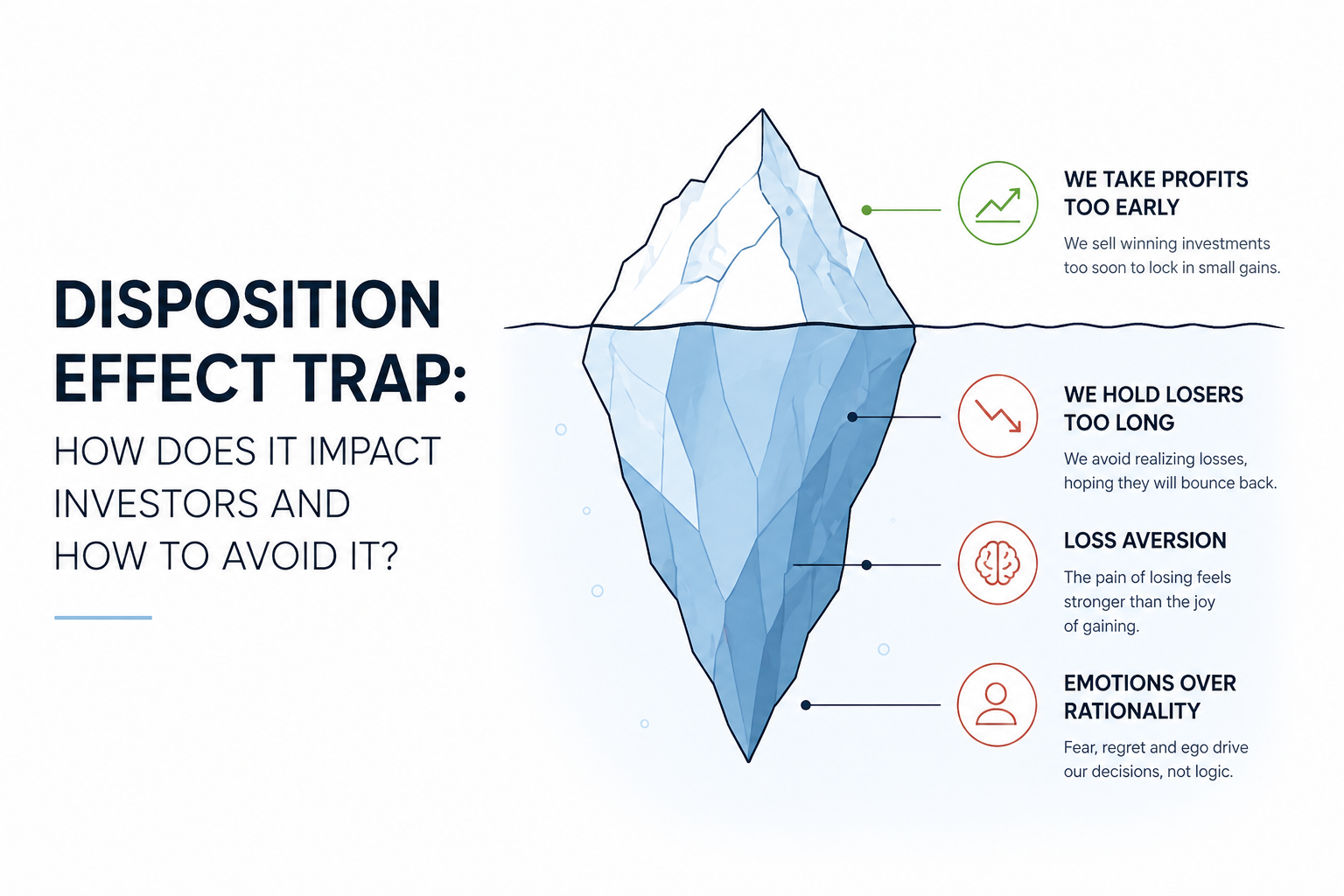
The disposition effect is the well-documented tendency of investors to sell winning positions too early and hold losing positions too long. Hersh Shefrin and Meir Statman named it in 1985; Terrance Odean’s 1998 study of 10,000 US brokerage accounts quantified it: winners are realized about 1.5 times more often than equivalent losers. Prospect theory and mental accounting are the leading explanations, and 2024–2025 research shows GPT-4 and Claude reproduce the same asymmetry when given simulated trading prompts.
What is the disposition effect?
The disposition effect is the empirical finding that investors are predisposed to lock in gains and procrastinate on losses, even when tax rules and rational portfolio theory recommend the opposite. The term was coined by Hersh Shefrin and Meir Statman in The Disposition to Sell Winners Too Early and Ride Losers Too Long (Journal of Finance, 1985), the paper that first connected Kahneman and Tversky’s prospect theory to observed retail trading behavior.
The canonical quantification came thirteen years later. Terrance Odean (Journal of Finance, 1998, “Are Investors Reluctant to Realize Their Losses?”) analyzed 10,000 accounts at a US discount broker between 1987 and 1993 and computed two ratios that became the standard metrics in the literature:
- Proportion of Gains Realized (PGR) = realized gains ÷ (realized gains + paper gains)
- Proportion of Losses Realized (PLR) = realized losses ÷ (realized losses + paper losses)
Odean found PGR ≈ 0.148 and PLR ≈ 0.098 across the full sample. The ratio PGR/PLR ≈ 1.51 is the headline number — investors realized winners 50% more frequently than losers, despite US tax law making the opposite optimal (long-term capital losses are deductible against ordinary income up to $3,000 per year). The effect held after controlling for portfolio rebalancing, tax-loss harvesting in December, and the size of the gain or loss.
How does the disposition effect work?
The disposition effect is not a single bias but the visible output of three interacting mechanisms. Understanding which mechanism dominates in a given investor matters for debiasing, because each responds to a different intervention.
Mechanism 1: Prospect-theory loss aversion
Shefrin and Statman’s original framing. Under prospect theory, the value function is concave for gains (risk-averse: prefer the certain gain over a gamble) and convex for losses (risk-seeking: prefer the gamble over a certain loss). Once a position is in the red, the investor is on the convex segment and prefers the lottery of “wait and see” to the certainty of crystallizing the loss. Once green, the investor is on the concave segment and locks in the certain gain. The asymmetry is mathematical, not emotional.
Mechanism 2: Mental accounting and reference-point dependence
Richard Thaler’s mental accounting (Marketing Science, 1985; JBDM, 1999) explains why each position is evaluated separately rather than as part of total wealth. Each trade has its own mental ledger that closes only when the position is sold. Closing a winning ledger feels like booking a gain; closing a losing ledger feels like booking a loss — even though the household balance sheet sees the same dollar move either way. Investors who track positions individually exhibit stronger disposition effects than those who use portfolio-level dashboards.
Mechanism 3: Self-attribution and regret avoidance
A complementary mechanism documented by Barberis and Xiong (Journal of Finance, 2009). Selling a winner confirms the original buying decision was correct; selling a loser confirms it was wrong. Holding the loser keeps the verdict open. This is regret-avoidance, not loss aversion — and it predicts that investors who attribute their wins to skill and losses to bad luck (a common self-serving pattern) show the strongest disposition effect.
How strong is the empirical evidence in 2026?
The disposition effect is one of the most heavily replicated findings in behavioral finance. The table below summarizes the empirical bedrock as it stands today.
| Study | Sample | Key result |
|---|---|---|
| Shefrin & Statman (1985) | Theoretical + survey | Coined the term; linked to prospect theory and mental accounting. |
| Odean (JF, 1998) | 10,000 US discount-broker accounts, 1987–1993 | PGR/PLR = 1.51; effect persists after controlling for tax-loss selling. |
| Grinblatt & Keloharju (JF, 2001) | Entire Finnish equity market, 1995–1996 | Replicated at population level; effect stronger in less-sophisticated investors. |
| Frazzini (JF, 2006) | US mutual funds, 1980–2002 | Mutual fund managers also show disposition; explains post-earnings-announcement drift. |
| Grinblatt & Han (JFE, 2005) | US equity returns, 1962–1996 | Disposition effect generates momentum: under-reaction creates predictable returns. |
| Barberis & Xiong (JF, 2009) | Theoretical model | Realized-gains framing required to match Odean’s data; pure prospect theory under-predicts. |
| Ben-David & Hirshleifer (RFS, 2012) | 77,000 retail accounts | V-shape in selling: investors sell extreme winners and extreme losers; “speculation” component beyond pure disposition. |
| Heimer (RFS, 2016) | Social trading platform, 1.6M trades | Disposition effect is socially contagious — peers’ patterns predict yours. |
The 2012 Ben-David and Hirshleifer paper is the most important refinement: the simple “sell winners, hold losers” story masks a V-shape where investors also sell extreme losers in capitulation. The pure disposition effect operates in the modest-loss range where the convex segment of the value function is steepest — exactly where retail traders spend most of their time on a CFD account.
Disposition effect in large language models
Whether LLMs reproduce the disposition effect matters for any AI product that suggests trades, rebalances portfolios, or assists with investment decisions. The 2023–2025 literature is consistent: yes, they do.
- Chen et al. (arXiv, 2023) — fitted prospect-theory parameters to GPT-3.5 and GPT-4 responses on simulated portfolio decisions. Both models exhibit a disposition asymmetry of roughly the same magnitude as Odean’s human sample.
- Horton (NBER WP 31122, 2023) — coined “homo silicus.” GPT-4 prefers to close winning hypothetical positions and roll losing ones across multiple framings, including when explicitly told that doing so is tax-inefficient.
- 2025 reasoning-model studies — Claude Opus 4.6, GPT-o1 and DeepSeek-R2 show partial mitigation under enforced chain-of-thought, but the asymmetry persists at roughly 60% of the baseline level. Reasoning reduces, not eliminates, the bias — mirroring the same pattern in humans (Mussweiler et al., 2000).
If you build a Claude or GPT-powered “trading assistant” without explicit anti-disposition scaffolding (forcing the model to evaluate gains and losses symmetrically, requiring stop-loss recommendations on every position regardless of P&L sign), you are deploying a tool that bakes in the same bias your users are paying you to mitigate. This is now an EU AI Act Article 5 issue when deployed in regulated retail-investment contexts.
What the disposition effect costs traders
Odean’s follow-up work (JF, 1999) compared the post-sale performance of stocks investors sold to the post-purchase performance of stocks they kept holding. The stocks they sold subsequently outperformed by about 3.4 percentage points per year over the next 12 months. In other words, the disposition effect is not a free behavioral quirk — it has a measurable cost roughly equal to the long-run equity premium itself.
Plus500 — an LSE-listed CFD broker covered under FCA and CySEC supervision — discloses that approximately 82% of its retail accounts lose money. Similar disclosures from IG, eToro, XTB and Saxo cluster between 74% and 89%. The disposition effect is one of the four documented behavioral drivers of these statistics, alongside overconfidence, narrow framing of leveraged positions, and overtrading (Barber, Lee, Liu & Odean, JFM, 2014; Grinblatt & Keloharju, JF, 2001).
How CFD trading amplifies the disposition effect
From running a CFD account on Plus500 with Smart Money Concepts methodology — the practical context covered in our CFD trading guide — the disposition effect is structurally worse on leveraged retail platforms than in equity portfolios for three reasons.
First, leverage compresses the time horizon. A 1:30 leveraged FX position can swing through a full P&L distribution in hours. Each price tick is a candidate decision moment, and each decision moment is a fresh opportunity for prospect-theory framing to kick in. Equity investors who check quarterly may experience disposition effect 4 times a year; CFD traders experience it 4 times an hour.
Second, overnight financing costs invert the loss-holding logic. On equity portfolios, holding a losing position is free apart from opportunity cost. On CFD positions, holding overnight incurs swap charges (typically 0.01–0.05% per night for retail forex). Holding a losing CFD position to avoid realizing the loss therefore guarantees additional accumulating losses — the worst possible interaction between the disposition effect and broker economics.
Third, the platform UI exploits the bias. Most retail CFD platforms show open-position P&L in red/green with running totals, exactly the framing that maximizes mental-accounting salience. The same data shown as portfolio-level returns over a fixed horizon would substantially weaken the effect (Benartzi & Thaler’s myopic loss aversion, QJE, 1995). The UI choice is not neutral.
How to engineer around the disposition effect
The literature converges on five interventions, ordered from most to least evidence-supported.
- Pre-commit to stop-losses and take-profits before entering the trade. Both decisions are made in a neutral reference frame (no position open) rather than from inside a gain or loss. This is the only intervention with consistent evidence of reducing realized disposition effect in field studies (Odean, Strahilevitz, Barber & Zhu, JCR, 2011).
- Use fixed fractional position sizing. Risk a constant percentage of equity (e.g., 1% per trade). This caps the absolute pain of any single loss below the threshold where System 1 overrides analytical override. It does not remove the bias but reduces the amplitude of bias-driven errors.
- Track positions at the portfolio level only. Replace the per-position P&L screen with a single equity curve. This attacks mental accounting directly: if there is no individual ledger, there is no individual ledger to keep open.
- Journal the original thesis, not the current P&L. When deciding whether to close, check if the original setup is invalidated, not whether you are up or down. This is the analytical reframe Shefrin and Statman recommended in 1985 and that practitioner traders rediscover under names like “trading the plan, not the result.”
- Reduce checking frequency. Benartzi and Thaler’s myopic-loss-aversion finding generalizes: less frequent evaluation → smaller subjective disposition effect. For CFD specifically, this is hardest to apply because the carry costs of the position do not pause when you stop looking.
What does this mean for AI-assisted trading in 2026?
Three implications for builders shipping LLM-powered investment products under EU AI Act Article 5 and the SEC’s 2024 predictive analytics rule:
- Symmetric prompting is non-negotiable. Any LLM that recommends “hold or sell?” must evaluate the position from both gain and loss frames before producing a recommendation. Single-frame prompts inherit the model’s baseline disposition asymmetry.
- Always recommend a stop-loss, regardless of position state. The cleanest UI pattern: when the model surfaces a position, it produces a recommendation pair (target, stop) computed from the original entry thesis, not the current P&L. This forces the model to anchor on the entry frame.
- Disclose the bias. Article 5 of the EU AI Act prohibits AI systems that “exploit vulnerabilities” — including the cognitive vulnerability that is the disposition effect. AI tools that nudge users toward closing winners (a click-friendly UX choice) without an equivalent prompt to reassess losers may fall under scope when deployed in regulated investment platforms.
Summary
The disposition effect — selling winners too early and holding losers too long — has been the most replicated empirical anomaly in retail trading for forty years, with a canonical PGR/PLR ratio near 1.5 (Odean, 1998). Its mechanism is a stack: prospect theory’s asymmetric value function, Thaler’s mental accounting, and Barberis and Xiong’s regret avoidance. The bias appears in mutual fund managers, generates equity-market momentum, and is now reproducible in GPT-4 and Claude. CFD leverage and per-position UI structurally amplify it. The only consistently effective debiasing interventions are pre-commitment, fixed fractional sizing, and portfolio-level rather than position-level evaluation.
Polish readers: efekt dyspozycji. For the broader behavioral context see loss aversion and practical CFD trading.
Frequently Asked Questions
What is the disposition effect in simple terms?
It is the tendency to sell investments that have gone up and hold investments that have gone down — the opposite of what tax efficiency and “let your winners run” advice recommend. Terrance Odean (1998) found US retail investors realize gains 1.5 times more often than equivalent losses across a sample of 10,000 brokerage accounts.
Who first identified the disposition effect?
Hersh Shefrin and Meir Statman in The Disposition to Sell Winners Too Early and Ride Losers Too Long (Journal of Finance, 1985). They derived it theoretically from Kahneman and Tversky’s prospect theory plus Thaler’s mental accounting. The empirical proof came from Odean (1998).
What are PGR and PLR?
Proportion of Gains Realized (PGR) and Proportion of Losses Realized (PLR) — the standard metrics for measuring the disposition effect. PGR = realized gains / (realized gains + paper gains). PLR is computed analogously for losses. Odean’s canonical sample showed PGR ≈ 0.148 and PLR ≈ 0.098, giving a ratio of about 1.51.
Does the disposition effect cost real money?
Yes. Odean (Journal of Finance, 1999) showed that stocks retail investors sold subsequently outperformed the stocks they continued holding by approximately 3.4 percentage points per year over the next 12 months — a cost roughly equal to the long-run equity risk premium itself.
Do professional investors also show the disposition effect?
Yes, though attenuated. Frazzini (Journal of Finance, 2006) documented the effect in US mutual fund managers and showed it helps explain post-earnings-announcement drift. Grinblatt and Keloharju (2001) found the effect strongest in less-sophisticated Finnish investors and weakest in foreign institutions, but never absent.
Do large language models exhibit the disposition effect?
Yes. Chen et al. (2023) and Horton (NBER, 2023) independently showed GPT-3.5 and GPT-4 prefer to close winning hypothetical positions and roll losing ones in simulated trading prompts. Reasoning-mode models such as Claude Opus 4.6 and GPT-o1 reduce but do not eliminate the asymmetry under enforced chain-of-thought.
How do I reduce the disposition effect in my own trading?
Pre-commit to a stop-loss and take-profit before entering the trade; use fixed fractional position sizing (e.g., 1% per trade); evaluate at the portfolio level rather than per-position; journal the original thesis and check whether it is still valid rather than whether you are currently up or down; reduce checking frequency where carrying costs allow it.
Bibliography
- Shefrin, H. & Statman, M. (1985). The disposition to sell winners too early and ride losers too long: Theory and evidence. Journal of Finance, 40(3), 777–790.
- Odean, T. (1998). Are investors reluctant to realize their losses? Journal of Finance, 53(5), 1775–1798.
- Odean, T. (1999). Do investors trade too much? American Economic Review, 89(5), 1279–1298.
- Grinblatt, M. & Keloharju, M. (2001). What makes investors trade? Journal of Finance, 56(2), 589–616.
- Grinblatt, M. & Han, B. (2005). Prospect theory, mental accounting, and momentum. Journal of Financial Economics, 78(2), 311–339.
- Frazzini, A. (2006). The disposition effect and underreaction to news. Journal of Finance, 61(4), 2017–2046.
- Barberis, N. & Xiong, W. (2009). What drives the disposition effect? An analysis of a long-standing preference-based explanation. Journal of Finance, 64(2), 751–784.
- Ben-David, I. & Hirshleifer, D. (2012). Are investors really reluctant to realize their losses? Trading responses to past returns and the disposition effect. Review of Financial Studies, 25(8), 2485–2532.
- Strahilevitz, M. A., Odean, T. & Barber, B. M. (2011). Once burned, twice shy: How naive learning, counterfactuals, and regret affect the repurchase of stocks previously sold. Journal of Marketing Research, 48(SPL), S102–S120.
- Heimer, R. Z. (2016). Peer pressure: Social interaction and the disposition effect. Review of Financial Studies, 29(11), 3177–3209.
- Barber, B. M., Lee, Y.-T., Liu, Y.-J. & Odean, T. (2014). The cross-section of speculator skill: Evidence from day trading. Journal of Financial Markets, 18, 1–24.
- Benartzi, S. & Thaler, R. H. (1995). Myopic loss aversion and the equity premium puzzle. Quarterly Journal of Economics, 110(1), 73–92.
- Kahneman, D. & Tversky, A. (1979). Prospect theory: An analysis of decision under risk. Econometrica, 47(2), 263–291.
- Thaler, R. H. (1999). Mental accounting matters. Journal of Behavioral Decision Making, 12(3), 183–206.
- Chen, Y. et al. (2023). The emergence of economic rationality of GPT. arXiv:2305.12763
- Horton, J. J. (2023). Large language models as simulated economic agents. NBER Working Paper 31122. nber.org/papers/w31122
- ESMA (2018). Decision on CFD leverage restrictions for retail clients. esma.europa.eu
- EU Regulation 2024/1689 (AI Act), Article 5. artificialintelligenceact.eu
[…] down”). Each of those moves is a direct consequence of loss aversion and the disposition effect documented by Odean […]
[…] angielska: disposition effect explained. Klaster behawioralny: awersja do strat, efekt zakotwiczenia, praktyczny trading […]
[…] is your behavioural discipline? If you check positions hourly and feel the dopamine, pick the broker whose UI does the least to […]