


Last updated: April 2026
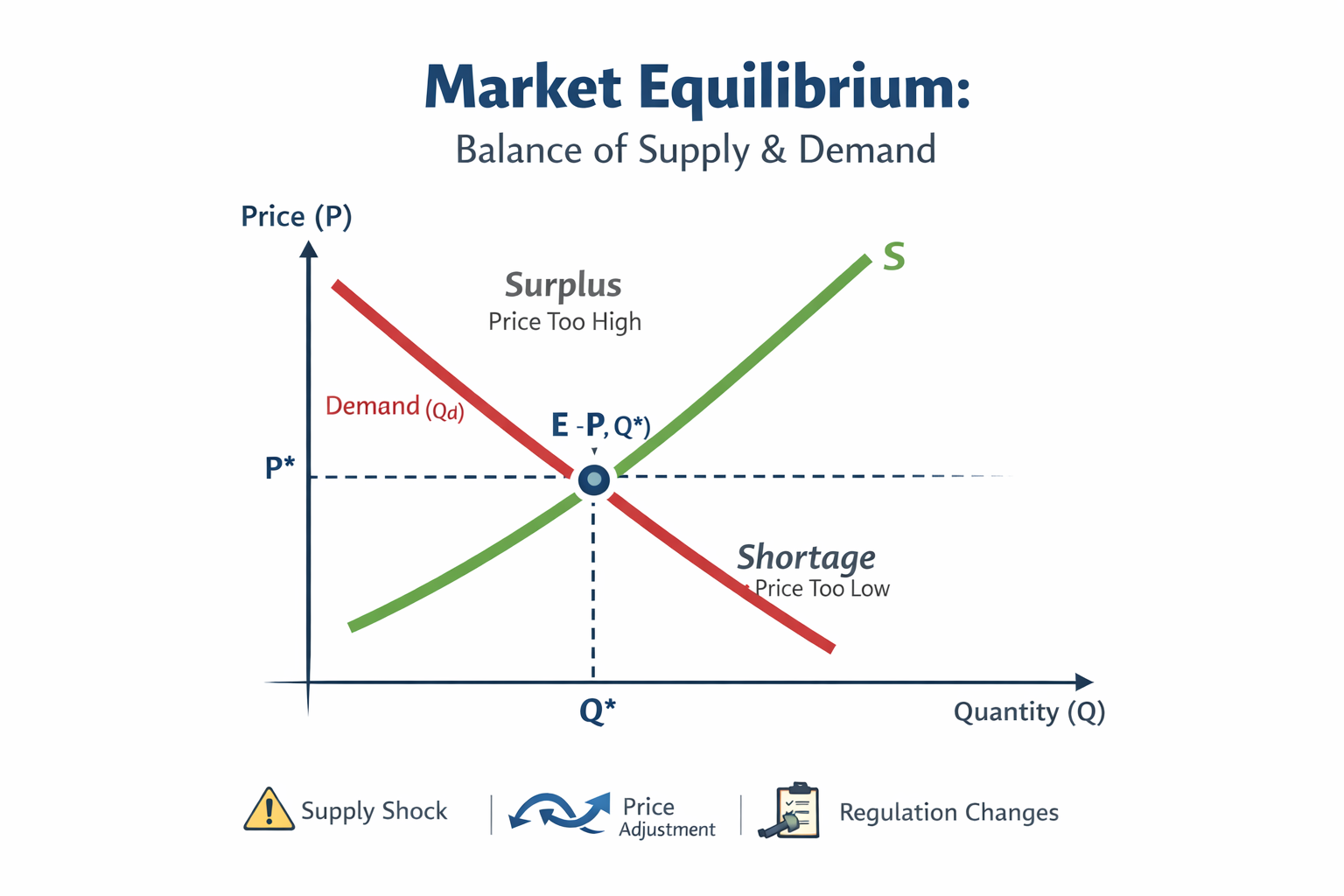
Market equilibrium is the single price at which the quantity consumers want to buy equals the quantity producers want to sell. Mathematically: Qd(P*) = Qs(P*), where P* is the equilibrium price and neither surplus nor shortage persists. Real markets rarely stay at exact equilibrium — they oscillate toward it, with disequilibrium events (Uber surge, EU gas 2022, US housing 2020–2024) triggered by supply or demand shocks and often corrected within months via price, quantity, or regulatory adjustment.
What is market equilibrium?
Market equilibrium is the state in which the quantity demanded at a given price exactly equals the quantity supplied, leaving no systematic pressure for the price to move. Graphically it is the intersection of the downward-sloping demand curve and the upward-sloping supply curve. Alfred Marshall formalised the concept in Principles of Economics (1890, Book V), and it remains the single most-taught idea in introductory microeconomics — partly because it is the simplest framework that explains how millions of uncoordinated buyers and sellers converge on a single clearing price without any central planner.
Two things are useful to flag upfront. First, equilibrium is a tendency, not a resting state: any real market absorbs new information — weather, policy, technology, sentiment — every second, so prices usually oscillate around the equilibrium rather than sit on it. Second, equilibrium is Pareto-efficient under tight assumptions (perfect competition, perfect information, no externalities); the moment you relax any of those, the equilibrium price may still clear the market but fail to maximise welfare. Both qualifications matter for the real-world examples later in this article.
How does market equilibrium form?
The mechanism Marshall described — and what every introductory textbook still uses — runs in three stages:
- Disequilibrium with surplus (price too high). Sellers bring more units to market than buyers want at that price. Inventories build up. Producers lower price to clear stock.
- Disequilibrium with shortage (price too low). Buyers compete for too few units. Queues form, secondary markets emerge. Producers raise price.
- Equilibrium (P*, Q*). The price settles where Qd(P*) = Qs(P*). Any outward shock triggers stages 1 or 2 again.
The equilibrium price formula
For a linear textbook market the equilibrium is the algebraic solution to two equations.
Demand: Qd = a − b·P
Supply: Qs = c + d·P
Equilibrium: set Qd = Qs → P* = (a − c) / (b + d), Q* = a − b·P*
Example. If Qd = 120 − 2P and Qs = 20 + 3P, then P* = (120 − 20) / (2 + 3) = 20 and Q* = 120 − 2·20 = 80. Ten thousand students learn this every semester. The useful part is what you do after: comparative statics. Shift demand up by 10 (a = 130) and P* jumps to 22 and Q* to 86. That small algebra is the entire engine of supply-and-demand reasoning that journalists and analysts use when reporting on commodities, housing or labour markets.
Real markets need a more flexible functional form because both sides rarely behave linearly, especially at the tails. For goods with low price elasticity of demand (fuel, insulin, tobacco) the demand curve is nearly vertical, so supply shocks translate almost one-for-one into price. For elastic goods (specific brands, restaurants, holiday dates) the same shock produces mostly a quantity response.
What happens when a market is out of equilibrium?
Two textbook situations — surplus and shortage — play out predictably in real markets, though the adjustment speed varies wildly. Agricultural commodities clear daily on futures exchanges; labour markets take quarters; residential housing can stay in persistent disequilibrium for years because supply is zoning-constrained.
| State | Condition | Typical market response | Speed |
|---|---|---|---|
| Surplus | P > P*, Qs > Qd | Inventory build-up → price cuts, promotions, production cuts | Weeks–months (retail), quarters (manufacturing) |
| Shortage | P < P*, Qd > Qs | Queues, rationing, black/grey markets, price hikes | Days (perishables), years (housing) |
| Price ceiling | Regulatory Pmax < P* | Permanent shortage, quality degradation, waiting lists | As long as regulation holds |
| Price floor | Regulatory Pmin > P* | Permanent surplus (minimum wage, CAP buffer stocks) | As long as regulation holds |
Five real-world examples of market equilibrium
1. Uber surge pricing — algorithmic equilibrium in minutes
Ride-hail is the textbook 21st-century example because the platform implements the equilibrium mechanism explicitly. Hall, Kendrick & Nosko (2015) found that during a New Year’s Eve spike in New York demand rose ~4× while supply (drivers) rose ~2×; without surge pricing the platform would have seen a ~40% completion-rate collapse. With surge — a multiplier raising the price until Qd falls and Qs rises — the completion rate stayed above 90%. Cohen, Hahn, Hall, Levitt & Metcalfe (NBER WP 22627, 2016) later estimated that surge pricing generated USD 6.8 billion in annual consumer surplus in the US. What used to be a two-day adjustment in taxi markets now happens in 3–5 minutes.
2. European natural gas 2022 — the textbook demand shock
Russia’s invasion of Ukraine in February 2022 and subsequent pipeline cuts removed ~140 bcm of EU gas supply. Dutch TTF spot prices spiked from around EUR 70/MWh in January 2022 to a peak above EUR 340/MWh in August 2022, a 4.8× move (Eurostat). The re-equilibration took roughly 12 months: by spring 2023 prices had fallen back below EUR 50/MWh as consumers cut demand ~15%, LNG imports rose ~60%, and storage was refilled. EU Council Regulation 2022/1854 added a temporary price ceiling on inframarginal revenues — which by design produces a permanent surplus in some generation tech but was accepted as the political cost of shielding households.
3. US housing 2020–2024 — supply-constrained disequilibrium
The US Census Bureau reports 1.4 million housing starts in 2023 versus estimated household formation of ~1.7 million, after a decade of underbuilding. The NAR median existing-home price moved from USD 270k (2019) to USD 413k (Q3 2024), a 53% nominal increase. The equilibrium response on the supply side is slow: permitting, labour and materials add ~18–24 months of lag, and in California, New York and Massachusetts zoning binds the long-run supply curve below the “free-market” equilibrium. This is a persistent, decades-long disequilibrium — not a market failure, but a supply curve truncated by regulation.
4. European egg market 2022–2023 — supply shock, slow re-equilibration
The 2022–2023 wave of avian flu (H5N1) forced culling of more than 50 million poultry in the EU (DG SANTE). Wholesale egg prices in Germany and the Netherlands rose ~80% year-on-year by Q1 2023. Rebuilding flocks takes 5–6 months (chicks to lay), so the shortage persisted well into Q3 2023. Consumers responded partly by substitution (tofu, plant-based), partly by absorbing the price — a clean demonstration of how rebuild time sets the re-equilibration horizon.
5. Polish electricity 2023–2024 — state-imposed price freeze
Faced with the same wholesale spike, Poland’s URE regulator and Ministry of Climate capped retail household electricity prices at PLN 412/MWh up to a 2 MWh annual allowance (URE, ustawa z 7 października 2022 r., Dz.U. 2022 poz. 2127). Below this cap the regulated retail market stayed in structural shortage versus free-market equilibrium — covered by fiscal transfers to suppliers. This is a textbook binding price ceiling, and it worked as theory predicts: household consumption did not drop, while industrial consumers (uncapped) absorbed the full equilibrium adjustment and cut usage ~13% in 2023 (IEA WEO 2024).
Across these five cases the unified lesson is about adjustment speed, not the existence of equilibrium. When both supply and demand can move fast (Uber), equilibrium reforms in minutes. When one side has a biological or regulatory lag (eggs, housing), disequilibrium persists for quarters or years. Forecasting price requires forecasting the rate of re-equilibration, not just the new equilibrium point.
How do AI and LLMs change market equilibrium?
Three threads of 2023–2025 research matter for anyone modelling equilibrium in markets touched by AI pricing or AI-mediated trade.
- Algorithmic price convergence. Calvano, Calzolari, Denicolò & Pastorello (AER 2020) showed that independent Q-learning pricing bots in duopoly experiments converge on supra-competitive prices without communicating — effectively shifting equilibrium upward. The EU AI Act (Regulation 2024/1689, Art. 5) now prohibits AI practices that exploit consumer vulnerabilities, and the European Commission’s 2024 competition enforcement priorities include algorithmic collusion as a supervisory focus. Practically: automated pricing can produce a tacit-collusion equilibrium above the competitive P*.
- LLMs as simulated agents. Horton (NBER WP 31122, 2023) runs classic price-setting experiments through GPT-4 and reports responses consistent with textbook demand theory, including convergence to equilibrium in repeated auctions. Brand, Israeli & Ngwe (HBS WP 23-062, 2024) use LLMs to estimate demand elasticities from product descriptions — reducing the empirical cost of mapping the demand curve, which is the harder half of the equilibrium calculation.
- Multi-agent LLM markets. Zhao, Jin, Wu & Shi (arXiv 2401.14212, 2024) simulate GPT-4 agents in a Bertrand duopoly and find equilibrium emerges but with persistent off-equilibrium pricing episodes driven by agent personas and prompt sensitivity — a warning that LLM traders may re-introduce behavioural biases (anchoring, loss aversion) that pure Q-learning bots avoid.
The regulatory implication is that 2025–2027 enforcement will shift from “did firms collude?” to “did your pricing algorithm converge on a supra-competitive equilibrium, even without intent?” That is a much harder question for compliance teams.
Market equilibrium vs trading: supply/demand zones
For anyone reading this from a trading angle — I trade CFDs on gold and indices on Plus500 in a Smart Money Concepts (SMC) style — “market equilibrium” translates into the supply/demand zone concept. In SMC methodology a demand zone is a past consolidation from which price rallied with momentum, interpreted as institutional buying above fair equilibrium; a supply zone is the mirror for selling. The idea reframes equilibrium not as one price but a band within which market-makers neutralise retail order flow.
Two disciplined implications. First, round-number anchoring (USD 2,000/oz gold, EUR 1.10/USD) frequently coincides with zones because retail limit orders cluster there; a working trading edge is to lean on those bands and fade exhaustion, not chase breakouts without confirmation. Second, liquidity events — NFP, CPI, ECB decisions — expand the equilibrium band temporarily; sizing should halve into events because the band widens faster than stop-losses tighten. This is a direct application of Marshall’s adjustment logic, with the time horizon compressed into minutes and the adjustment mechanism dominated by algorithmic market-makers. More on this in behavioral finance.
Regulatory responses to disequilibrium
Policy has three historical instruments for acting on equilibrium: set the price (ceiling/floor), tax/subsidise one side of the market, or change the information environment. All three are in active use in 2024–2026.
- Price instruments. EU Reg. 2022/1854 (energy revenue cap), Polish electricity cap (Dz.U. 2022 poz. 2127), US insulin cap under the Inflation Reduction Act (HR 5376) — each binds supply or demand below the free-market equilibrium and absorbs the gap via fiscal transfers.
- Tax instruments. Pigouvian taxes (CO₂ pricing under EU ETS2 from 2027, UK sugar levy from 2018) raise equilibrium price toward the social-cost equilibrium, shrinking Q*. Works best when demand is inelastic (tobacco) because revenue stays predictable.
- Information instruments. The Omnibus Directive 2019/2161 — requiring sellers to display the lowest price in the last 30 days — pushes information symmetry into the demand curve, reducing the scope for sellers to exploit reference-price bias. The EU AI Act extends this logic to algorithmic pricing.
Conclusion — why market equilibrium still matters in 2026
Market equilibrium is the oldest mental model in economics and, 135 years after Marshall, still the single most productive lens for reading prices. Every serious news story about fuel, eggs, housing, drugs, semiconductors, or electricity implicitly uses it. The honest caveats — adjustment lags, non-competitive structure, regulatory ceilings, algorithmic pricing, behavioural biases — do not break the framework; they parameterise it. A reader who can write down the linear demand and supply curves for a market, flag what is shifting, and estimate the adjustment horizon will out-forecast most commentators.
If you want the Polish-language version with regulatory context specific to the Polish energy market, URE and PFR, read our paired article at równowaga rynkowa. For the price sensitivity that determines how fast markets re-equilibrate, see price elasticity of demand.
Frequently asked questions (FAQ)
What is the simplest definition of market equilibrium?
Market equilibrium is the price at which the quantity of a good demanded by buyers equals the quantity supplied by sellers, so inventories neither build up (surplus) nor run down (shortage). Any other price creates pressure to adjust back toward this equilibrium.
How do you calculate equilibrium price?
Set the demand equation Qd = a − bP equal to the supply equation Qs = c + dP and solve for P. The result is P* = (a − c) / (b + d). Substituting P* into either curve gives the equilibrium quantity Q*. For example, Qd = 120 − 2P and Qs = 20 + 3P yields P* = 20 and Q* = 80.
What causes a market to move out of equilibrium?
Any shock that shifts demand or supply: weather events, geopolitics (EU gas 2022), biological events (avian flu 2022–2023), policy changes, technology breakthroughs, or changes in preferences. Price ceilings and floors can lock a market into persistent disequilibrium for as long as the regulation holds.
How fast does a market return to equilibrium?
From minutes (algorithmic markets like Uber surge, financial exchanges) to years (housing, constrained by zoning and construction lag). The biological, regulatory or construction lag of the slower side of the market usually sets the adjustment horizon.
Is market equilibrium always efficient?
Only under perfect competition, perfect information, and no externalities. With market power (monopoly, algorithmic collusion), asymmetric information, or unpriced externalities (pollution), the equilibrium clears the market but does not maximise social welfare. That is the classic justification for regulation and Pigouvian taxes.
Do AI pricing algorithms change market equilibrium?
Yes. Calvano et al. (AER 2020) showed Q-learning pricing bots can converge on supra-competitive prices without communicating — a tacit-collusion equilibrium above the competitive P*. The EU AI Act (2024/1689, Art. 5) treats some algorithmic pricing as a supervisory priority, and Commission enforcement in 2025–2027 is expected to shift from proving intent to proving supra-competitive convergence.
How does market equilibrium relate to supply and demand zones in trading?
In Smart Money Concepts (SMC) trading, a demand zone is a price band where past buying produced upward momentum, interpreted as institutional accumulation above fair value; a supply zone is the mirror for selling. The framework reframes Marshall’s equilibrium point as a band within which market-makers neutralise retail order flow — the classical concept compressed into minutes and mediated by algorithms.
Bibliography
- Marshall, A. (1890). Principles of Economics, Book V.
- Varian, H. R. (2014). Intermediate Microeconomics: A Modern Approach (9th ed.). W. W. Norton.
- Hall, J., Kendrick, C., & Nosko, C. (2015). The Effects of Uber’s Surge Pricing: A Case Study. University of Chicago Booth white paper.
- Cohen, P., Hahn, R., Hall, J., Levitt, S., & Metcalfe, R. (2016). Using Big Data to Estimate Consumer Surplus: The Case of Uber. NBER WP 22627.
- Calvano, E., Calzolari, G., Denicolò, V., & Pastorello, S. (2020). Artificial Intelligence, Algorithmic Pricing and Collusion. American Economic Review, 110(10), 3267–3297.
- Eurostat — Energy Statistics Database (TTF prices and EU gas consumption 2021–2024)
- EU Council Regulation 2022/1854 — Emergency intervention on high energy prices
- National Association of Realtors — Housing Statistics (Existing-Home Sales, 2019–2024)
- US Census Bureau — New Residential Construction (annual starts, 2020–2024)
- European Commission DG SANTE — Avian Influenza situation reports 2022–2023
- Urząd Regulacji Energetyki (URE) — Polish electricity retail price regulations
- IEA — World Energy Outlook 2024
- Horton, J. J. (2023). Large Language Models as Simulated Economic Agents. NBER WP 31122.
- Brand, J., Israeli, A., & Ngwe, D. (2024). Using GPT for Market Research. HBS WP 23-062.
- Zhao et al. (2024). CompeteAI: Understanding the Competition Behaviors in Large Language Model-based Agents. arXiv 2401.14212.
- EU AI Act (Regulation 2024/1689) — Article 5 (Prohibited AI practices)
- EU Directive 2019/2161 — Omnibus Directive (reference price transparency)