

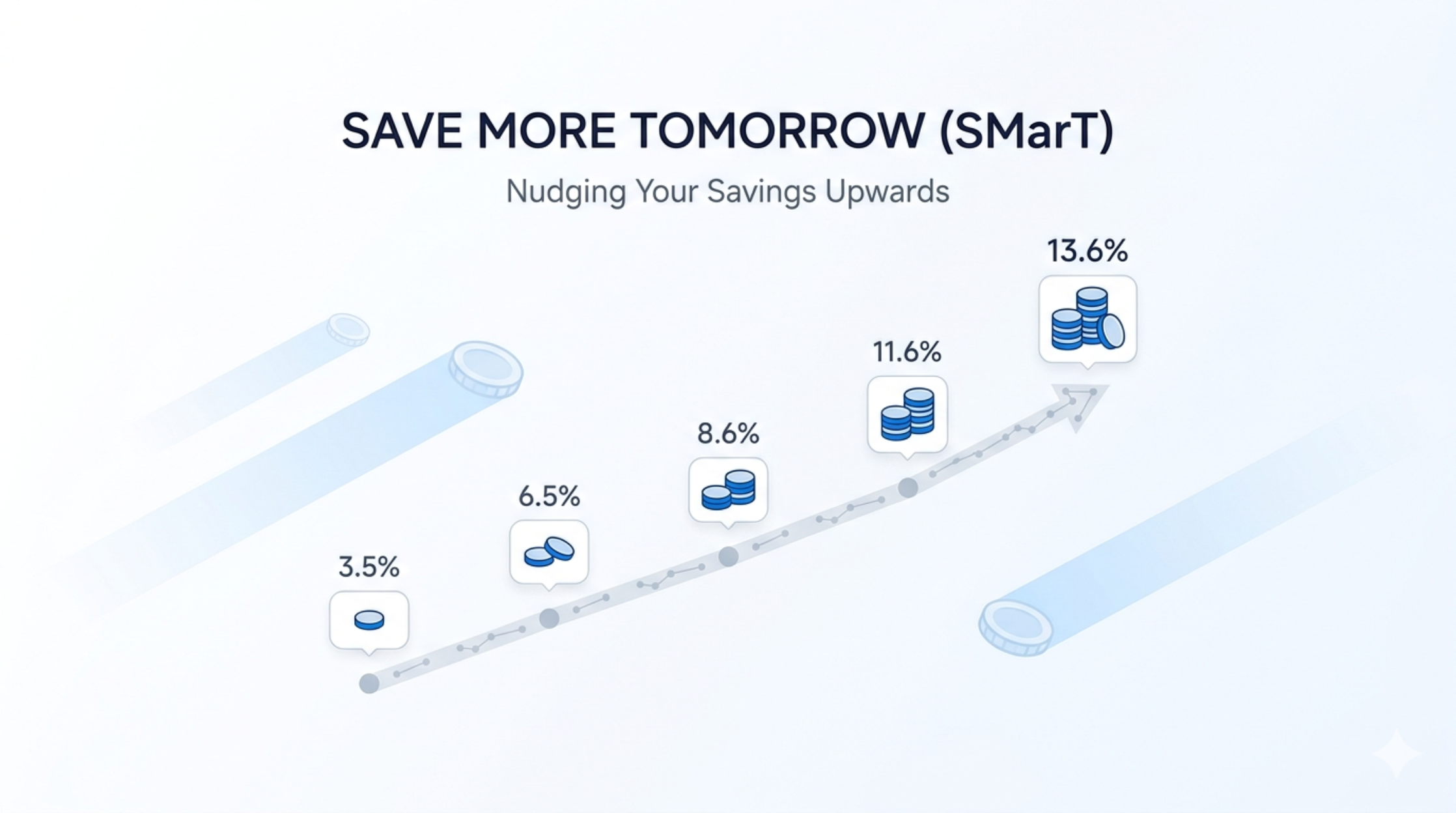

Save More Tomorrow (SMarT) is the auto-escalation retirement nudge designed by Richard Thaler and Shlomo Benartzi in 1996 and field-tested in 1998 at a midwestern manufacturer. Workers who joined the program lifted their 401(k) savings rate from 3.5% to 13.6% over 40 months, with 78% still enrolled four pay raises later. The mechanism — pre-commit to escalating savings out of future raises — neutralises loss aversion, status quo bias, and present-bias in a single design move. In December 2022 the United States Congress turned the experiment into federal law: SECURE 2.0 makes auto-enrollment and 1-percentage-point auto-escalation the default for most new 401(k) plans starting 2025.
What is the Save More Tomorrow plan?
Save More Tomorrow — usually shortened to SMarT — is a retirement-savings program in which employees pre-commit a portion of their next pay raise to a 401(k) deferral, and keep doing so automatically at every subsequent raise until they hit a personal cap. Nothing comes out of today’s paycheck. The idea sounds trivial, which is exactly why it works: the design was built so that none of the three behavioral barriers to saving — loss aversion, inertia, and present-bias — actually fire.
Richard Thaler and Shlomo Benartzi proposed it in a 1996 working paper, ran the first field test at an unnamed manufacturing firm in 1998, and published the results six years later in Save More Tomorrow: Using Behavioral Economics to Increase Employee Saving (Journal of Political Economy 2004). The paper is one of the most cited applications of behavioral economics in public policy and a load-bearing chunk of Richard Thaler‘s 2017 Nobel citation for “incorporating psychologically realistic assumptions into analyses of economic decision-making.”
The four design ingredients
Thaler and Benartzi list four moves that, in combination, make SMarT robust:
- Approach employees several months before a pay raise. The raise has not yet entered the worker’s reference point, so future-you, not present-you, is making the decision. Hyperbolic discounting (Laibson 1997) is on the side of the saver.
- Tie escalations to pay raises, not calendar dates. Take-home pay never falls. Without a perceived cut, loss aversion (Kahneman & Tversky 1979; loss aversion explained) does not block the increase.
- Default into auto-escalation; require an opt-out, not an opt-in. Status quo bias and inertia (Samuelson & Zeckhauser 1988) now work for the saver, not against them.
- Cap the escalation at a sensible ceiling. The original cap was 14%. Beyond that the worker has to renew consent — preserving autonomy and avoiding regulatory overreach.
Behavioral economics has a name for the asymmetry the program exploits: present-biased preferences. We discount the cost of saving sharply when the cost is felt today and only mildly when the cost is felt next year. Thaler and Benartzi simply moved the cost into “next year” — and harvested the discount.
The original 1998 result — 3.5% to 13.6% in 40 months
The first SMarT deployment took place at a manufacturer with a low-paid blue-collar workforce. Of 315 eligible employees who met with the financial planner, 79 were already saving the recommended rate. Of the remaining 236, the planner first proposed an immediate 5-percentage-point hike — 28% agreed. The 162 who refused the immediate hike were offered SMarT. 78% of them joined, escalating their contribution by 3 percentage points at every raise, capped at 14%.
The four-pay-raise tracking from the 2004 paper is what makes the result canonical:
The 13.6% terminal rate is roughly quadruple the baseline. For comparison: a 5-percentage-point bump under standard financial advice was rejected by ~70% of workers; the same 10-percentage-point lift achieved over four years through SMarT was retained by ~80% of joiners. The effect did not require new income, new investment products, or financial literacy — only a smarter default.
From experiment to law — SECURE 2.0 and the global rollout
SMarT spent its first decade as a corporate option. Vanguard, Fidelity, and other recordkeepers added it to their plan sponsor menus, and adoption climbed steadily. The structural shift came in two waves: the Pension Protection Act of 2006 gave employers a regulatory safe harbor for auto-enrollment, and the SECURE 2.0 Act of 2022 (signed December 2022) made it close to mandatory.
| Program / law | Year | Mechanism | Reach |
|---|---|---|---|
| Original SMarT field test (US) | 1998 | Voluntary, 4 raises, cap 14% | 162 workers, 1 employer |
| Pension Protection Act (US) | 2006 | Safe harbor for auto-enrollment | Tens of thousands of plans |
| UK Pensions Act / NEST | 2008 (rollout 2012) | Mandatory auto-enrolment, 8% combined | ~11M enrolled by 2024 (DWP) |
| Polish PPK | 2019 | Auto-enrolment every 4 years; 2%+1.5%+0.24% | ~3.6M participants 2024 (PFR) |
| SECURE 2.0 Act (US) | 2022 (effective 2025) | New 401(k)/403(b) plans must auto-enroll 3–10% with annual 1pp escalation up to 10–15% | Most US private employers |
The Vanguard How America Saves 2025 report documents the cumulative effect: 61% of plans Vanguard administers had auto-enrollment in 2024 and 69% of those layered auto-escalation on top — versus single-digit shares twenty years earlier. Among large plans (5,000+ participants) auto-enrollment now exceeds 80%. The Investment Company Institute’s 2025 retirement-market data place total US 401(k) assets at roughly $8.9 trillion at end-2024 — a pool whose growth rate increasingly reflects SMarT-style architecture rather than worker-by-worker decisions.
Why SMarT works — the three behavioral levers
Stripped to mechanism, SMarT is a deliberate stack of three nudges, each targeting a distinct cognitive failure mode:
- Loss aversion (Kahneman & Tversky 1979). Saving from a future raise is not coded as a loss. The reference point — current take-home pay — never moves down. λ ≈ 2.25 doesn’t activate.
- Status quo bias (Samuelson & Zeckhauser 1988). Inertia, often the enemy of good intentions, is repurposed: once enrolled, the worker has to act to stop the escalation. Anchoring on the existing arrangement is the saver’s friend.
- Present-bias / hyperbolic discounting (Laibson 1997). The savings cost lives in the future, where it carries less psychic weight. By the time the future arrives, the new contribution rate is the status quo, completing a self-reinforcing loop.
Madrian & Shea (QJE 2001) had already shown the size of the inertia channel before SMarT was published: at one large company, switching the 401(k) from opt-in to opt-out moved participation from 37% to 86%. Two-thirds of new hires stayed at the default contribution rate and the default investment fund for years. SMarT’s contribution was to attack not just whether workers save, but how much.
Auto-escalation in code — what a SMarT engine actually does
For practitioners building retirement, fintech, or HR software, the SMarT logic is short. The hard part is wiring it to payroll events and consent records, not the algorithm itself:
from dataclasses import dataclass
from datetime import date

@dataclass
class SmartEnrollment:
    employee_id: str
    current_rate: float          # e.g. 0.035 → 3.5%
    increment: float = 0.01      # SECURE 2.0 default 1pp
    cap: float = 0.15            # personal ceiling
    enrolled_on: date = date.today()
    opted_out: bool = False

def on_pay_raise(enrollment: SmartEnrollment, raise_pct: float) -> SmartEnrollment:
    """
    Called by the payroll system when a raise event fires.
    Pre-conditions: enrollment.opted_out == False AND raise_pct > 0.
    Post-condition: deferral never increases beyond cap;
                    take-home pay never falls because increment <= raise_pct.
    """
    if enrollment.opted_out or raise_pct <= 0:
        return enrollment
    new_rate = min(enrollment.current_rate + enrollment.increment, enrollment.cap)
    # Safety check — increment cannot exceed the raise itself
    bounded_increment = min(enrollment.increment, raise_pct)
    enrollment.current_rate = min(
        enrollment.current_rate + bounded_increment,
        enrollment.cap,
    )
    return enrollment

# Telemetry signal worth logging:
#   - participation_rate (overall)
#   - escalation_attach_rate (auto-enrolled who keep escalation on)
#   - opt_out_rate at each raise event
#   - average_terminal_rate (proxy for SMarT effectiveness)
The interesting implementation question is not the loop, it is the commitment device wrapping it. SECURE 2.0 lets workers opt out at any time, and roughly 10% of newly auto-enrolled US workers do so within their first 90 days (Vanguard 2025). The defaults set the upper bound on saving; the friction of opting out determines whether the bound is reached.
Where SMarT lives outside the US — UK auto-enrolment, Polish PPK
The closest international cousin is the UK’s auto-enrolment regime under the Pensions Act 2008, rolled out from 2012 onward. Employees aged 22+ earning over £10,000 are auto-enrolled into a pension at a combined contribution rate that rose to 8% (3% employer, 4% employee, 1% tax relief). The Department for Work and Pensions reports that opt-out has remained around 9% across a decade — closely matching the original SMarT retention rate. The UK now has roughly 11 million additional savers compared with the pre-2012 baseline.
Poland’s flagship is Pracownicze Plany Kapitałowe (PPK), introduced by the 2018 Act and rolled out 2019–2021. It blends auto-enrolment with mandatory employer contributions, but every four years the saver is re-enrolled by default — a rare design choice that hardwires re-engagement against inertia. Polskie Fundusze Rozwoju (PFR) data place active participation at roughly ~45% of eligible workers in 2024. That is well below the UK rate and a useful reminder that SMarT-style architecture is not a magic wand: implementation quality, employer contribution levels, and trust in the public pension system all condition the result. We discussed PPK in the broader context of choice architecture in nudge — teoria popychania (Polish).
Poland’s ~45% PPK participation versus the UK’s ~91% retention has a structural explanation. UK enrolment is automatic and continuous; Polish enrolment is automatic but renewed every four years after a previous opt-out. Each renewal costs trust capital. The design move that should have boosted re-engagement instead became the program’s main attrition channel. SMarT’s core lesson — defaults work because they are silent — applies in reverse.
The critique — does SMarT still work as advertised?
Two decades of replications have sharpened both the support and the caveats:
- Heterogeneity in real-world plans. Beshears, Choi, Laibson & Madrian have documented for years (e.g., NBER WP 2017, JPE 2022) that the average effect on savings rates in deployed plans is meaningful but smaller than the 1998 demonstration. Many employers choose lower escalation caps (6–10%) than the original 14%; many workers opt down after a raise even if they don’t fully opt out.
- The publication-bias correction. Maier et al. (PNAS 2022) re-examined the broader nudge literature and reported Cohen’s d falling from 0.43 to 0.08 once publication bias is corrected. SMarT itself is robust because of the field-test scale, but smaller behavioral interventions in the same family rarely survive the correction.
- i-frame vs s-frame (Chater & Loewenstein, BBS 2023). SMarT is the canonical i-frame intervention: change the individual’s choice architecture, not the system. Critics argue that auto-escalation has been used as a substitute for raising mandatory contribution floors or fixing the public pension. The 13.6% terminal rate looks impressive in isolation; against the ~15% private retirement saving target most US economists recommend, it is still under.
- Sectoral coverage gaps. SECURE 2.0 exempts small employers (under 10 workers), new firms (under 3 years old), churches, and government. Roughly 30% of US private-sector workers still have no employer-sponsored plan — the population that needs SMarT most is excluded by design.
The honest reading: SMarT remains the strongest applied behavioral economics intervention on the books, and it has demonstrably moved trillions of dollars into retirement accounts. It is not a substitute for systemic reform of social security or for rising real wages. Both Thaler and Benartzi have said as much in print.
SMarT meets AI — behavioral coaches and silicon savers
The 2024–2026 wave of LLM-powered personal-finance coaches (Cleo, Copilot Money, Magnify Money’s chatbot, Wealthfront’s “Path”) inherits an awkward fact from behavioral economics: the same models exhibit measurable loss aversion themselves. Chen et al. (arXiv 2305.12763) fitted prospect-theory parameters to GPT-3.5 and GPT-4 and recovered λ ≈ 1.8–2.4. Horton’s homo silicus work (NBER WP 31122) shows GPT-4 reproducing endowment effect, anchoring, and present-bias in approximately human magnitudes. An LLM-backed savings coach that nudges the user with “you’re losing money by not contributing” is, in effect, a biased agent leveraging biased framing.
The clearer use case is on the design side: silicon-based pilots. Before launching a new SMarT-like product feature on a million-user fintech, you can run cheaper pilot RCTs on AI agents that approximate human responses, then validate winners on a small human cohort. The August 2026 high-risk provisions of the EU AI Act, Article 5 classify AI systems that exploit cognitive vulnerabilities as prohibited — including in fintech. Auto-escalation that helps users hit their declared goals is on the right side of the line; opaque escalation tied to product fees is not.
How to deploy SMarT logic without a 401(k)
SMarT is built into US and UK workplace pensions. For freelancers, founders, and anyone outside an employer plan — large in Poland, where 401(k)-equivalent IKE/IKZE participation has stayed in single digits — the same architecture is reproducible by hand:
- Pre-commit the increment to a future income event, not today. Bonus, freelance milestone, raise, tax refund. Anything where the marginal money has not yet entered your reference point.
- Automate the transfer the day the income hits. Same-day standing orders to a separate account beat any monthly self-promise. Mental accounting does the rest.
- Set a personal cap. SMarT uses 14%; pick whatever yours is, but write it down. The cap is a precommitment against escalation drift, not a ceiling on saving.
- Use friction asymmetrically. Make depositing trivial and withdrawal slow (a savings account in a separate bank, a 90-day-notice product, a long-bond ladder). Status quo bias should defend the goal account, not the spending account.
- Avoid checking too often. Benartzi & Thaler (1995) call this myopic loss aversion: frequent evaluation activates loss aversion and depresses savings. Quarterly is enough.
Bottom line
Save More Tomorrow demonstrates something every economist before Thaler had ruled out: the same worker, the same income, the same investment menu — saves four times more under a different default. The 1998 result has held up across a quarter-century of replication, scaled into US, UK, and Polish public policy, and survived the broader replication crisis intact. It is also a lesson in design humility: SMarT works because all four moves point in the same direction, not because any one of them is decisive.
For builders, the corollary is simple. Defaults are not neutral. The architecture you ship — the pre-checked checkbox, the order of options, the moment you ask for consent — is policy. SMarT is what that policy looks like when it is engineered for the user.
FAQ
Who actually invented Save More Tomorrow?
Richard Thaler (University of Chicago) and Shlomo Benartzi (UCLA) co-designed the program. The first working paper circulated in 1996; the field test ran from 1998; the canonical write-up is Benartzi & Thaler, Save More Tomorrow, Journal of Political Economy 2004, 112(S1). Thaler received the 2017 Nobel in Economics; SMarT is one of the cited contributions.
How is SMarT different from regular 401(k) auto-enrollment?
Auto-enrollment sets a starting contribution rate (often 3%). SMarT adds the second move: that rate increases automatically — typically by 1 percentage point — at every pay raise, up to a cap. Auto-enrollment fights inertia about joining; SMarT fights inertia about contributing enough. SECURE 2.0 mandates both for new plans starting 2025.
What did the 1998 results actually show?
78% of workers offered SMarT joined. Among joiners, 80% stayed in across all four raise cycles. Average savings rate climbed from 3.5% to 13.6% over 40 months — almost a quadrupling — without any worker ever experiencing a take-home pay cut.
Does SMarT only work in the US?
No. The UK’s Pensions Act 2008 and the resulting NEST-led auto-enrolment scheme run on the same logic at population scale, with ~9% opt-out and ~11 million additional savers. Poland’s PPK uses an auto-enrolment-with-quadrennial-renewal variant; New Zealand’s KiwiSaver is another close cousin. Implementation quality varies, but the underlying nudge stack is portable.
What’s the strongest critique of SMarT?
The most credible critique is the i-frame vs s-frame argument from Chater & Loewenstein (BBS 2023): SMarT is good behavioral architecture but it is also a politically convenient substitute for raising mandatory contribution rates or strengthening the public pension. The 13.6% terminal rate is impressive in context, still short of the ~15% saving target most economists recommend, and excludes the ~30% of US private workers without an employer plan.
Does SECURE 2.0 force every employer to auto-enroll?
Almost. New 401(k) and 403(b) plans started after December 29, 2022 must auto-enroll workers at 3–10% and auto-escalate by 1 percentage point per year up to 10–15%, starting with the 2025 plan year. Plans started before that date are grandfathered, and employers with under 10 workers, firms under 3 years old, churches, and government plans are exempt.
Can I run a personal SMarT without a workplace plan?
Yes. Set a standing order that triggers on income events you don’t yet treat as “yours” — bonus, raise, freelance milestone, tax refund — at a fixed percentage that escalates by 1 pp each year up to your cap. Same-day automation matters more than account choice. The behavioral mechanism does not require a 401(k).
Bibliography & sources
- Benartzi S., Thaler R. — Save More Tomorrow: Using Behavioral Economics to Increase Employee Saving, Journal of Political Economy 2004, 112(S1) — journals.uchicago.edu.
- Madrian B., Shea D. — The Power of Suggestion: Inertia in 401(k) Participation and Savings Behavior, Quarterly Journal of Economics 2001, 116(4).
- Thaler R., Benartzi S. — Behavioral Economics and the Retirement Savings Crisis, Science 2013, 339(6124).
- Thaler R. — Misbehaving: The Making of Behavioral Economics, W. W. Norton 2015.
- Beshears J., Choi J., Laibson D., Madrian B. — The Effect of Providing Peer Information on Retirement Savings Decisions, Journal of Finance 2015, 70(3).
- Carroll G. D., Choi J., Laibson D., Madrian B., Metrick A. — Optimal Defaults and Active Decisions, Quarterly Journal of Economics 2009, 124(4).
- Kahneman D., Tversky A. — Prospect Theory: An Analysis of Decision under Risk, Econometrica 1979, 47(2).
- Samuelson W., Zeckhauser R. — Status Quo Bias in Decision Making, Journal of Risk and Uncertainty 1988, 1(1).
- Laibson D. — Golden Eggs and Hyperbolic Discounting, Quarterly Journal of Economics 1997, 112(2).
- Maier M. et al. — No Evidence for Nudging After Adjusting for Publication Bias, PNAS 2022, 119(31) — pnas.org.
- Chater N., Loewenstein G. — The i-frame and the s-frame: How Focusing on Individual-Level Solutions Has Led Behavioral Public Policy Astray, Behavioral and Brain Sciences 2023, 46.
- SECURE 2.0 Act of 2022 — Division T of the Consolidated Appropriations Act 2023, Public Law 117–328 — congress.gov.
- Pension Protection Act of 2006 — Public Law 109–280 — congress.gov.
- UK Pensions Act 2008 — legislation.gov.uk.
- UK Department for Work and Pensions — Workplace Pension Participation and Savings Trends 2024 — gov.uk.
- Vanguard — How America Saves 2025 — institutional.vanguard.com.
- Investment Company Institute — Retirement Markets Year-End 2024 — ici.org.
- Polskie Fundusze Rozwoju — PPK statistics 2024 — mojeppk.pl.
- Ustawa z 4 października 2018 r. o pracowniczych planach kapitałowych (Dz.U. 2018 poz. 2215) — isap.sejm.gov.pl.
- Chen Y. et al. — The Emergence of Economic Rationality of GPT, arXiv:2305.12763, 2023.
- Horton J. — Large Language Models as Simulated Economic Agents, NBER Working Paper 31122, 2023.
- EU AI Act, Article 5 — Prohibited Practices — artificialintelligenceact.eu.
- Nobel Prize 2017 — Richard H. Thaler, Facts — nobelprize.org.
[…] an extra 5%.” SMarT did the opposite, and this is the single detail most raise advice misses. Breakdowns of the program’s design point to three moves that all pulled in the same […]
[…] DecodetheFuture.org, “Save More Tomorrow Explained — Thaler’s SMarT Plan,” May 2026. https://decodethefuture.org/en/save-more-tomorrow-explained/ […]