
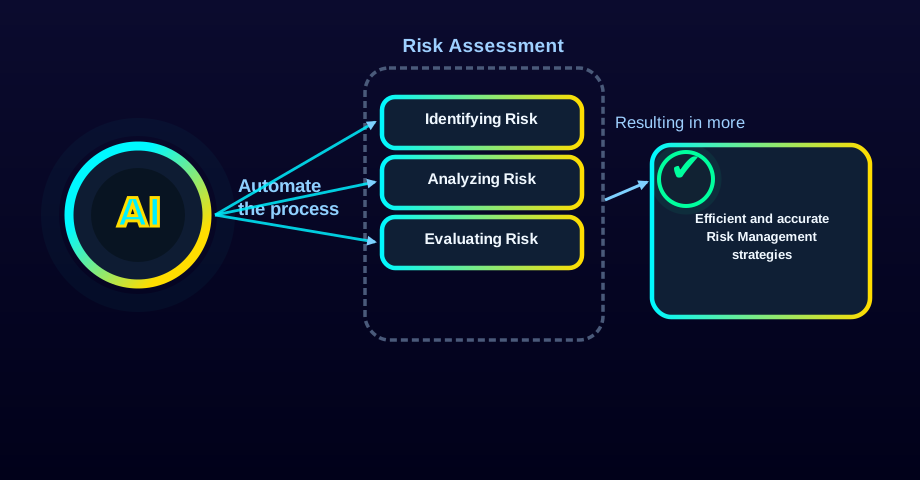

AI for risk management uses machine learning models, automated monitoring pipelines, and governance frameworks to identify, quantify, and mitigate risks across enterprise operations. In 2026, organizations must align with the NIST AI RMF and EU AI Act (most provisions effective August 2, 2026) while addressing new challenges from agentic AI, model drift, and shadow AI — the average enterprise now runs 66 different GenAI applications.
AI is no longer a pilot project. By 2025, 88% of organizations reported using AI in at least one business function. But the faster AI scales into core workflows — lending decisions, medical diagnostics, fraud detection, hiring — the more it behaves like any other critical infrastructure: when it fails, the consequences are systemic.
This article is a practitioner’s guide. You’ll learn the three dominant risk management frameworks in 2026, understand what the EU AI Act demands before its August 2026 enforcement date, see working Python code for drift detection, and walk through real architecture patterns for production AI monitoring. If you’ve read our guides on machine learning and AI in trading, this is where theory meets operational reality.
Why Does AI Risk Management Matter in 2026?
An MIT study across 32 datasets and four industries found that 91% of machine learning models degrade over time. Models untouched for six months see error rates jump by 35% on new data. In finance, that means incorrect credit decisions. In healthcare, it means wrong diagnoses. In trading — I speak from experience with CFD strategies on Plus500 — a model that worked on historical data can quietly bleed capital once market microstructure shifts.
The risk is no longer theoretical. McKinsey’s 2026 AI Trust Maturity Survey shows that while the average Responsible AI maturity score increased from 2.0 to 2.3 year-over-year, only about a third of organizations score 3 or higher in governance and strategy. Technical capabilities are outpacing oversight structures everywhere. The organizations investing $25 million or more in responsible AI report significantly higher maturity scores and are far more likely to see measurable impact on EBIT.
Then there’s regulation. The EU AI Act — the world’s first comprehensive AI law — makes most of its provisions applicable on August 2, 2026, including the full compliance framework for high-risk AI systems. Fines reach up to €35 million or 7% of global annual turnover for violations. This isn’t a theoretical future; compliance timelines are active right now.
What Are the 3 Dominant AI Risk Management Frameworks?
In 2026, three frameworks form the backbone of enterprise AI risk governance. Mature organizations don’t pick one — they layer them. Here’s how each fits into the stack.
1. NIST AI Risk Management Framework (AI RMF)
Released in January 2023 and expanded with the Generative AI Profile (NIST-AI-600-1) in July 2024, the NIST AI RMF is the most widely adopted voluntary framework globally. It’s organized around four core functions: Govern, Map, Measure, and Manage. The GenAI profile added over 200 specific actions addressing unique risks from large language models and generative systems — hallucination, intellectual property infringement, toxic output, and data privacy violations.
For organizations in the US, NIST provides the shared language that connects security operations, risk management, and executive oversight. The framework is voluntary, but more companies are aligning internal controls to it because it offers practical guidance on documentation, oversight, testing, and monitoring. If you’re working with RAG architectures or AI agents, the GenAI profile is particularly relevant.
2. ISO/IEC 42001 — AI Management System Standard
Where NIST is a framework, ISO 42001 is a certifiable standard. It provides the formal assurance mechanism for AI governance — repeatable control management, auditability, and external validation. For companies doing business across borders or needing to demonstrate AI governance to customers and regulators, ISO 42001 certification is becoming a competitive requirement.
However, ISO 42001 alone doesn’t address continuous control effectiveness, real-time AI-driven risks, or model drift monitoring. It’s a foundation that needs to be complemented by NIST AI RMF for dynamic risk and by operational MLOps tooling for technical controls.
3. EU AI Act — Risk-Based Legal Framework
The EU AI Act is the first comprehensive AI regulation in the world. Unlike NIST and ISO (voluntary/certifiable), it’s law — with legally binding obligations and substantial penalties. Its risk-based approach classifies AI systems into four tiers: unacceptable risk (prohibited since February 2025), high risk (full compliance required by August 2, 2026), limited risk (transparency obligations from August 2026), and minimal risk (unregulated).
High-risk systems — those in biometrics, critical infrastructure, education, employment, law enforcement, and financial services — must implement risk management systems, data governance, technical documentation, record-keeping, transparency measures, human oversight, and cybersecurity controls. Providers must complete conformity assessments, obtain CE marking, and register in the EU database before placing these systems on the market.
August 2, 2026 is the main application date. Most provisions for high-risk AI systems (Annex III) take effect on that date. If your AI system is used in hiring, credit scoring, medical diagnosis, or law enforcement — preparation should be underway now. Fines: up to €35M or 7% of global annual turnover.
| Framework | Type | Scope | Key Strength | Gap |
|---|---|---|---|---|
| NIST AI RMF | Voluntary | All sectors, US-centric | GenAI Profile with 200+ actions | No legal enforcement |
| ISO/IEC 42001 | Certifiable | Global, cross-sector | Third-party audit trail | Static — no real-time monitoring |
| EU AI Act | Legally binding | EU market, extraterritorial | Enforceable with penalties | Complex classification rules |
The most effective organizations in 2026 don’t run these as separate programs. They build a unified operating model: NIST + ISO for governance and assurance, EU AI Act as a regulatory overlay, and operational MLOps tooling (model monitoring, drift detection, automated retraining) for continuous risk control.
How Does Model Drift Threaten AI Systems?
Model drift is the silent killer of production AI. Your model doesn’t throw an error. It doesn’t crash. It just slowly gets worse — and by the time you notice, the damage is done.
There are three primary types of drift. Data drift occurs when the statistical distribution of input features changes — new customer demographics, seasonal patterns, market regime shifts. Concept drift happens when the relationship between inputs and outputs changes — the patterns your model learned no longer hold. Prediction drift is when the model’s output distribution shifts, often an early warning of concept drift underneath.
In my experience building a multi-strategy Python trading bot, drift was the primary destroyer of backtested edge. A strategy optimized on 2024 market microstructure — specific liquidity patterns, volatility clusters, spread behavior — degrades when those conditions shift in 2025. The model doesn’t know it’s wrong. It just keeps executing, burning capital with decreasing accuracy.
Detecting Drift: Python Implementation
Here’s a production-ready drift detection pipeline using Population Stability Index (PSI) — the industry standard for credit risk models — and Kolmogorov-Smirnov tests. This code monitors feature distributions against a training baseline and triggers alerts when drift exceeds defined thresholds.
import numpy as np
from scipy import stats
from dataclasses import dataclass

@dataclass
class DriftResult:
    feature: str
    psi: float
    ks_stat: float
    ks_pvalue: float
    drifted: bool

def calculate_psi(
    reference: np.ndarray,
    current: np.ndarray,
    bins: int = 10
) -> float:
    """Population Stability Index — industry standard
    for monitoring distribution shifts.
    PSI < 0.1  → no significant drift
    PSI 0.1–0.2 → moderate drift, investigate
    PSI > 0.2  → significant drift, retrain
    """
    ref_pcts, bin_edges = np.histogram(
        reference, bins=bins, density=False
    )
    cur_pcts, _ = np.histogram(
        current, bins=bin_edges, density=False
    )

    # Normalize to proportions, add epsilon to avoid log(0)
    eps = 1e-6
    ref_pcts = ref_pcts / len(reference) + eps
    cur_pcts = cur_pcts / len(current) + eps

    psi = np.sum(
        (cur_pcts - ref_pcts) * np.log(cur_pcts / ref_pcts)
    )
    return float(psi)

def detect_drift(
    reference: dict[str, np.ndarray],
    current: dict[str, np.ndarray],
    psi_threshold: float = 0.2,
    ks_alpha: float = 0.05,
) -> list[DriftResult]:
    """Run PSI + KS drift detection across all features.
    Returns DriftResult for each feature with a boolean flag.
    """
    results = []
    for feature in reference:
        ref = reference[feature]
        cur = current[feature]

        psi = calculate_psi(ref, cur)
        ks_stat, ks_p = stats.ks_2samp(ref, cur)

        drifted = psi > psi_threshold or ks_p < ks_alpha

        results.append(DriftResult(
            feature=feature,
            psi=round(psi, 4),
            ks_stat=round(ks_stat, 4),
            ks_pvalue=round(ks_p, 6),
            drifted=drifted,
        ))
    return results

# --- Usage example ---
if __name__ == "__main__":
    np.random.seed(42)

    # Simulate training data (reference)
    ref_data = {
        "credit_score": np.random.normal(680, 50, 10_000),
        "income": np.random.lognormal(10.8, 0.6, 10_000),
        "debt_ratio": np.random.beta(2, 5, 10_000),
    }

    # Simulate production data — income distribution shifted
    prod_data = {
        "credit_score": np.random.normal(682, 52, 5_000),
        "income": np.random.lognormal(11.1, 0.7, 5_000),  # ← drift
        "debt_ratio": np.random.beta(2, 5, 5_000),
    }

    results = detect_drift(ref_data, prod_data)
    for r in results:
        flag = "🔴 DRIFT" if r.drifted else "🟢 OK"
        print(f"{r.feature:>15} | PSI={r.psi:.4f} | "
              f"KS p={r.ks_pvalue:.6f} | {flag}")
Running this code produces output where `income` is flagged as drifted — the production distribution shifted from the training baseline. In a real system, this would trigger an alert to the ML team and potentially initiate an automated retraining pipeline.
Don’t just monitor feature drift in isolation. Track the share of drifted features across the entire dataset. If 30%+ of features drift simultaneously, you’re likely experiencing a regime change, not isolated noise. Combine PSI with Wasserstein distance for continuous features and Jensen-Shannon divergence for categorical data for maximum coverage.
What Does an AI Risk Monitoring Architecture Look Like?
Production AI monitoring operates on three layers, each catching a different class of failure. The data monitoring layer validates input quality, schema integrity, and distribution conformance against training baselines. The model monitoring layer tracks accuracy, fairness, explainability, and drift metrics to detect silent performance degradation. The system monitoring layer watches infrastructure health — latency, throughput, resource utilization, and security anomalies.
A pattern emerging in mature organizations is the secure prompt gateway — instead of connecting employees directly to LLM providers, interactions pass through a gateway that performs PII redaction, policy enforcement, prompt sanitization, and logging. Only sanitized prompts reach external models. This architecture addresses the biggest AI risk in 2026: sensitive data leaving the organization through prompts.
Shadow AI: The Hidden Risk Multiplier
Shadow AI occurs when employees use browser-based AI tools that bypass corporate security. They share sensitive data without realizing the tools may use it for model training, potentially leaking it to competitors. Traditional monitoring can’t detect this activity, and the average enterprise now runs 66 different GenAI applications — with about 10% classified as high-risk.
The mitigation pattern is a three-tier classification: every discovered AI tool gets categorized as Sanctioned (approved, integrated with enterprise identity management), Restricted (allowed with additional controls), or Blocked (high-risk, prohibited). This requires continuous discovery — you can’t govern what you can’t see.
How Should You Implement AI Risk Management? A 5-Step Roadmap
Whether you’re a startup deploying your first production model or an enterprise managing hundreds, the implementation follows the same sequence. Skip a step and you create exactly the governance gaps that scale amplifies.
Step 1: Inventory and classify all AI systems. You cannot manage risk for systems you don’t know exist. Map every AI system — including vendor-provided ones, shadow AI tools, and embedded ML components. Classify each against the EU AI Act risk tiers (prohibited, high-risk, limited, minimal) and assess business criticality. For organizations with existing context engineering or fine-tuned models, include those in the inventory with their specific risk profiles.
Step 2: Establish governance structure. Define clear ownership. Every AI system needs an accountable owner, an oversight committee, and escalation paths. The governance model should address: who approves new AI deployments, who monitors post-deployment performance, who decides on retraining, and who owns incident response. McKinsey’s data shows governance and agentic AI controls lag behind technical capabilities across all regions — this is a globally consistent gap.
Step 3: Deploy technical controls. Implement the three-layer monitoring architecture. Set up drift detection (start with PSI + KS tests on your highest-risk models), configure alerting thresholds, and build retraining pipelines. For deep learning models, add prediction confidence monitoring — a drop in average confidence often precedes accuracy loss. Use tools like Evidently (open-source, 25M+ downloads), MLflow for experiment tracking, or enterprise platforms like Fiddler for full observability.
Step 4: Align with regulatory frameworks. Map your controls to NIST AI RMF functions (Govern → Map → Measure → Manage) and cross-reference with EU AI Act requirements if you operate in or serve the EU market. For high-risk systems: prepare technical documentation, implement conformity assessment procedures, and set up post-market monitoring and incident reporting before the August 2026 deadline.
Step 5: Iterate and mature. AI risk management is not a one-time project. Schedule regular red-teaming exercises — simulated attacks to identify weaknesses. Update risk assessments quarterly as AI use cases evolve. Track your maturity against the five dimensions McKinsey uses: strategy, risk management, data & technology, governance, and (new for 2026) agentic AI governance.
What’s Different About Agentic AI Risk?
Agentic AI is the most important emerging risk category in 2026. Traditional AI agents generate content. Agentic AI systems perform actions — they execute code, call APIs, make database changes, send emails, process transactions. Without proper controls, they become automated privilege escalation mechanisms.
Agentic AI requires execution governance, not just data protection. Certain actions must always require human approval: financial transactions above defined thresholds, changes to access controls, data deletion, external communications, and modifications to production systems. AI agents should follow strict Zero Trust principles — minimal permissions, continuous verification, complete audit trails.
This is where Model Context Protocol (MCP) and proper prompt engineering intersect with risk management. Every tool an agent can access, every action it can take, must be explicitly defined, permissioned, and logged. The architecture isn’t just about what the agent can do — it’s about what happens when the agent encounters adversarial input or makes a mistake.
What Does This Mean in Practice?
Here’s my honest assessment after building trading bots, testing drift detection pipelines, and studying the frameworks: most organizations are over-invested in AI capabilities and under-invested in AI controls. The McKinsey data confirms this — technical maturity consistently outpaces governance maturity.
The organizations that will thrive aren’t those with the best initial models. They’re those with the best production model management: continuous monitoring, automated drift detection, disciplined retraining, and governance frameworks that treat AI as a governed operational capability rather than just a technology initiative.
For practitioners starting today: begin with Step 1 (inventory). You’ll be surprised how many AI systems are running in your organization that nobody is actively monitoring. Then deploy basic drift detection on your highest-risk model — the PSI + KS pipeline above takes a day to implement and provides immediate visibility. The rest follows naturally from there.
The window for proactive preparation is closing. August 2, 2026 isn’t a soft target — it’s a regulatory enforcement date with real penalties. Start now.
FAQ
AI risk management is the structured process of identifying, assessing, mitigating, and monitoring risks that emerge when organizations deploy artificial intelligence systems. It covers model risks (drift, bias, degradation), data risks (leakage, poisoning, privacy violations), operational risks (shadow AI, model sprawl), compliance risks (EU AI Act, GDPR), security risks (adversarial attacks, prompt injection), and ethical risks (fairness, transparency, explainability). Unlike traditional software risk, AI systems are probabilistic and data-dependent, requiring continuous monitoring rather than one-time testing.
The NIST AI RMF is a voluntary framework released in January 2023 by the US National Institute of Standards and Technology. It provides organizations with a structured approach to managing AI risks through four core functions: Govern (establishing accountability and oversight), Map (understanding the AI system’s context and risks), Measure (assessing risks with quantitative and qualitative methods), and Manage (treating and monitoring identified risks). In July 2024, NIST released the Generative AI Profile (NIST-AI-600-1) adding over 200 specific risk mitigation actions for LLMs and generative AI systems.
The main application date is August 2, 2026, when most provisions become enforceable including the full compliance framework for high-risk AI systems listed in Annex III (biometrics, critical infrastructure, education, employment, financial services, law enforcement). AI systems in products covered by existing EU safety legislation (Annex I) have a later deadline of August 2, 2027. Penalties for non-compliance can reach up to €35 million or 7% of global annual turnover, whichever is higher.
Model drift detection uses statistical methods to compare production data distributions against training baselines. The two most common approaches are the Population Stability Index (PSI), which quantifies distribution changes with thresholds at 0.1 (moderate) and 0.2 (significant), and the Kolmogorov-Smirnov test, which tests whether two samples come from the same distribution. In practice, you should monitor both feature drift (input distributions) and prediction drift (output distributions), combining multiple metrics like Wasserstein distance for continuous features and Jensen-Shannon divergence for categorical data.
Shadow AI refers to employees using unauthorized browser-based AI tools that bypass corporate security policies. The danger is twofold: sensitive data shared through these tools may be used to train external models, potentially leaking to competitors; and ungoverned AI outputs may be used for business decisions without quality controls or audit trails. The average enterprise runs 66 different GenAI applications, with about 10% classified as high-risk. Mitigation requires continuous AI tool discovery and a three-tier classification system (sanctioned, restricted, blocked) integrated with enterprise identity management.
Traditional AI systems generate content — text, predictions, classifications. Agentic AI systems perform actions: they execute code, call APIs, modify databases, send communications, and process transactions autonomously. This shifts the risk from information quality to execution safety. Without proper controls, agentic AI can become an automated privilege escalation mechanism. Managing agentic AI risk requires execution governance (defining what actions require human approval), Zero Trust principles (minimal permissions with continuous verification), complete audit trails, and human-in-the-loop controls for irreversible or high-stakes actions.
For most teams starting from scratch, begin with open-source tools: Evidently (25M+ downloads) for drift detection and data monitoring, MLflow for experiment tracking and model versioning, and SHAP for explainability metrics. For enterprise-scale deployments, consider platforms like Fiddler for AI observability, IBM OpenPages for governance, or Weights & Biases for full MLOps lifecycle management. The most important thing isn’t the specific tool — it’s implementing basic drift detection and alerting on your highest-risk production model first, then expanding coverage iteratively.
Bibliography
- NIST AI Risk Management Framework (AI RMF 1.0), National Institute of Standards and Technology, January 2023. nist.gov/itl/ai-risk-management-framework
- NIST-AI-600-1: Generative Artificial Intelligence Profile, NIST, July 2024. airc.nist.gov/Docs/1
- EU Artificial Intelligence Act — Full text and implementation timeline. artificialintelligenceact.eu
- ISO/IEC 42001:2023 — Artificial intelligence management system. iso.org/standard/81230.html
- McKinsey, “State of AI Trust in 2026: Shifting to the Agentic Era,” March 2026. mckinsey.com
- Financial Services AI Risk Management Framework, Cyber Risk Institute / FSSCC. cyberriskinstitute.org
- Aon, “AI Risk 2026: What Business Leaders Need to Know,” March 2026. aon.com
- OWASP Machine Learning Security Top 10. owasp.org
- MITRE ATLAS — Adversarial Threat Landscape for AI Systems. atlas.mitre.org
- Evidently AI — Open-source ML monitoring library. evidentlyai.com
[…] Establish baselines for “normal” API traffic. One of the hardest parts of detecting adversarial distillation is distinguishing it from a legitimate enterprise customer with high query volume. Pooled data lets the labs build better classifiers. (This is the same kind of pattern recognition we covered in our piece on AI for risk management.) […]