
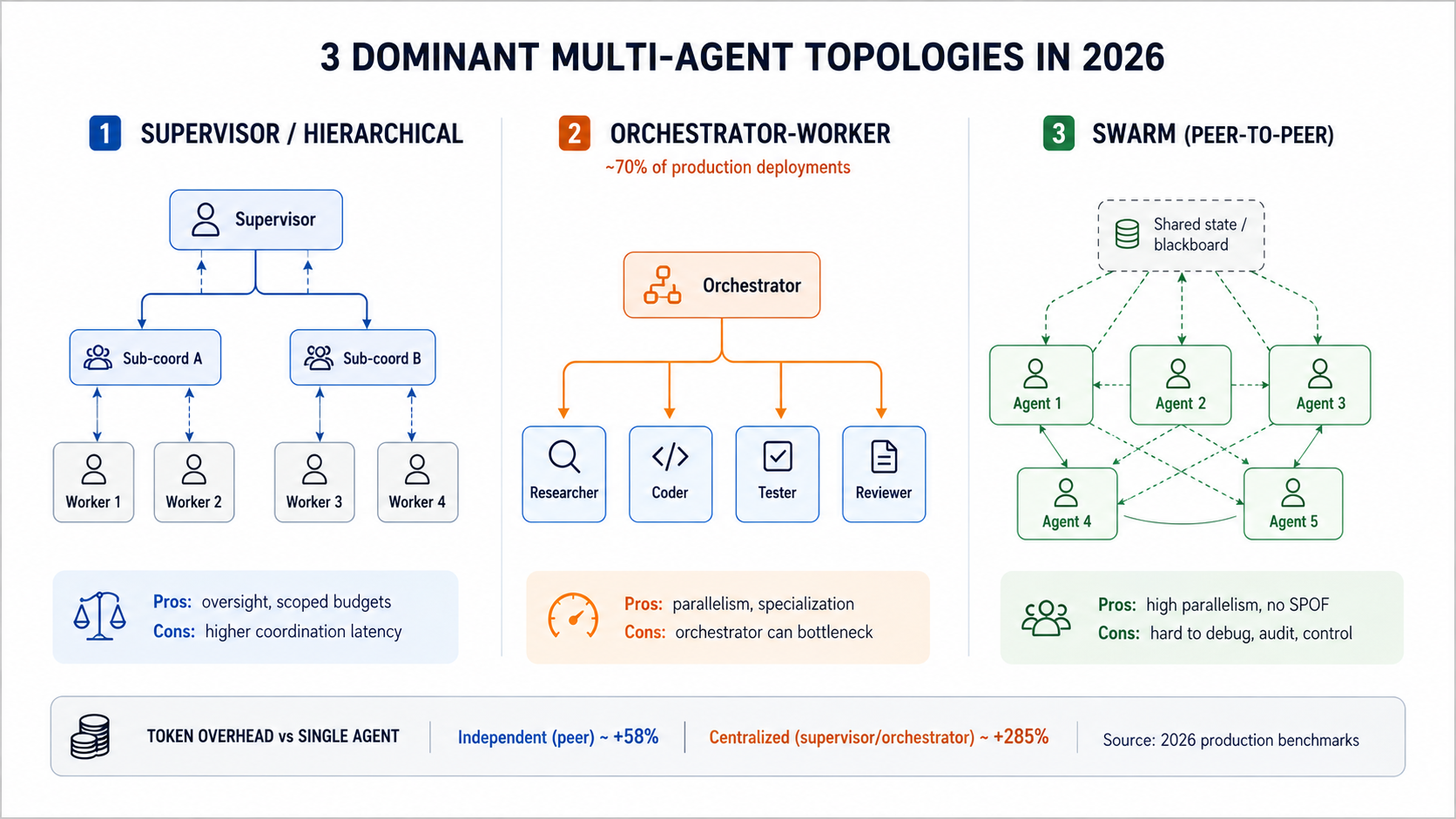

A multi-agent system is an architecture in which two or more LLM-driven agents — each with a distinct role, prompt, model tier, or tool set — coordinate to complete a task that a single agent would handle worse, slower, or not at all. In 2026, three topologies dominate: supervisor / hierarchical (a coordinator dispatches workers), orchestrator-worker (the most common — about 70% of production deployments), and swarm (peer agents, no central control). The honest economics: independent multi-agent setups typically incur ~58% extra token overhead and centralized ones around 285% extra, so multi-agent only pays off when the task genuinely benefits from specialization, parallelism, or critique — not as a default.
What is a multi-agent AI system?
A multi-agent AI system is software in which two or more agents — each itself an LLM-in-a-loop with tools — work together on a task. The agents differ in at least one of: the model they run on, the tools they can call, the prompt that defines their role, or the data they have access to. The system as a whole is meant to do what a single agent cannot, or could only do worse.
The shift from single-agent to multi-agent thinking happened sometime in 2024 and accelerated in 2025 as protocols, frameworks, and managed services made coordination cheap to wire up. By early 2026, every major lab and framework ships a “multi-agent” SKU: Anthropic’s Claude Sub-agents, OpenAI’s Agents SDK, Google’s ADK, LangGraph supervisor templates, CrewAI Crews, AutoGen GroupChats. Multi-agent is the default talking point — and that, as we’ll see below, is part of the problem.
This article is the deep dive on multi-agent specifically: when it wins, when it loses, the three topologies that cover almost every production system, the framework benchmarks that matter, and the failure modes you only hit when you split the work across more than one agent. For the foundational picture see our hub article What is an AI Agent? Complete Guide for 2026 and the architecture spoke AI Agent Architecture Explained: 4 Layers + Patterns.
What are the 3 dominant multi-agent topologies in 2026?
Almost every production multi-agent system in 2026 is a variation on one of three topologies. The differences are not stylistic — they shape latency, cost, debuggability, and failure behaviour.
Topology 1: Supervisor / Hierarchical
A supervisor agent sits at the top, sub-coordinators sit in the middle, worker agents sit at the bottom. The supervisor reads the goal, decides which sub-team should handle it, dispatches, and aggregates results. This mirrors how human organizations chunk work.
The strength is oversight and scoped budgets — the supervisor can enforce per-branch token limits, cancel sub-trees that wander, and produce a clean audit trail. The cost is coordination latency: a three-level hierarchy with a 2-second LLM call at each level adds at least 6 seconds before any worker even starts running. For latency-sensitive flows (interactive UX, real-time customer service), that math doesn’t work.
Topology 2: Orchestrator-Worker (the production default)
A single orchestrator classifies the incoming task, decomposes it into sub-tasks, dispatches each to a specialized worker (researcher, coder, tester, reviewer), and merges results. Industry surveys put this at roughly 70% of production multi-agent deployments in 2026, including most internal builds at Stripe, Mercury, and the public Anthropic and OpenAI reference designs.
It wins on the trade-off between flat (no coordination) and hierarchical (heavy coordination): one level of routing, parallelism across workers, manageable observability. Anthropic’s Building Effective Agents piece calls this exact pattern orchestrator-workers and recommends it as the first non-trivial design to consider when a single agent isn’t enough.
Topology 3: Swarm
No central control. Peer agents read and write a shared blackboard (Redis, Postgres, a vector store, or an A2A-coordinated bus) and decide individually what to do next. The swarm pattern came from robotics and ant-colony optimization; in 2026 it’s the rarest of the three for general-purpose agents but the right shape for inherently parallel work — large-scale data labelling, simulation, distributed research, or red-teaming where you want many independent attempts.
The price is debuggability and auditability. There is no single “trace” of how the system reached its output; reconstructing a failure means replaying many concurrent agents against shared state. For regulated domains (finance, healthcare, anything in EU AI Act Annex III), swarm is usually not a defensible architecture.
What is the honest cost of multi-agent versus single-agent?
The most-quoted 2026 finding in this space comes from production benchmarks measuring token overhead against a tuned single-agent baseline on the same task. Independent multi-agent setups (peer agents communicating laterally) incur about a 58% token overhead. Centralized multi-agent (supervisor or orchestrator) incurs around 285%. A separate 2026 arXiv result (Single-Agent LLMs Outperform Multi-Agent Systems on Multi-Hop Reasoning Under Equal Thinking Token Budgets) showed that when you give a single agent the same total compute the multi-agent system uses, the single agent often matches or beats it on reasoning tasks.
The implication is uncomfortable for the multi-agent narrative: coordination is not free, and a lot of multi-agent value disappears when you normalize for compute. Multi-agent wins reliably when at least one of three conditions holds:
- Specialization yields better outputs than generalization — a coder agent, a tester agent, and a reviewer agent each have prompts and tools tuned to their role; one agent juggling all three roles in context loses fidelity.
- Parallelism shortens wall-clock time — if the task contains five independent sub-tasks, five workers in parallel finish faster than one worker doing them sequentially, even at higher token cost.
- Critique improves quality — a reviewer or critic agent catches errors the executor misses, lifting reliability above what self-critique inside one agent (Reflexion) achieves.
If none of these holds, the answer is almost always scale up the single agent first: better prompt, better model, ReAct + Reflexion, more tools. That ordering — single-agent first, multi-agent only when justified — is the unfashionable but correct production heuristic in 2026.
Adding agents multiplies orchestration overhead, debugging surface, and failure modes. Don’t reach for multi-agent because the framework demos look impressive. Reach for it when you have a measurable single-agent ceiling — recurring failure modes, latency wall-clocks that parallelism would help, or a quality bar a critic clearly raises. Otherwise, more agents make things slower and more expensive without making them better.
Which multi-agent framework should you use? LangGraph vs CrewAI vs AutoGen
Three frameworks dominate open-source production multi-agent work in 2026, plus the newer vendor-native SDKs from Anthropic, OpenAI, and Google.
| Framework | Maker | Topology fit | Production readiness | Complex-task success |
|---|---|---|---|---|
| LangGraph | LangChain | All three; supervisor is the canonical example | High — built-in checkpointing, time travel, LangSmith observability | ~62% |
| CrewAI | CrewAI Inc. | Orchestrator-Worker (Crews + role-based tasks) | Medium — rapid ecosystem, limited checkpointing | ~54% |
| AutoGen / AG2 | Microsoft Research | Conversational topologies (GroupChat) | Medium — AG2 rewrite maturing; AutoGen in maintenance mode | ~58% |
| Anthropic Agent SDK + Sub-agents | Anthropic | Orchestrator-Worker, native MCP | High — vendor-aligned, MCP-native | n/a |
| OpenAI Agents SDK | OpenAI (March 2025) | Orchestrator-Worker, handoff primitive | High — production telemetry from day one | n/a |
| Google ADK | Google (April 2025) | Orchestrator-Worker; A2A-native | High — A2A as default cross-agent protocol | n/a |
Three points worth flagging.
First, the success-rate numbers (62 / 54 / 58%) come from a 2026 benchmark of complex multi-step tasks with comparable prompts; they are useful for relative ranking, not as absolute capability claims. Real success on your task depends on prompt quality, tool design, and eval harness as much as framework choice.
Second, AutoGen has effectively entered maintenance mode. Microsoft has shifted attention to its broader Agent Framework, and major AutoGen feature work has stopped. New production builds in 2026 should look at AG2 (the community fork) or pick another framework.
Third, the vendor-native SDKs (Anthropic, OpenAI, Google) are the right fit when you’re committed to one model family. The trade-off is portability: switching from Anthropic Agent SDK to OpenAI Agents SDK is non-trivial. LangGraph and CrewAI sit on top of any provider, which is why they remain the cross-vendor production choice.
For deeper coverage of the underlying model layer that all of these sit on, see our 2026 frontier model comparison and the AI coding assistants review for how multi-agent shows up in practice.
A small LangGraph supervisor in code
The smallest meaningful supervisor pattern with LangGraph fits in about 30 lines. The supervisor is itself an LLM that picks which worker to route to next; the workers are independent agents with their own tools. Replace the placeholders with your real workers and tools.
from langgraph.graph import StateGraph, END
from langgraph.prebuilt import create_react_agent
from langchain_anthropic import ChatAnthropic

llm = ChatAnthropic(model="claude-sonnet-4-6")

researcher = create_react_agent(llm, tools=[web_search, fetch_url])
coder      = create_react_agent(llm, tools=[read_file, write_file, run_tests])
reviewer   = create_react_agent(llm, tools=[read_file, lint])

def supervisor(state):
    decision = llm.invoke([
        {"role": "system",
         "content": "Route to one of: researcher, coder, reviewer, FINISH."},
        {"role": "user", "content": state["task"]},
    ]).content.strip()
    return {"next": decision}

graph = StateGraph(dict)
graph.add_node("supervisor", supervisor)
graph.add_node("researcher", researcher)
graph.add_node("coder",      coder)
graph.add_node("reviewer",   reviewer)
graph.set_entry_point("supervisor")
graph.add_conditional_edges(
    "supervisor",
    lambda s: s["next"],
    {"researcher": "researcher", "coder": "coder",
     "reviewer": "reviewer", "FINISH": END},
)
for w in ["researcher", "coder", "reviewer"]:
    graph.add_edge(w, "supervisor")
app = graph.compile(checkpointer=...)  # plug in Postgres/Redis for durability
Two production-grade details worth pointing at: the checkpointer argument turns the run into a durable, resumable workflow (LangGraph’s interrupt-and-resume primitive is the EU AI Act Article 14 implementation in disguise), and the supervisor’s prompt should hard-cap which worker names it can return — otherwise you get the orchestrator-bottleneck failure mode below.
How do agents in a multi-agent system actually communicate?
Four communication patterns dominate, each with different trade-offs.
- Sequential handoff — agent A finishes, passes structured output to agent B, which finishes and passes to C. Cleanest, easiest to debug, no concurrency. Used by CrewAI default Process.sequential.
- Parallel fan-out — orchestrator dispatches N workers concurrently, then merges. Best when sub-tasks are independent. ReWOO with multiple tools is essentially this at the tool layer.
- Debate / discussion — agents argue over multiple rounds toward consensus. Sounds good in demos; in practice majority pressure suppresses independent correction, and 2026 research shows debate value is much narrower than commonly claimed. Use only when intrinsic agent strength is high and roles bring genuinely different priors.
- Market-based / contract-net — agents bid for tasks; the winner executes and reports back. Borrowed from distributed AI research; rare but useful when worker availability or capability varies dynamically (e.g., specialist sub-models behind A2A).
Across all four patterns, the cross-vendor production stack converges on the A2A (Agent2Agent) protocol — Google’s April 2025 standard for agent discovery, task lifecycle, and structured handoff. A2A is to multi-agent what MCP is to tools: a vendor-neutral interop layer that lets a CrewAI agent delegate to an Anthropic sub-agent that calls a custom Pydantic AI critic. We covered the protocol stack in detail in the architecture spoke.
What are the failure modes specific to multi-agent systems?
Single agents have their own pathologies (drift, prompt injection, cost blow-ups). Multi-agent systems add five more that you only see when more than one agent is in the loop.
- Orchestrator bottleneck. The supervisor or orchestrator becomes the latency floor and the single point of failure. Mitigation: cache routing decisions where possible, use a smaller fast model (Haiku 4.5, GPT-5.5 Mini) as router, and add a circuit breaker for routing oscillation.
- Agreement bias in debate. When agents see each other’s outputs, they conform rather than independently judging. Result: false consensus. Mitigation: blind voting, independent first-pass before any inter-agent visibility, weighting by track record on the eval set.
- Observability collapse. Five concurrent agents producing five concurrent traces with shared state mutations is unreadable. Mitigation: OpenTelemetry GenAI semantic conventions on every span, stable trace IDs, structured handoff messages with explicit causal links.
- Token cost explosion. The 285% overhead headline is the average; pathological loops between two agents can 10× a budget in seconds. Mitigation: per-task token cap at the orchestration layer, hard wall-clock limit, alerting on consecutive same-agent calls.
- Role drift. Over many turns, the “tester” agent starts coding and the “coder” agent starts reviewing. Mitigation: tight role prompts that re-ground the agent’s identity at every call, role-restricted tool sets so the wrong agent literally can’t perform the wrong action.
What are the real-world multi-agent reference designs in 2026?
Three production-grade public references worth studying. They are not hypothetical: their architectures are documented in vendor blogs, conference talks, and live products.
Anthropic — Claude Sub-agents
Anthropic’s official Sub-agents pattern lets a parent Claude agent spin up child agents with separately-scoped tool permissions, prompts, and context. The parent acts as orchestrator; sub-agents run in isolated contexts, return structured results, and never share working memory unless the parent explicitly forwards it. The architecture is the cleanest production expression of orchestrator-worker on a single vendor stack — context isolation is the security and observability win that motivates it. Claude Code’s memory consolidation pipeline uses this pattern internally.
OpenAI — Agents SDK with handoff primitive
OpenAI’s Agents SDK (released March 2025) ships a first-class handoff primitive: agent A can hand control to agent B with a structured payload, and the SDK records the transition for replay. The implicit topology is orchestrator-worker, but handoffs can chain into supervisor-style hierarchies. Production telemetry is built in, which closes one of the biggest historical gaps in multi-agent debugging.
Google — ADK and the A2A reference stack
Google’s Agent Development Kit (April 2025) treats multi-agent as the default deployment mode and uses A2A for cross-agent communication out of the box. The reference architecture: an ADK supervisor talks to ADK workers via A2A; any of those workers can talk to non-Google agents (Anthropic, custom Python, third-party SaaS) via the same A2A protocol. This is the first major-vendor stack designed cross-vendor by default — a meaningful bet that 2026 enterprise multi-agent deployments will mix vendors.
How does the EU AI Act treat multi-agent systems?
The AI Act doesn’t name “multi-agent” as a category — but the obligations it imposes get harder, not easier, when the system has multiple LLM-driven components. Three concrete consequences for multi-agent designers.
Article 14 (human oversight) is harder to implement when the agent boundary is unclear. A user pausing the system needs to know which agent is doing what; a kill switch needs to halt the whole crew, not just one worker. Architectural answer: route all human-in-the-loop checkpoints through the orchestrator, not through individual workers.
Article 13 (transparency) requires documentation of intended purpose, capabilities, and limits. For multi-agent, this expands: each role’s prompt, each worker’s tool set, and the orchestration logic itself need to be documented and accessible to deployers. The procedural-memory layer of your architecture is where this lives.
Article 26 (deployer obligations) in conjunction with Annex III high-risk categories applies to the system as a whole — and the regulator does not care that you split the work across five agents. If the resulting system makes credit decisions, screens employees, or operates in any other Annex III domain, the deployer obligations attach to the system regardless of internal topology. Multi-agent doesn’t dilute responsibility; it concentrates it on whoever wired the orchestrator. Our explainer on AI credit scoring under the EU AI Act walks the credit-scoring case in detail.
When should you NOT use multi-agent?
The strongest production heuristic in 2026 is the negative one: most teams reach for multi-agent too early and pay for it. Six situations where staying single-agent is the right answer.
- Your single-agent baseline isn’t tuned yet. If you haven’t tried ReAct + Reflexion on a frontier model with tight prompts, you don’t know your ceiling.
- The task fits in one context window cleanly. 200K Claude or 1M Gemini contexts cover most enterprise tasks; splitting an in-context job across agents adds overhead without benefit.
- Latency budget is under 10 seconds. Coordination overhead alone can break interactive UX.
- You don’t have observability infrastructure. Multi-agent failures without traces are unfixable in practice.
- The work is sequential by nature. No parallelism, no specialization gain — just orchestration tax.
- Regulator scrutiny is high. Multi-agent makes Article 13 transparency and Article 14 oversight harder, not easier. Single-agent is often the more defensible architecture in regulated domains.
Personal note: where I do and don’t use multi-agent
The agent that writes DTF articles — the one shipping this one — is single-agent on purpose. Claude Code with the dtf-article skill, MCP tools, and CLAUDE.md memory does the entire flow: crawler, research, draft, SEO validation, source updates, log entry. There’s no “researcher / writer / editor” split because the same model with the same context handles all three better than three separate agents would, with a fraction of the orchestration tax. Splitting the flow would be theatre.
Where I do use multi-agent is the daily AI/finance research brief I run on Pydantic AI: a “fetcher” agent pulls and dedupes sources, a “summarizer” agent compresses each into a 3-line abstract, and a “ranker” agent picks the top 5 by signal-to-noise. Three agents, sequential handoff, structured JSON between them. Each role has different prompts and different tool permissions; combining them into one agent measurably hurt quality on the eval set I built. That’s the test: does the multi-agent version measurably beat the single-agent version on a real eval? If not, ship the single-agent.
The non-negotiable rule for trading and finance, repeated from the architecture spoke because it matters: do not connect any agent — single or multi — to a brokerage execution API on retail capital. Multi-agent makes this worse, not better; concurrent agents writing to the same execution surface compound the failure modes covered above. Use agents to research and monitor; keep humans in the execution loop.
Where are multi-agent systems heading next?
Three directions visible in early-2026 research and product roadmaps.
First, cross-vendor multi-agent becomes default. Google ADK already ships A2A as the default; expect Anthropic and OpenAI to interoperate over A2A within the next year. Enterprise teams will mix Anthropic for code, OpenAI for browsing, Google for search-grounded reasoning, and call the result one system.
Second, agentic eval infrastructure becomes the bottleneck. Single-agent eval is hard; multi-agent eval (where do you attribute a failure when three agents touched it?) is harder. Expect new eval frameworks specifically for multi-agent attribution — probably riding on OpenTelemetry GenAI conventions plus deterministic replay.
Third, regulatory enforcement clarifies multi-agent responsibility. The first EU AI Act enforcement action against a multi-agent deployment in an Annex III domain will set precedent for how oversight, transparency, and logging obligations attach when the system has fuzzy internal boundaries. Architectural conservatism — single-agent unless multi-agent is provably better — looks safer than ever from a compliance angle.
FAQ — multi-agent AI systems in 2026
What is a multi-agent AI system?
A system in which two or more LLM-driven agents — each with a distinct role, prompt, model tier, or tool set — coordinate to complete a task. The agents differ in at least one architectural dimension, and the system as a whole is meant to do what a single agent can’t, or could only do worse. In 2026, three topologies dominate: supervisor / hierarchical, orchestrator-worker (about 70% of production), and swarm.
When is multi-agent better than single-agent?
When at least one of three conditions holds: specialization yields better outputs than a generalist agent, parallelism shortens wall-clock time on independent sub-tasks, or a critic agent measurably raises quality above what self-critique inside one agent achieves. If none of those holds, scale up the single agent first — better prompt, better model, ReAct + Reflexion, more tools. Most production teams reach for multi-agent too early.
What is the cost overhead of multi-agent versus single-agent?
2026 production benchmarks measure roughly +58% token overhead for independent multi-agent setups and around +285% for centralized supervisor / orchestrator topologies, compared to a tuned single-agent baseline on the same task. A separate 2026 study showed single agents often match or beat multi-agent reasoning when given the same total token budget. Multi-agent is not a free upgrade.
What is the most popular multi-agent topology in production?
Orchestrator-worker — about 70% of production multi-agent deployments in 2026. A central orchestrator classifies the incoming task, decomposes it into sub-tasks, dispatches each to a specialized worker (researcher, coder, tester, reviewer), and merges results. Anthropic’s Building Effective Agents writeup calls this exact pattern out as the right first non-trivial design when a single agent isn’t enough.
LangGraph vs CrewAI vs AutoGen — which should I pick?
LangGraph for production work that needs cycles, branching logic, durable checkpointing, and observability — highest production readiness and roughly 62% complex-task success in 2026 benchmarks. CrewAI for fast-to-build role-based crews where you accept lighter persistence — about 54%. AutoGen / AG2 for conversational topologies — about 58%, but AutoGen itself is in maintenance mode. For Anthropic-only stacks, the Anthropic Agent SDK with Sub-agents is MCP-native and avoids the cross-vendor abstraction tax.
What is the A2A protocol and why does it matter for multi-agent?
A2A (Agent2Agent) is Google’s open protocol, announced in April 2025, for agent discovery, task lifecycle, and structured handoff between agents. It is the horizontal interop layer for multi-agent systems — what MCP is to tool integration. A2A lets a CrewAI agent delegate to an Anthropic sub-agent that calls a custom Pydantic AI critic, all over the same protocol. The two-layer stack (MCP + A2A) is the architectural default for cross-vendor enterprise multi-agent deployments in 2026.
Does multi-agent debate actually improve answer quality?
Less than you’d hope. 2026 research shows that intrinsic agent strength and genuine role diversity drive most of the value; structural parameters like discussion order and confidence visibility add little. More importantly, majority pressure suppresses independent correction — agents conform to consensus rather than catching each other’s mistakes. Use debate sparingly: only when individual agents are strong, roles bring genuinely different priors, and you’ve built a blind first-pass before any inter-agent visibility.
Bibliography & sources
- Anthropic — Building Effective Agents (engineering blog). Workflow vs agent distinction; orchestrator-workers and evaluator-optimizer patterns explicitly named.
- Google Developers — A2A: A new era of agent interoperability (April 2025). Original Agent2Agent protocol announcement.
- Linux Foundation — Agentic AI Foundation launch (December 2025). MCP donation; vendor-neutral governance for the agent protocol stack.
- OpenAI — Agents SDK announcement (March 2025). Handoff primitive and built-in tracing for agent transitions.
- Google — Agent Development Kit (ADK) documentation (April 2025). A2A-native multi-agent framework.
- LangChain — LangGraph supervisor multi-agent tutorial. Reference implementation of the supervisor topology.
- CrewAI — CrewAI Crews documentation. Role-based orchestrator-worker framework with sequential and hierarchical processes.
- Microsoft Research — AutoGen framework. Conversational multi-agent topology; AutoGen now in maintenance mode with focus shifting to Microsoft Agent Framework / AG2.
- Anthropic — Anthropic Agent SDK and Sub-agents documentation. Native MCP, context-isolated sub-agents.
- Wu, J. et al. — Single-Agent LLMs Outperform Multi-Agent Systems on Multi-Hop Reasoning Under Equal Thinking Token Budgets (arXiv 2026). Compute-normalized comparison of single vs multi-agent reasoning.
- Google Research — Towards a science of scaling agent systems. When and why multi-agent helps; cost-benefit framing.
- Multi-agent debate critique — Efficient LLM Safety Evaluation through Multi-Agent Debate (2026). Limits of debate as deliberation; majority-pressure failure mode.
- Yao, S. et al. — ReAct: Synergizing Reasoning and Acting in Language Models (NeurIPS 2022). Single-agent baseline most multi-agent comparisons reference.
- Shinn, N. et al. — Reflexion: Language Agents with Verbal Reinforcement Learning (NeurIPS 2023). Single-agent self-critique baseline; the bar multi-agent critic patterns must beat.
- OpenTelemetry — GenAI semantic conventions. Standardized tracing for agentic systems; the only realistic answer to multi-agent observability collapse.
- OWASP — Top 10 for Large Language Model Applications (2025). LLM-08 Excessive Agency, LLM-01 Prompt Injection — both surface area expands in multi-agent designs.
- European Union — Regulation (EU) 2024/1689 (AI Act). Articles 13, 14, 26, Annex III — apply to the system as a whole regardless of internal multi-agent topology.
- Anthropic — Model Context Protocol announcement (November 2024). The vertical interop layer that complements A2A horizontally.