
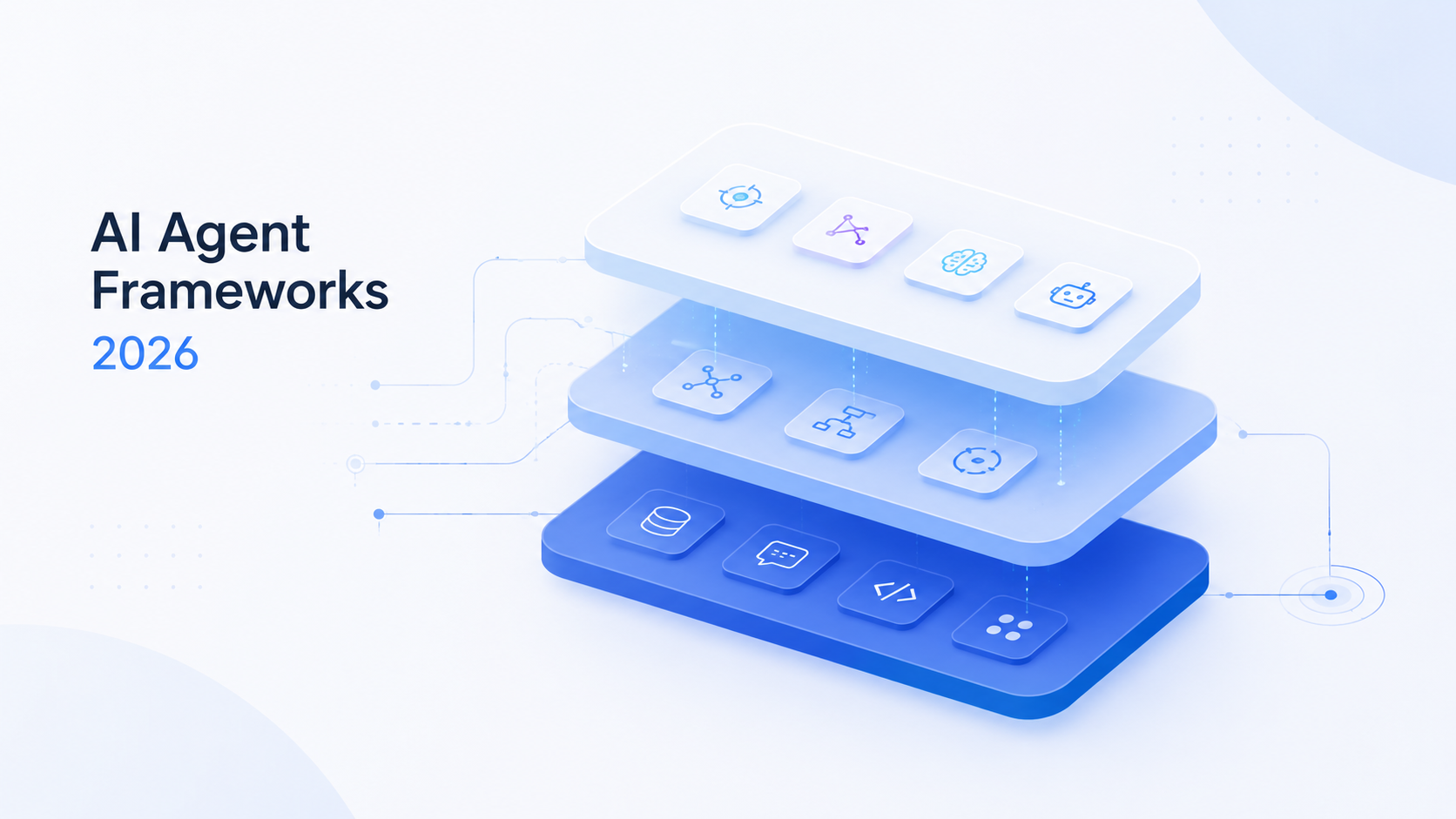

The best AI agent frameworks in 2026 split across three layers: vendor SDKs (Claude Agent SDK, OpenAI Agents SDK, Google ADK) for tight model integration; orchestration frameworks (LangGraph 1.0, Microsoft Agent Framework 1.0, CrewAI, Pydantic AI v1) for multi-step graphs and durable execution; and specialised approaches (smolagents for code-action agents, Mastra for TypeScript). LangGraph leads enterprise production after its October 2025 GA, Microsoft Agent Framework 1.0 (April 2026) has merged AutoGen into maintenance mode, and Pydantic AI’s type-safe v1 has become the cleanest path for teams that want minimal abstraction. Pick the framework that matches your orchestration shape, not your favourite vendor — production agents typically combine a vendor SDK inside an orchestration framework.
What is an AI agent framework?
An AI agent framework is the software glue between an LLM and the world it acts on. It gives you four things you would otherwise build by hand: a control loop that decides when to call the model and when to call a tool; state and memory that survive across turns; tool integration with retries, validation, and structured outputs; and observability for traces, evaluations, and human-in-the-loop checkpoints. Without a framework you write the same 200–500 lines of plumbing for every project.
In 2026 the landscape splits into three functional layers, and confusing them is the main reason teams pick a framework that fights their architecture.
- Layer 1 — Vendor SDKs: tight wrappers around a single model provider’s API. Claude Agent SDK, OpenAI Agents SDK, Google ADK. Best when one provider covers the whole product surface and you want native features (sandboxing, hosted tools, voice, computer use) without abstraction tax.
- Layer 2 — Orchestration frameworks: model-agnostic state graphs and multi-agent topologies. LangGraph 1.0, Microsoft Agent Framework 1.0, CrewAI, Pydantic AI v1. Best when you need durable execution, audit trails, multi-vendor portability, or human-in-the-loop checkpoints.
- Layer 3 — Specialised approaches: opinionated bets on a particular agent paradigm. smolagents (code-action agents that emit Python instead of JSON tool calls) and Mastra (TypeScript-first observability-native framework). Best when the specialisation matches your stack better than a general orchestrator does.
The non-obvious detail: most production agents in 2026 use both layers 1 and 2. You wrap a vendor SDK call in a LangGraph node, or you call anthropic.messages.create from inside a Pydantic AI agent. Frameworks are not mutually exclusive — they sit at different abstraction altitudes.
This article is the fourth spoke of the DTF AI Agents cluster. For the foundational picture see What is an AI Agent? Complete Guide for 2026; for how the agent itself is wired together, AI Agent Architecture Explained; for orchestration patterns, Multi-Agent Systems Explained; and for evaluation, AI Agent Benchmarks 2026.
The 9 AI agent frameworks compared (May 2026)
Hundreds of frameworks claim “agent” branding. Nine are credible enough to pick from for a new project this year — either because they have crossed the v1 / GA line, because they ship with a frontier vendor’s brand behind them, or because they fill a gap none of the others do. Everything else is either a wrapper around these nine or too narrow for general production.
| Framework | Layer | Language | v1 / GA | GitHub stars (May 2026) | Sweet spot |
|---|---|---|---|---|---|
| LangGraph | Orchestration | Python, TypeScript | v1.0 · Oct 2025 | ~24k (fastest growth) | Durable production graphs, audit trails |
| Microsoft Agent Framework | Orchestration | Python, .NET | v1.0 · 3 Apr 2026 | ~27k (with SK + AutoGen merge) | Enterprise .NET / Python, Magentic-One |
| CrewAI | Orchestration | Python | v0.x · production-used | ~44k (largest) | Role-based crews, fast prototyping |
| Pydantic AI | Orchestration | Python | v1.0 · Sep 2025 | ~15k | Type-safe agents, structured outputs |
| Claude Agent SDK | Vendor SDK | Python, TypeScript | GA · rolling | Bundled with Claude Code | Coding / OS agents, deepest MCP |
| OpenAI Agents SDK | Vendor SDK | Python, TypeScript | v1 + harness Apr 2026 | ~19k | Handoffs, hosted tools, sandboxes |
| Google ADK | Vendor SDK + A2A | Python, Java | v1 · rolling | ~17k | Cross-vendor multi-agent over A2A |
| smolagents | Specialised | Python | v1 · production-used | ~25k | Code-action agents, ~30% fewer LLM calls |
| Mastra | Specialised | TypeScript | v1 · rolling | ~19k | TypeScript-first, OpenTelemetry-native |
Microsoft has merged AutoGen and Semantic Kernel into the new Microsoft Agent Framework 1.0 (released 3 April 2026). AutoGen continues to receive bug fixes and critical security patches, but no new features. Do not start new projects in AutoGen — pick MAF for the .NET / Python parity, the AutoGen-derived patterns (group chat, Magentic-One), and the supported migration path. AutoGen tutorials still rank well in search; check the publication date before following one.
Layer 1 — Vendor SDKs: when one provider covers the surface
Vendor SDKs are the right starting point when (a) you have already committed to a single provider for the production surface, (b) you want native access to features that have no portable equivalent (Claude’s computer use, OpenAI’s hosted code interpreter, Google’s Live API), or (c) you are building a single-agent product where adding an orchestration framework would just be ceremony.
Claude Agent SDK — hooks, subagents, deepest MCP
The Claude Agent SDK (renamed in 2025 from “Claude Code SDK”) centres on two primitives: hooks, which intercept agent behaviour at lifecycle points (before tool calls, after responses, on errors), and subagents, child agents with their own context window and tool set that the parent dispatches to and aggregates results from. It ships with eight built-in tools — Read, Write, Edit, Bash, Glob, Grep, WebSearch, WebFetch — the same primitives that Claude Code uses, and supports MCP for everything else. The MCP integration is the deepest of any framework on this list because Anthropic authored the protocol; community MCP servers (Postgres, GitHub, Linear, Slack, Sentry, Notion) work out of the box.
Where Claude Agent SDK shines: developer assistants, coding agents, and any product that follows the “give the agent a computer” paradigm. Where it gets cramped: multi-vendor stacks — if you want to call GPT-5.5 and Gemini 3 alongside Claude, you will end up with a Claude Agent SDK plus another orchestration layer rather than using the SDK across all three.
OpenAI Agents SDK — handoffs, harness, native sandboxes
The OpenAI Agents SDK launched in March 2025 with one strong abstraction: the handoff. Each agent declares a list of other agents it can transfer control to; the SDK records every handoff for replay and tracing. In April 2026 OpenAI shipped a major upgrade introducing a Codex-style harness (the same scaffolding that powers Codex), with file operations, code execution, shell access, and resume bookkeeping for long-running agents. The same release added native sandboxing against seven providers: E2B, Modal, Cloudflare, Daytona, Runloop, Vercel, and Blaxel.
Where OpenAI Agents SDK shines: voice agents, agents that need hosted tools (web search, file search, code interpreter), and pure OpenAI stacks where you want one-line tracing. Where it gets cramped: anything that involves swapping models across vendors mid-conversation — the abstractions assume an OpenAI-shaped runtime.
Google ADK — first cross-vendor SDK by default
Google released the Agent Development Kit in April 2025 as the first major-vendor framework that treats cross-vendor multi-agent as the default rather than an afterthought. ADK uses A2A (Agent-to-Agent) as the native protocol for agent-to-agent communication, which means an ADK agent can hand work to a non-Google agent (LangGraph, MAF, CrewAI) over the wire without a custom adapter. With the December 2025 Linux Foundation Agentic AI Foundation launch, A2A and MCP both became vendor-neutral.
Where Google ADK shines: enterprise multi-agent estates that span vendors (Anthropic for reasoning, Google for retrieval, OpenAI for voice). Where it gets cramped: small projects where the A2A overhead is more wiring than the problem deserves.
Layer 2 — Orchestration frameworks: where production agents live
Orchestration frameworks are model-agnostic. They give you a graph or a state machine to describe the agent’s control flow, plus persistence, retries, observability, and human-in-the-loop checkpoints. In 2026 four are credible enough to start a new production project on.
LangGraph 1.0 — the new enterprise default
LangGraph reached v1.0 in October 2025 after more than a year of iteration and adoption by Uber, LinkedIn, and Klarna. The core abstraction is a state graph: nodes are functions that read and write a typed state object; edges are conditional branches. The headline 1.0 feature is durable execution: state is checkpointed at every node, so if your server restarts mid-workflow — or a long-running approval pauses for a week — the agent picks up exactly where it left off without reprocessing previous steps.
from langgraph.graph import StateGraph, END
from langgraph.checkpoint.postgres import PostgresSaver
from typing_extensions import TypedDict
import anthropic  # Claude Agent SDK lives inside a node

class State(TypedDict):
    messages: list
    next_agent: str

def supervisor(state: State) -> State:
    # routes to research / coder / reviewer based on state
    state["next_agent"] = decide_next(state["messages"])
    return state

def coder(state: State) -> State:
    client = anthropic.Anthropic()
    reply = client.messages.create(
        model="claude-opus-4-7",
        max_tokens=4096,
        messages=state["messages"],
    )
    state["messages"].append({"role": "assistant", "content": reply.content})
    return state

graph = StateGraph(State)
graph.add_node("supervisor", supervisor)
graph.add_node("coder", coder)
graph.add_conditional_edges("supervisor", lambda s: s["next_agent"])
graph.add_edge("coder", "supervisor")
graph.set_entry_point("supervisor")

# Postgres-backed checkpointer = durable execution
app = graph.compile(checkpointer=PostgresSaver.from_conn_string("postgresql://..."))
Where LangGraph shines: long-running production agents (multi-day approvals, background research jobs), audit-heavy domains (finance, healthcare, legal), and teams that need interrupt() as their human-in-the-loop primitive — which doubles as the canonical implementation of EU AI Act Article 14 oversight requirements. Where it gets cramped: 50-line scripts where a state graph is overkill.
Microsoft Agent Framework 1.0 — AutoGen + Semantic Kernel, unified
Microsoft shipped Agent Framework 1.0 GA on 3 April 2026 — the production-ready convergence of AutoGen and Semantic Kernel. The single SDK now offers what AutoGen had (simple agent abstractions, conversational multi-agent, group chat) plus what Semantic Kernel had (session-based state, type safety, middleware, telemetry, .NET parity). MAF supports five orchestration patterns out of the box: sequential, concurrent, handoff, group chat, and Magentic-One — the manager / planner pattern from Microsoft Research’s original Magentic-One paper. MCP and A2A are both first-class.
The Magentic pattern deserves a sentence: a manager agent analyses the task, drafts a plan, optionally pauses for human review, selects the right specialist agent for each subtask, monitors progress, and re-plans on stalls. It is closer to a project-management workflow than the supervisor pattern in LangGraph, and it is the most opinionated multi-agent topology shipping with any framework right now.
Where MAF shines: enterprise stacks with .NET production code, teams migrating from AutoGen or Semantic Kernel, organisations that want one of the five patterns built in rather than coded by hand. Where it gets cramped: pure Python startups already invested in LangGraph or Pydantic AI — switching costs are real.
CrewAI — role-based crews, fastest prototyping
CrewAI sits at the highest abstraction level on this list. You declare agents with a role, a goal, and a backstory; you declare tasks with a description and an expected output; you assemble them into a crew that runs sequentially (Process.sequential) or hierarchically with a manager LLM (Process.hierarchical). The framework handles the wiring. CrewAI teams claim idea-to-production in under a week, and the abstraction is genuinely designed to minimise setup cost.
The numbers: ~44k GitHub stars (largest of any agent framework), and CrewAI cites use by 60%+ of Fortune 500 companies. The growth has slowed relative to LangGraph in early 2026 because enterprise teams have moved toward graph-based audit trails, but CrewAI remains the dominant choice for content generation, research workflows, and analysis crews where role-play simulation is the natural fit.
Where CrewAI shines: rapid prototyping, content / research crews, teams that prefer declarative role descriptions over imperative graphs. Where it gets cramped: tightly-controlled production graphs with rollback semantics, anything where the role-play abstraction obscures the actual control flow you need.
Pydantic AI v1 — type-safe agents, minimal abstraction tax
Pydantic AI hit v1.0 in September 2025 and is currently on v1.93.0 (May 2026), with v2 promised no earlier than April 2026 plus six months of v1 security maintenance after that. Built by the same team that maintains Pydantic itself, the framework treats type safety not as overhead but as the design principle: every agent input, output, tool parameter, and dependency is validated at the type level. Logfire — the team’s OpenTelemetry-based observability platform — is the natural production companion, with built-in features for visualising LLM conversations, tool calls, token usage, and cost.
Pydantic AI added graph support in 2025 for durable, async, multi-agent workflows that preserve state across failures. It is the cleanest framework on this list for teams that want minimal “magic” — the runtime feels like writing typed Python rather than learning a new DSL. The 15k stars under-represent its enterprise adoption: Pydantic itself is among the top 10 most-downloaded Python packages, so trust in the maintainer brand is unusually high.
Where Pydantic AI shines: production agents with strict typed contracts, teams that need to swap LLM providers without rewriting business logic, anything where the type system itself is part of your reliability story. Where it gets cramped: low-effort prototypes where typing every parameter feels like friction.
Layer 3 — Specialised approaches: when paradigm matters more than generality
smolagents — code-action agents from Hugging Face
smolagents is built on a contrarian bet: instead of having the LLM emit a JSON tool call for the framework to execute, the LLM writes a small Python snippet that the framework runs in a sandbox. The Hugging Face team’s measurements show this code-action approach reduces total LLM calls and steps by roughly 30% on complex benchmarks compared to JSON tool-calling, because the model can compose multiple tool calls inside a single Python expression.
The framework’s other selling point is its size: about 1,000 lines of agent logic in the core. That makes it easy to read, fork, and reason about, which is rare in this category. smolagents supports any LLM through LiteLLM (OpenAI, Anthropic, Hugging Face Hub, local Ollama with Qwen Coder or DeepSeek), so it is a natural fit for teams that want to run frontier models in production but local models in development.
Where smolagents shines: research workflows, agents that compose many small tool calls, teams that value reading the framework source. Where it gets cramped: production audit requirements (the generated Python is harder to log structurally than discrete JSON tool calls), and any environment where executing model-generated code is a security risk you cannot sandbox away.
Mastra — the TypeScript-first framework
Mastra fills a gap most Python-centric agent frameworks leave open: a TypeScript-native runtime with first-class workflows, memory, RAG, and OpenTelemetry tracing. ~19k stars in early 2026 and growing. Mastra ships agents, deterministic workflows, knowledge bases, and evals as primitives; observability is OpenTelemetry-native rather than bolted on.
Where Mastra shines: full-stack TypeScript / Next.js teams, products where the agent ships in the same Vercel / Cloudflare deployment as the web app, anything where moving to Python just for the agent layer is a non-starter. Where it gets cramped: research-heavy workflows where the Python ecosystem (LangChain integrations, ML libraries, academic snippets) carries more weight than the language.
How to pick: a 6-scenario decision matrix
Most “which framework should I use?” guides give you a tier list. A tier list is misleading because the right answer depends on what you are shipping. The matrix below maps six common scenarios to the framework most teams converge on after one or two false starts.
| If you are building… | Best framework (May 2026) | Why |
|---|---|---|
| A coding / OS-control agent | Claude Agent SDK | 8 built-in tools, deepest MCP, hooks for safety, subagents for delegation |
| A long-running production graph (multi-day approvals, audits) | LangGraph 1.0 | Durable execution, interrupt(), Postgres checkpointer, EU AI Act-friendly |
| A .NET enterprise stack | Microsoft Agent Framework 1.0 | Only credible cross-runtime option for .NET shops, AutoGen migration path |
| A type-safe agent inside a Python service | Pydantic AI v1 | Minimal abstraction tax, Logfire observability, multi-vendor by default |
| A role-based research / content crew | CrewAI | Highest abstraction, declarative role + task model, fastest prototype-to-prod |
| A TypeScript / Next.js agent in the same deployment as your web app | Mastra | Native TypeScript, OpenTelemetry-first, no Python dependency |
Production agents in 2026 typically use both a vendor SDK and an orchestration framework. You wrap a Anthropic.messages.create call inside a LangGraph node; you call the OpenAI Agents SDK from a Pydantic AI tool; you use the Claude Agent SDK as the runtime for a Magentic-One specialist inside Microsoft Agent Framework. The decision tree is not “which one?” — it is “which orchestration shape do I need, and which vendor’s native features must I keep access to?”
How each framework implements EU AI Act Article 14 (human oversight)
The EU AI Act in force since August 2024 makes human oversight a deployer obligation under Article 14 for high-risk AI systems — including most agent deployments that touch credit scoring, biometric ID, employment, or critical infrastructure (Annex III). For framework selection in regulated sectors this is not optional. Each framework on this list maps to Article 14 differently:
- LangGraph 1.0:
interrupt()in any node pauses the graph and persists state via the checkpointer; a human resumes the graph withCommand(resume=...). The canonical reference implementation. - Microsoft Agent Framework 1.0: all five orchestration patterns support pause / resume and human-in-the-loop approvals out of the box. Magentic-One additionally supports a “plan review” checkpoint before execution starts.
- CrewAI: human input as a tool is the typical pattern;
Process.hierarchicalwith a manager that delegates approval to a human user-proxy agent. - Pydantic AI v1: graph nodes can yield to the calling code, which then awaits human input before resuming — a typed-Python expression of the same pattern.
- Claude Agent SDK:
permission_mode="askForApproval"on tool definitions, plus hooks before tool calls. Subagent dispatch can require confirmation per call. - OpenAI Agents SDK: the April 2026 harness added approvals and pause / resume as first-class primitives alongside tracing.
- Google ADK: A2A’s task lifecycle includes an
input-requiredstate that maps directly to “wait for human” without custom plumbing. - smolagents: sandboxed code execution with explicit step-by-step approval; smaller surface, less ceremony.
- Mastra: workflow steps can pause and emit events; human review is wired through the same observability layer as everything else.
The convergence is real: every credible framework now treats human oversight as a primitive rather than something the user implements. That is the direct effect of Article 14 enforcement starting February 2026 (high-risk obligations begin August 2026). If a framework you are evaluating does not have this primitive, that is a yellow flag for any high-risk deployment in the EU.
Migration cost: which frameworks are easiest to leave?
Switching framework after the first six months is more painful than the original choice was wide. The cost is not the lines of code — it is the implicit assumptions baked into your agent’s behaviour by the framework’s prompt scaffolding, retry semantics, and tool-call format. A rough ranking from easiest to hardest to migrate away from:
- Pydantic AI — easiest. Type-safe contracts and minimal magic mean the business logic is portable; you mostly rewrite the runtime adapter.
- OpenAI / Claude / Google SDKs — medium. Vendor-specific features (handoffs, hooks, A2A) need replacements; tool definitions usually port cleanly.
- LangGraph 1.0 — medium. The state graph is portable in concept; checkpointer + interrupt semantics need bespoke ports to other frameworks.
- Microsoft Agent Framework / CrewAI — medium-hard. Pattern-specific scaffolding (Magentic-One, hierarchical crews) does not map 1:1 onto other frameworks — you usually redesign the topology.
- smolagents — hardest. Code-action agents encode behaviour in generated Python; the agent’s “muscle memory” lives in the prompt and example traces, neither of which is portable.
5 mistakes when picking an AI agent framework in 2026
The same mistakes show up across teams that started with one framework and re-platformed within a year. Five worth naming explicitly:
- Picking by GitHub stars. CrewAI has the most stars, LangGraph has the highest enterprise momentum, and Pydantic AI has the strongest maintainer brand — star count alone tells you almost nothing about fit. The multi-agent benchmark numbers are a better signal.
- Treating vendor SDKs as alternatives to orchestration frameworks. They are different layers. Claude Agent SDK + LangGraph is a real combination; Claude Agent SDK vs LangGraph is the wrong frame.
- Starting a new project in AutoGen. AutoGen entered maintenance mode in April 2026. Use Microsoft Agent Framework 1.0 instead — it has the same patterns, an actual roadmap, and a supported migration path.
- Building multi-agent before single-agent is squeezed dry. The Wu et al. 2026 single-agent paper shows single agents matching or beating multi-agent systems on equal token budgets for many task classes. Pick a framework that lets you start single and scale to multi when the data justifies it.
- Underestimating observability. Tracing, evaluations, and replay are the difference between an agent you can debug and one you cannot. Pydantic AI + Logfire and Mastra + OpenTelemetry both treat this as primary; the others get there with LangSmith / Langfuse / Helicone / Arize / Datadog. Whichever you pick, wire it on day one, not month six.
Personal note: how DTF’s own agent stack is wired
DTF’s article-production agent is deliberately one notch simpler than the architectures in this article would suggest. The runtime is the Claude Agent SDK with a single orchestrator call — no LangGraph, no CrewAI — because the article-writing loop genuinely is single-agent: read the brief, read the related sources/ file, draft the HTML, run a deterministic verifier (a 200-line Python script, scripts/check_seo.py), patch the failures, ship. The verifier is the most important component in the stack. It catches what the model misses (meta description over 160 chars, missing div.dtf-bibliography wrapper, hreflang format violations) and gives the agent a tight feedback loop that no leaderboard score can substitute for.
The one place the stack does become multi-agent is the research brief that feeds each article: a sequential three-agent pass (search → deduplicate → cite-check) implemented as Claude Agent SDK subagents. That maps onto LangGraph’s supervisor pattern conceptually, but the volume (one brief per article, ~2 articles per week) does not justify the orchestration framework’s overhead. If the cadence ever climbs to ~50 articles per week, LangGraph 1.0 with Postgres checkpointing is the obvious next step — precisely because at that volume an interrupted run is no longer something I can manually replay.
That decision tree — “which orchestration shape, and at what volume does the framework pay for itself?” — is the actually useful question. The framework names are downstream of it.
What changes by 2027
Three structural shifts to watch over the next 12–18 months will reshape this list:
- Agent Communication Protocol (ACP) standardisation. A2A and MCP both donated to the Linux Foundation in late 2025 are the first generation of vendor-neutral primitives. By 2027 expect a third primitive — either an “agent identity” standard (signed agent cards) or a “task receipt” standard (deterministic proofs of agent action) — that the EU AI Act enforcement record creates demand for.
- Runtime convergence. The five biggest orchestration frameworks all converged on the same human-in-the-loop primitive (pause / resume with checkpointer) in the last 18 months. The next convergence is likely on the cost-aware Pareto primitive — routing decisions that account for tokens spent and not just success rate. LangGraph and MAF will probably ship this first.
- Code-action versus tool-call. If smolagents’ 30% efficiency claim holds across larger benchmarks, expect either LangGraph or Pydantic AI to ship a code-action mode by 2027 as an alternative to JSON tool-calling. The pattern is too good to leave to one framework.
None of this changes the May 2026 recommendation. Pick LangGraph 1.0 for production graphs, Microsoft Agent Framework 1.0 for .NET, Pydantic AI v1 for typed Python, the relevant vendor SDK for tight integration, smolagents for code-actions, Mastra for TypeScript — and combine them where it makes sense.
FAQ
What is the best AI agent framework in 2026?
There is no single best framework — the right answer depends on the orchestration shape you need. LangGraph 1.0 is the new enterprise default for production graphs (Uber, LinkedIn, Klarna), Microsoft Agent Framework 1.0 is the safe pick for .NET stacks after merging AutoGen and Semantic Kernel in April 2026, Pydantic AI v1 is the cleanest choice for type-safe Python, CrewAI is the fastest path to a working role-based crew, and smolagents wins on efficiency for code-action workflows. Vendor SDKs (Claude, OpenAI, Google) often sit inside one of these orchestration frameworks rather than competing with them.
Should I use LangGraph or CrewAI in 2026?
Use LangGraph 1.0 for long-running production agents, audit trails, durable execution that survives server restarts, and EU AI Act Article 14 human-in-the-loop checkpoints — it is the de facto enterprise default after the October 2025 GA. Use CrewAI for fast prototyping, role-based crews (research, content, analysis), and teams that prefer declarative role descriptions over imperative graphs. CrewAI still has more GitHub stars (~44k vs ~24k), but LangGraph has surpassed it in growth rate and enterprise adoption since early 2026.
Is AutoGen still alive in 2026?
AutoGen is in maintenance mode as of April 2026. Microsoft merged AutoGen and Semantic Kernel into the new Microsoft Agent Framework 1.0, which shipped GA on 3 April 2026. AutoGen continues to receive bug fixes and critical security patches, but no new features. Microsoft positions Agent Framework as the successor for new agent-development work. Migration tooling is documented in the Agent Framework release blog — do not start new projects in AutoGen.
What is the difference between an AI agent framework and a vendor SDK?
A vendor SDK (Claude Agent SDK, OpenAI Agents SDK, Google ADK) is a tight wrapper around one provider’s API; it gives you native access to that vendor’s features (computer use, hosted code interpreter, A2A) without abstraction tax but locks you to the vendor. An agent framework (LangGraph, CrewAI, Pydantic AI, MAF) is model-agnostic and gives you a graph or state machine to describe control flow, plus persistence, retries, observability, and human-in-the-loop checkpoints. Production agents in 2026 typically use both — vendor SDK calls live inside framework nodes.
Is Pydantic AI production-ready?
Yes. Pydantic AI hit v1.0 in September 2025 with a public API stability commitment and is currently on v1.93.0 (May 2026). v2 will release no earlier than April 2026, with at least six months of v1 security maintenance after that. The framework is built by the same team that maintains Pydantic itself (top-10 most-downloaded Python package), and the Logfire observability platform integrates natively. Best fit for type-safe production agents and teams that want minimal abstraction tax.
What is Magentic-One in Microsoft Agent Framework?
Magentic-One is an opinionated multi-agent orchestration pattern from Microsoft Research, now shipped as one of five built-in patterns in Microsoft Agent Framework 1.0. A manager agent analyses the task, drafts a plan, optionally pauses for human review, selects the right specialist agent for each subtask, monitors progress, detects stalls, and re-plans when needed. It is closer to a project-management workflow than the supervisor pattern in LangGraph, and it is the most opinionated multi-agent topology shipping with any framework right now — designed for complex open-ended tasks that require dynamic collaboration.
Why are smolagents 30% more efficient than JSON tool-calling agents?
smolagents uses code-action agents: instead of the LLM emitting a JSON tool call for the framework to execute, the LLM writes a small Python snippet that the framework runs in a sandbox. The Hugging Face team’s measurements show this reduces total LLM calls and steps by roughly 30% on complex benchmarks because the model can compose multiple tool calls inside a single Python expression — one LLM call replaces what would otherwise be a chain of three or four tool-call rounds. Trade-off: generated Python is harder to log structurally than discrete JSON tool calls, so audit-heavy deployments need extra observability work.
Bibliography & further reading
- LangChain — LangGraph 1.0 is now generally available (changelog, October 2025). changelog.langchain.com
- LangChain — Durable execution (LangGraph docs). docs.langchain.com
- LangChain AI — LangGraph (GitHub). github.com/langchain-ai/langgraph
- Microsoft Agent Framework team — Microsoft Agent Framework Version 1.0 (3 April 2026). devblogs.microsoft.com
- Microsoft Learn — Microsoft Agent Framework Overview. learn.microsoft.com
- Microsoft — Migrate your Semantic Kernel and AutoGen projects to Microsoft Agent Framework. devblogs.microsoft.com
- Microsoft Learn — Magentic orchestration pattern. learn.microsoft.com
- CrewAI — Crews documentation. docs.crewai.com
- Pydantic — Pydantic AI v1: A Predictable & Robust GenAI Framework (September 2025). pydantic.dev
- Pydantic AI — Version policy. ai.pydantic.dev
- Pydantic — Logfire AI observability. pydantic.dev/logfire
- Anthropic — Claude Agent SDK documentation. docs.anthropic.com
- OpenAI — New tools for building agents (Agents SDK) (March 2025). openai.com
- OpenAI — Agents Python SDK documentation. openai.github.io
- Google Developers — A2A: A new era of agent interoperability (April 2025). developers.googleblog.com
- Google — Agent Development Kit (ADK) documentation. google.github.io/adk-docs
- Hugging Face — Introducing smolagents: simple agents that write actions in code. huggingface.co/blog/smolagents
- Hugging Face — smolagents (GitHub). github.com/huggingface/smolagents
- Mastra — Official documentation. mastra.ai
- Linux Foundation — Agentic AI Foundation launch (December 2025). linuxfoundation.org
- Anthropic — Building Effective Agents (engineering blog). anthropic.com
- Wu et al. — Single-Agent LLMs Outperform Multi-Agent Systems Under Equal Token Budgets (arXiv 2026). arxiv.org/abs/2604.02460
- EU AI Act — Regulation (EU) 2024/1689, Articles 13, 14, 26. eur-lex.europa.eu
- OWASP — Top 10 for LLM Applications (2025). genai.owasp.org
- OpenTelemetry — GenAI semantic conventions. opentelemetry.io