
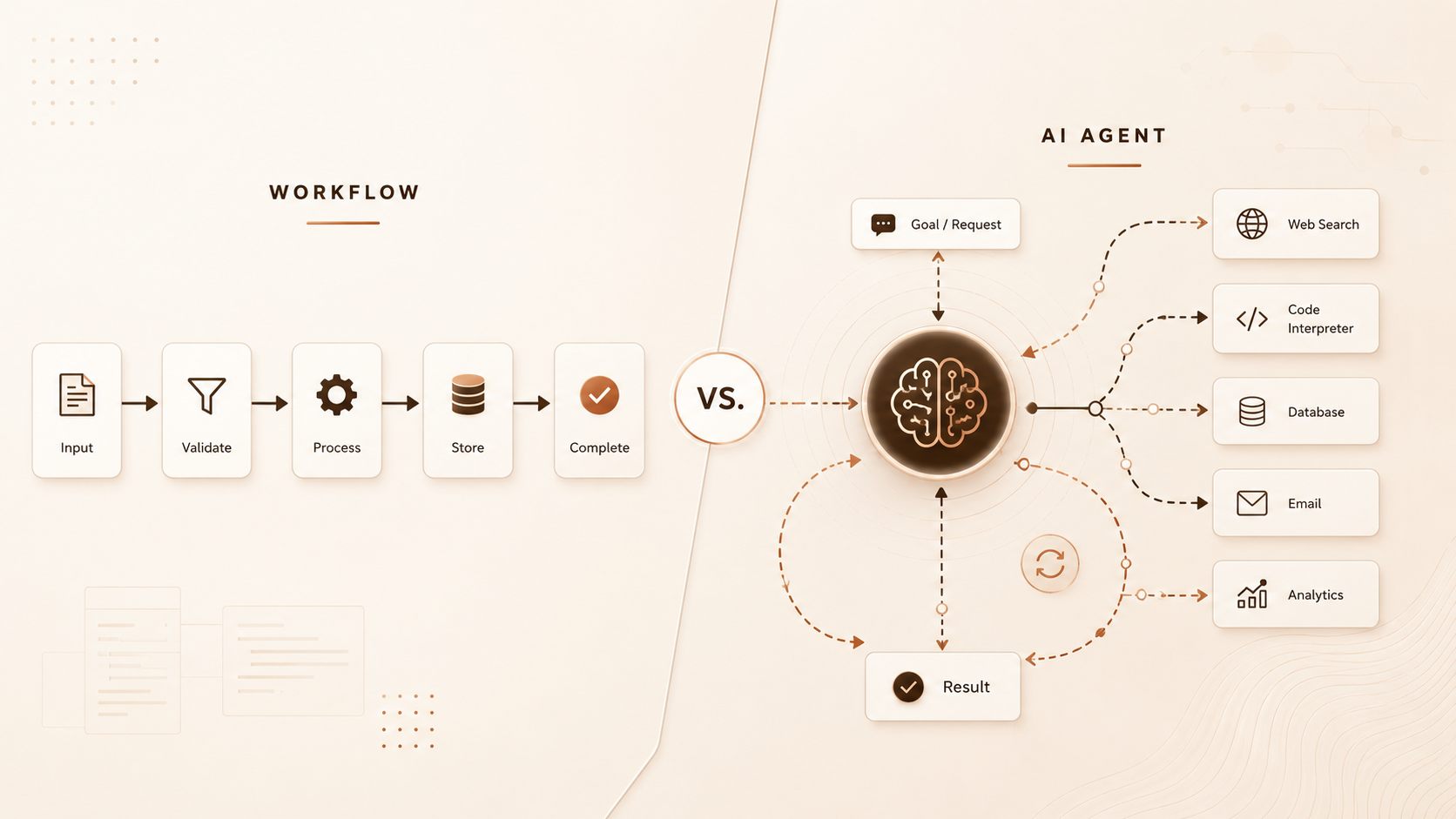

An agentic workflow is a system where a developer wrote the graph and the LLM fills in the nodes; an AI agent is a system where the LLM draws the next edge of the graph at runtime. That is the only test that survives contact with a production codebase. In 2026 the agent-shaped systems that ship are usually workflow with one agentic node embedded inside it — predictable on the outside, adaptive at the one decision point that actually needs it. The wrong choice is expensive: Gartner expects over 40% of agentic AI projects to be canceled by 2027, and its stated risk factors — escalating cost, unclear business value, and inadequate controls — hit hardest when control flow is left open-ended.
The one-line test: who draws the next edge of the graph?
Every useful definition of “agentic workflow vs AI agent” collapses to a single question. When the system needs to decide what step comes next, who decides — the developer (in code, before runtime) or the language model (at runtime, from the current state)? If the developer decided, you have a workflow. If the model decided, you have an agent. Everything else — planning, tool use, reflection, memory — sits on top of that one axis.
The framing comes from Anthropic’s December 2024 engineering essay Building Effective Agents, which has become one of the clearest reference points in production agent design. Anthropic defined workflows as “systems where LLMs and tools are orchestrated through predefined code paths” and agents as “systems where LLMs dynamically direct their own processes and tool usage, maintaining control over how they accomplish tasks.” Microsoft, OpenAI, LangChain, and Google ADK adopted compatible definitions over the following eighteen months. The convergence is now strong enough that engineering teams in 2026 can use the words without footnotes — provided everyone in the room agrees on which axis they are on.
For background on the agent side of the line, see our What is an AI Agent? Complete Guide for 2026 and the architectural deep dive in AI Agent Architecture Explained. For the workflow side — including the five canonical patterns — start with the hub article Agentic Workflows Explained. This article is the disambiguation page that sits between them.
Four terms that mean different things: workflow, agentic workflow, AI agent, agentic AI
The terminology is messier than it should be because vendors and analysts have used the words inconsistently since 2023. The U.S. Center for Strategic and International Studies warned in January 2026 that the definitional ambiguity is now serious enough to undermine procurement and governance frameworks — agencies that buy “agentic capabilities” without operational specs end up with vastly different systems under the same label (CSIS, Lost in Definition). Here are the four labels you will see in 2026 and what each one actually means.
| Term | What it means | LLM role | Who controls flow |
|---|---|---|---|
| AI workflow (non-agentic) | Deterministic pipeline; LLM is one transform among many. | Generates text in a fixed slot. | Developer (code). |
| Agentic workflow | Developer-defined graph; nodes are LLM calls with tools, retries, gates. | Reasons inside each node; sometimes routes between nodes. | Developer (graph), with model-driven branches at named decision nodes. |
| AI agent | System where an LLM dynamically picks tools and next actions until a stop condition. | Drives the control loop. | Model (at runtime). |
| Agentic AI (multi-agent) | Umbrella for systems composed of multiple agents and/or workflows coordinating toward a goal. | Multiple LLMs in supervisor / worker / peer roles. | Mixed — usually a supervisor agent on top of bounded workers. |
The most common confusion is collapsing “AI agent” and “agentic AI” into the same word. They are different scales of the same idea: a single agent is one autonomous decision loop; agentic AI typically means a system of agents and workflows, often with a supervisor on top. For the multi-agent layer specifically, see Multi-Agent Systems Explained. The second most common confusion is collapsing “AI workflow” and “agentic workflow” — a plain ETL pipeline that calls GPT-4 at one step is not agentic; agentic means the LLM has some control over branching, retries, or tool selection inside the graph.
How major vendors define the line (convergent, finally)
By Q2 2026 the major frameworks publish nearly compatible definitions. The differences below are mostly cosmetic; the substance is the same axis.
| Source | Workflow definition | Agent definition |
|---|---|---|
| Anthropic (Building Effective Agents, Dec 2024) | LLMs and tools orchestrated through predefined code paths. | LLMs dynamically direct their own processes and tool usage. |
| LangChain (Workflows and agents, LangGraph docs, 2026) | Graph with developer-defined nodes and edges; predictable execution. | Single node that loops over tool calls until the model emits stop. |
| OpenAI (Agents SDK docs, 2025–26) | Composition of tools, guardrails, and handoffs that the developer chains. | Model with instructions and tools that decides next action each turn. |
| Microsoft (Agent Framework 1.0, Apr 2026) | Process Framework: typed steps, parallelism, durable state. | Magentic-One and ChatAgent: planner drives multi-step loop. |
| Google (Agent Development Kit, 2025) | SequentialAgent / ParallelAgent: deterministic composition. | LlmAgent with tool use; A2A peers exchange messages until done. |
The strongest practical implication of this convergence is that the words now travel across stacks. A team that designed an evaluator-optimizer workflow in LangGraph can describe it to a Microsoft Agent Framework team in 2026 and expect the same mental model. That was not true twelve months earlier.
Side by side: the same task as a workflow and as an agent
Abstract definitions only get you halfway. The clearest way to feel the trade-off is to write the same task in both shapes. We will use a small, realistic one: given a pull request diff, decide whether to merge it. The job has a known shape (read diff, run lint, run tests, summarise risks, decide) but enough variability (some PRs need security review, some touch infra, some are docs only) that an “agent” framing is tempting.
Shape A — Agentic workflow (LangGraph, routing + chaining)
from langgraph.graph import StateGraph, END
from typing import TypedDict, Literal

class PRState(TypedDict):
    diff: str
    kind: Literal["docs", "code", "infra"]
    lint_ok: bool
    tests_ok: bool
    risks: list[str]
    decision: Literal["merge", "request_changes", "block"]

def classify(state: PRState) -> PRState:
    # one LLM call: routes the PR by kind
    state["kind"] = llm_classify(state["diff"])
    return state

def run_lint(state: PRState) -> PRState:
    state["lint_ok"] = lint_passes(state["diff"])
    return state

def run_tests(state: PRState) -> PRState:
    state["tests_ok"] = tests_pass(state["diff"])
    return state

def summarise_risks(state: PRState) -> PRState:
    # one LLM call: structured output, 3-5 bullets
    state["risks"] = llm_risks(state["diff"], state["kind"])
    return state

def decide(state: PRState) -> PRState:
    # one LLM call with strict JSON schema
    state["decision"] = llm_decide(state)
    return state

graph = StateGraph(PRState)
graph.add_node("classify", classify)
graph.add_node("lint", run_lint)
graph.add_node("tests", run_tests)
graph.add_node("risks", summarise_risks)
graph.add_node("decide", decide)

graph.set_entry_point("classify")
graph.add_conditional_edges(
    "classify",
    lambda s: "docs_path" if s["kind"] == "docs" else "code_path",
    {"docs_path": "risks", "code_path": "lint"},
)
graph.add_edge("lint", "tests")
graph.add_edge("tests", "risks")
graph.add_edge("risks", "decide")
graph.add_edge("decide", END)
app = graph.compile()
Five nodes, four LLM calls in the worst case, three in the docs-only case. The graph is a flowchart: any reviewer can read it. Token cost is bounded because each call has a fixed prompt budget. On Claude Sonnet 4.6 at typical sizes this runs in roughly 8–15 seconds end-to-end and costs around $0.04–$0.07 per PR. If any node fails, you retry that node, not the whole task.
Shape B — AI agent (Claude Agent SDK, tool loop)
from anthropic import Anthropic

client = Anthropic()
tools = [lint_tool, tests_tool, search_tool, security_scan_tool, read_file_tool]

def review_pr_agent(diff: str) -> dict:
    messages = [{"role": "user",
                 "content": f"Decide whether to merge this PR.\n\nDiff:\n{diff}"}]
    while True:
        resp = client.messages.create(
            model="claude-sonnet-4-6",
            max_tokens=4096,
            tools=tools,
            messages=messages,
        )
        if resp.stop_reason == "end_turn":
            return parse_decision(resp.content)
        if resp.stop_reason == "tool_use":
            tool_results = run_tools(resp.content)
            messages.append({"role": "assistant", "content": resp.content})
            messages.append({"role": "user", "content": tool_results})
            continue
        if len(messages) > 30:           # safety cap
            return {"decision": "request_changes",
                    "reason": "agent_loop_exceeded"}
One loop. The model picks which tools to call in which order. It might call lint_tool first, then realise the diff touches infra and run security_scan_tool twice, then read three files for context. On the same PRs as above this typically runs 25–90 seconds end-to-end, makes 6–14 model turns, and costs $0.18–$0.55 per PR — roughly 4–8× the workflow. Sometimes the agent finds a bug the workflow would have missed because it chose to read an adjacent file. Sometimes it loops on a flaky test and burns $2 before the safety cap kicks in. Auditing what it did requires reading the transcript, not a graph.
The agent is not “smarter” — it has access to the same model. What it has is freedom over control flow. That freedom buys adaptability to surprises (the bug the workflow missed) and costs predictability (the $2 flaky-test loop). The right choice depends on whether the surprises are worth the unpredictability, which is mostly an economic question, not a technical one.
The decision tree: which shape should you ship?
The tree above is the short form. The longer form is the eight-dimension matrix in the next section, which is the one you should use when comparing two designs in a real architecture review.
Eight-dimension decision matrix
| Dimension | Pick workflow when… | Pick agent when… |
|---|---|---|
| Predictability | Same input shape should follow the same path. | Path can legitimately vary with input. |
| Latency budget | Tight P95 (under 10–15s). | Long-horizon allowed (30s–minutes). |
| Token budget | Fixed cost per task is a requirement. | Variable cost is acceptable; outcome matters more. |
| Observability | You need a flowchart-style trace. | Transcript-level trace is enough. |
| Auditability | Regulator or auditor will read it. | Internal use, low audit pressure. |
| Reversibility of actions | Some actions are irreversible (money, prod writes, legal). | All actions are sandboxed / reversible. |
| Failure cost | One bad decision is expensive. | Errors are cheap, retries are free. |
| Novelty of inputs | You have seen most input shapes before. | Inputs are open-ended; you cannot enumerate them. |
A useful sanity check: if four or more rows point to workflow, default to workflow and pay the adaptability cost. If four or more point to agent, the system probably needs an agent — but check that the dimensions pointing to workflow are not the regulated ones (auditability, reversibility, failure cost), because those are the rows that get a system canceled in compliance review.
The hybrid pattern: workflow on the outside, agent on the inside
Almost no shipping system in 2026 is “pure” workflow or “pure” agent. The dominant pattern is a workflow shell with one or two agentic nodes inside it — usually at the step where a graph cannot be enumerated. Anthropic, LangChain, and Microsoft all describe variants of this pattern in their official guidance; LangChain’s docs name it directly in their Workflows and Agents guide. The shape looks like this in LangGraph:
from langgraph.graph import StateGraph, END
from langgraph.prebuilt import create_react_agent

# Inner agent: bounded tool loop for the one open-ended sub-task
investigate = create_react_agent(
    model="claude-sonnet-4-6",
    tools=[read_file, grep_repo, run_query],
    prompt="You investigate the root cause of a failing test. "
           "Return a structured report. Stop within 8 tool calls.",
)

def fetch(state):   return {"diff": fetch_diff(state["pr_id"])}
def lint(state):    return {"lint_ok": lint_passes(state["diff"])}
def tests(state):   return {"tests_ok": tests_pass(state["diff"])}

def investigate_node(state):
    # Only invoked when tests fail; bounded subagent decides next steps.
    report = investigate.invoke({"messages": [{"role": "user",
                "content": f"Tests failed on diff:\n{state['diff']}"}]})
    return {"investigation": report}

def decide(state):  return {"decision": llm_decide(state)}

g = StateGraph(dict)
g.add_node("fetch", fetch)
g.add_node("lint", lint)
g.add_node("tests", tests)
g.add_node("investigate", investigate_node)
g.add_node("decide", decide)

g.set_entry_point("fetch")
g.add_edge("fetch", "lint")
g.add_edge("lint", "tests")
g.add_conditional_edges("tests",
    lambda s: "investigate" if not s["tests_ok"] else "decide",
    {"investigate": "investigate", "decide": "decide"})
g.add_edge("investigate", "decide")
g.add_edge("decide", END)
app = g.compile()
The outer graph is a workflow: an auditor can read it. The inner investigate node is an agent — it gets a bounded tool budget and freedom to pick which file to read in which order, because investigating a failed test is genuinely open-ended. Token cost is dominated by the agent node when it fires, but capped because the agent itself has an explicit eight-call ceiling. Latency on the happy path (tests pass) is workflow-shaped; on the unhappy path the agent burns extra seconds where they are actually useful. This is the practical reason the hybrid pattern keeps showing up in production: the workflow gives you the rails, the agent gives you local adaptability, and the budget cap prevents the adaptive part from becoming the whole system.
Identify the one or two steps in your graph that you genuinely cannot enumerate. Make those nodes agents. Make every other node a deterministic function with at most one LLM call inside. Bound the agent nodes with a hard tool-call cap and a max-tokens stop. You now have most of the adaptability of an agent and most of the predictability of a workflow.
Cost and reliability math: why workflows are winning production
The decision is not aesthetic. Cost and reliability compound in different directions for the two shapes, and the math reliably favours workflows at scale. The two effects are token explosion (agents spend more per task because the loop is unbounded) and compound reliability decay (every additional step multiplies the failure probability).
Token explosion
An agent with five tools that takes an average of eight model turns to finish a task with 1.5k tokens of system prompt is consuming roughly 12k input tokens before tool results, plus whatever the tool results add. A workflow with five LLM nodes at 1.5k tokens of prompt each consumes 7.5k input tokens deterministically. On 100k tasks per month at typical Sonnet 4.6 pricing, the difference is in the thousands of dollars — and the agent’s per-task cost is variance-heavy: the 95th percentile can be 5–10× the median because the loop sometimes drags out.
Compound reliability
If each step in a chain succeeds with probability p, an n-step chain succeeds with probability pn. The numbers below show why everyone in 2026 caps the unbounded part of the system.
| Per-step success | 3 steps | 5 steps | 10 steps | 20 steps |
|---|---|---|---|---|
| 99% | 97% | 95% | 90% | 82% |
| 95% | 86% | 77% | 60% | 36% |
| 90% | 73% | 59% | 35% | 12% |
| 80% | 51% | 33% | 11% | 1% |
A workflow keeps n small and bounded by construction. An agent’s n is whatever the model decides, which in production traces commonly lands at 8–15. The numbers above are why Gartner’s mid-2025 forecast that over 40% of agentic AI projects will be canceled by 2027 is easier to understand as an architecture problem than as a model-quality problem. Digital Applied’s 2026 industry analysis reports that fewer than one in eight agent initiatives reaches production at all, with scope creep and data-quality issues accounting for roughly 61% of failures — both of which compound worse the longer the loop.
EU AI Act Article 14: different burden, same intent
For many high-risk AI systems placed on or used in the EU from 2 August 2026, Article 14 of the EU AI Act (Regulation 2024/1689) requires that the system be designed so natural persons can effectively oversee it while it is in use. The timeline has exceptions — including longer transition periods for some high-risk systems embedded in regulated products — but the oversight requirement is the right design target now. The intent is the same regardless of architecture, but the burden lands in different places.
| Article 14 requirement | Workflow implementation | Agent implementation |
|---|---|---|
| Human can intervene / interrupt | Add HITL gate at named nodes in the graph. | Must implement runtime interrupt with full agent state checkpoint. |
| Human can interpret output | Trace is a graph — reads like a flowchart. | Trace is a transcript — must engineer summarisation for humans. |
| Detection of anomalous behaviour | Per-node metrics; outlier detection on known dimensions. | Requires distribution monitoring of action sequences; harder. |
| Awareness of automation bias | UX shows graph status; humans see structure. | UX risks “trust the agent” failure mode without active design. |
| Stop the system | Disable graph or block at gate. | Need a tested kill-switch path that survives mid-loop. |
The practical implication: in regulated domains the cost of meeting Article 14 with an agent is real engineering work, not a checkbox. With a workflow the cost is mostly already paid by the graph itself. This is one of the reasons every major framework in 2026 ships first-class human-in-the-loop primitives at the graph layer — LangGraph’s interrupt(), Microsoft Agent Framework’s pause-resume, and Pydantic AI’s requires_approval / ApprovalRequired pattern. For the broader regulated-finance application of this idea, see our Agentic Workflows in Finance.
The procurement trap: what “agentic” hides on a vendor data sheet
Most enterprise buyers in 2026 are reading vendor materials that use “agentic” without operational specs. CSIS’s January 2026 governance brief warned that this is a real failure mode: “When procurement documents request ‘agentic capabilities’ without operational specifications, vendors can satisfy requirements in name while delivering vastly different systems.” The same vendor might be selling a fixed RAG pipeline with one tool call, a five-node LangGraph workflow, or a Magentic-One multi-agent system. All three could be labeled “agentic platform” with a straight face.
If you are buying, the following five questions move the conversation from marketing to architecture.
- Who draws the next edge in your system — the developer or the model? Both is acceptable; “we don’t think about it that way” is not.
- What is the bound on tool calls and model turns per task? A vendor who cannot answer in seconds has not measured it.
- Show me a trace from a production task. If the trace is a graph, you have a workflow. If it is a transcript, you have an agent. Decide whether that matches your need.
- What is your Article 14 oversight design? “Logs in CloudWatch” is not an oversight design.
- What is the failure mode when the model loops? Looping is the dominant agent failure mode; the answer should mention budgets, caps, or supervision.
If a vendor describes the system in purely behavioural language (“the AI figures out what to do”) and refuses to commit to a control-flow description, you cannot price the failure modes. The most expensive procurement mistakes in 2026 are not the agent systems that fail; they are the workflow systems that were sold as agents and over-bought as agents.
When to graduate from workflow to agent
The healthiest production trajectory is to start with a workflow, then upgrade specific nodes to agents only when you can name a reason. Four conditions justify the upgrade.
- The graph has grown beyond what a reader can hold in their head. When you find yourself adding the fifteenth conditional edge to handle yet another input variant, the variability has outgrown the workflow form. A bounded agent node is cheaper than ten more branches.
- The branch space is genuinely open. If you can enumerate the next steps, write them as code. If you genuinely cannot — debugging an unfamiliar codebase, answering a research question with unknown follow-ups — the agent shape is honest about that.
- Latency cost of fixed graphs exceeds adaptability cost. If your workflow always runs every node “just in case” and most tasks waste 60% of the work, an agent that skips irrelevant tools amortises its own overhead.
- You have invested in observability and evals. Agents are only safe in production when you have an eval harness, OpenTelemetry GenAI traces, cost guardrails, and a tested kill-switch. Without that, an agent is a $2-per-task time bomb.
And four conditions that should make you go back to the workflow.
- The agent’s 95th-percentile cost is more than 3× its median (variance is winning).
- Production traces show the same tool-call sequence repeating across most runs — if it is repeating, you can encode it.
- You cannot explain a single decision to a regulator without reading the transcript.
- Each new edge case adds an instruction to the system prompt instead of a node to the graph.
Personal note: how I run this at DecodeTheFuture
DTF Brain — the system that produces these articles — is a textbook workflow with one agentic node. The outer graph fetches the queue, picks a topic, runs a sources lookup, writes the draft, validates against check_seo.py, updates the sources file, and logs the result. Every one of those edges is in code I wrote. The one inside-the-node decision that I let the model make is “what is the information gain angle vs the current SERP top 10” — because I cannot enumerate it ahead of time, and getting it wrong is the difference between an article that ranks and one that does not. That is one agentic decision inside a workflow of about twenty deterministic edges, which is roughly the ratio I see in every shipping system I respect.
The lesson generalises. The mistake I made in 2024 was building an “AI agent” that wrote DTF articles end-to-end. It worked one day in three. The workflow with one agent node works every day. Same model, same tools, ten times the reliability and a third of the cost per article. If you are trying to ship something useful, do that.
What changes by 2027
Three shifts on the horizon will make this decision sharper, not blurrier.
- Standardised agent protocols. The Linux Foundation’s December 2025 Agentic AI Foundation and Google’s A2A protocol are converging on portable interfaces for tools, agent instructions, and agent-to-agent communication. Full workflow-graph portability is still emerging, but moving from “LangGraph workflow” to “MAF workflow” should become less of a rewrite by mid-2027.
- Cost-aware routing primitives. Frameworks will increasingly expose a per-node budget primitive, making the workflow/agent boundary a budgeted continuum rather than a binary choice. The migration path described above will get a runtime flag.
- Article 14 templates. As the EU AI Act’s high-risk obligations phase in from 2 August 2026, expect framework vendors to ship human-oversight templates that work most naturally for the workflow shape and require explicit configuration for the agent shape.
None of those shifts changes the underlying decision: it is still “who draws the next edge.” But the cost of getting it wrong drops, which means more teams will move from “agent everywhere” through “workflow with one agent” to a more deliberate mix per use case. That is the trajectory worth planning against.
FAQ
Are agentic workflows and AI agents the same thing?
No. An agentic workflow is a graph the developer wrote, where an LLM fills in some nodes. An AI agent is a loop the LLM controls, where the model picks the next action. Anthropic’s December 2024 essay Building Effective Agents introduced the distinction precisely; LangChain, Microsoft, OpenAI, and Google have since converged on compatible definitions.
Which is better — an agentic workflow or an AI agent?
Neither in the abstract. Workflows win on predictability, cost, and auditability; agents win on adaptability to inputs you cannot enumerate. In 2026 most production systems use a hybrid — a workflow on the outside with one or two agentic nodes for the parts that genuinely cannot be enumerated.
Is agentic AI the same as an AI agent?
Not quite. An AI agent is usually a single autonomous decision loop. “Agentic AI” is an umbrella term that often refers to multi-agent systems — several agents and workflows coordinating, typically with a supervisor on top. For the multi-agent layer specifically, see our companion article Multi-Agent Systems Explained.
How much more expensive is an AI agent than an agentic workflow?
On comparable tasks, agents commonly cost 4–8× more per task because the model loop is unbounded. Latency is also higher (30s–minutes vs under 15s for workflows) and the 95th-percentile cost can be 5–10× the median due to loops that the model fails to terminate. Putting a hard tool-call cap on the agent narrows the variance significantly.
Can a workflow contain an agent (or vice versa)?
Yes, and this is the dominant production pattern in 2026. A LangGraph workflow can include a node that is itself a tool-using agent with a bounded loop. The outer graph stays auditable; the inner agent gets local freedom where the problem genuinely needs it. Microsoft Agent Framework and Pydantic AI support similar nesting.
Does the EU AI Act treat workflows and agents differently?
Article 14 of the EU AI Act applies the same human-oversight intent to both, but the engineering burden is different. A workflow’s graph already provides the checkpoints Article 14 expects. An agent must implement runtime interrupts, state checkpointing, and human-readable trace summarisation explicitly. In regulated finance, healthcare, and HR contexts this often tips the architecture decision toward workflows or hybrids.
When should I graduate from a workflow to an agent?
When the branch space is genuinely open (you cannot enumerate the next steps), when the graph has grown beyond what a reader can hold in their head, when fixed graphs waste most of their work on irrelevant nodes, and when you have an eval harness and observability in place. Without those, an agent is more expensive than the problem it solves.
Sources prioritise primary framework documentation (Anthropic, LangChain, Microsoft, OpenAI, Google), the EU AI Act primary text, and independent research. Vendor performance figures are vendor-reported unless independently audited. Links accessed May 2026.
Bibliography (19 sources)
- Anthropic. Building Effective Agents (Dec 2024) — the canonical definition of workflow vs agent.
- LangChain. Workflows and agents, LangGraph documentation (2026) — vendor articulation of the same distinction with code primitives.
- LangChain. LangChain and LangGraph Agent Frameworks Reach v1.0 Milestones (Oct 2025) — durable execution, typed state, supervisor patterns.
- Microsoft. Microsoft Agent Framework Version 1.0 (Apr 2026) — Process Framework + Magentic agent patterns.
- OpenAI. OpenAI Agents SDK (Python docs) (2025–26) — agent loop, tools, handoffs.
- Google. Agent Development Kit (ADK) documentation (2025) — SequentialAgent / ParallelAgent / LlmAgent.
- European Union. Regulation (EU) 2024/1689 (EU AI Act) — Article 14 human oversight, primary text.
- European Commission. Regulatory framework for AI (2026) — timeline and high-risk obligations entry into force.
- Gartner. Press release: over 40% of agentic AI projects will be canceled by end of 2027 (Jun 2025).
- CSIS. Lost in Definition: How Confusion over Agentic AI Risks Undermining U.S. Governance Frameworks (Jan 2026) — definitional ambiguity, procurement implications.
- Linux Foundation. Formation of the Agentic AI Foundation (Dec 2025) — vendor-neutral protocols and projects including MCP, goose, and AGENTS.md.
- Anthropic. Claude Agent SDK documentation (2025–26) — tool loop primitives, sub-agents.
- Anthropic. Introducing Claude Sonnet 4.6 (Feb 2026) — model availability, context window, and public pricing reference.
- Pydantic. Pydantic AI documentation (2026) — human-in-the-loop tool approval and type-safe agent design.
- OpenTelemetry. Generative AI semantic conventions (2025–26) — standard for agent trace observability.
- OWASP. OWASP Top 10 for LLM Applications (2025) — agent-specific risks (LLM-06, LLM-08).
- Digital Applied. Why 88% of AI Agents Fail Production: Analysis Guide (2026) — industry analysis of pre-production failure patterns.
- Capital One Tech. AI agents vs. predefined workflows: practical decision guide (2026) — enterprise decision framing.
- arXiv. Bandara, E. et al. A Practical Guide for Designing, Developing, and Deploying Production-Grade Agentic AI Workflows (Dec 2025) — academic taxonomy of patterns.