

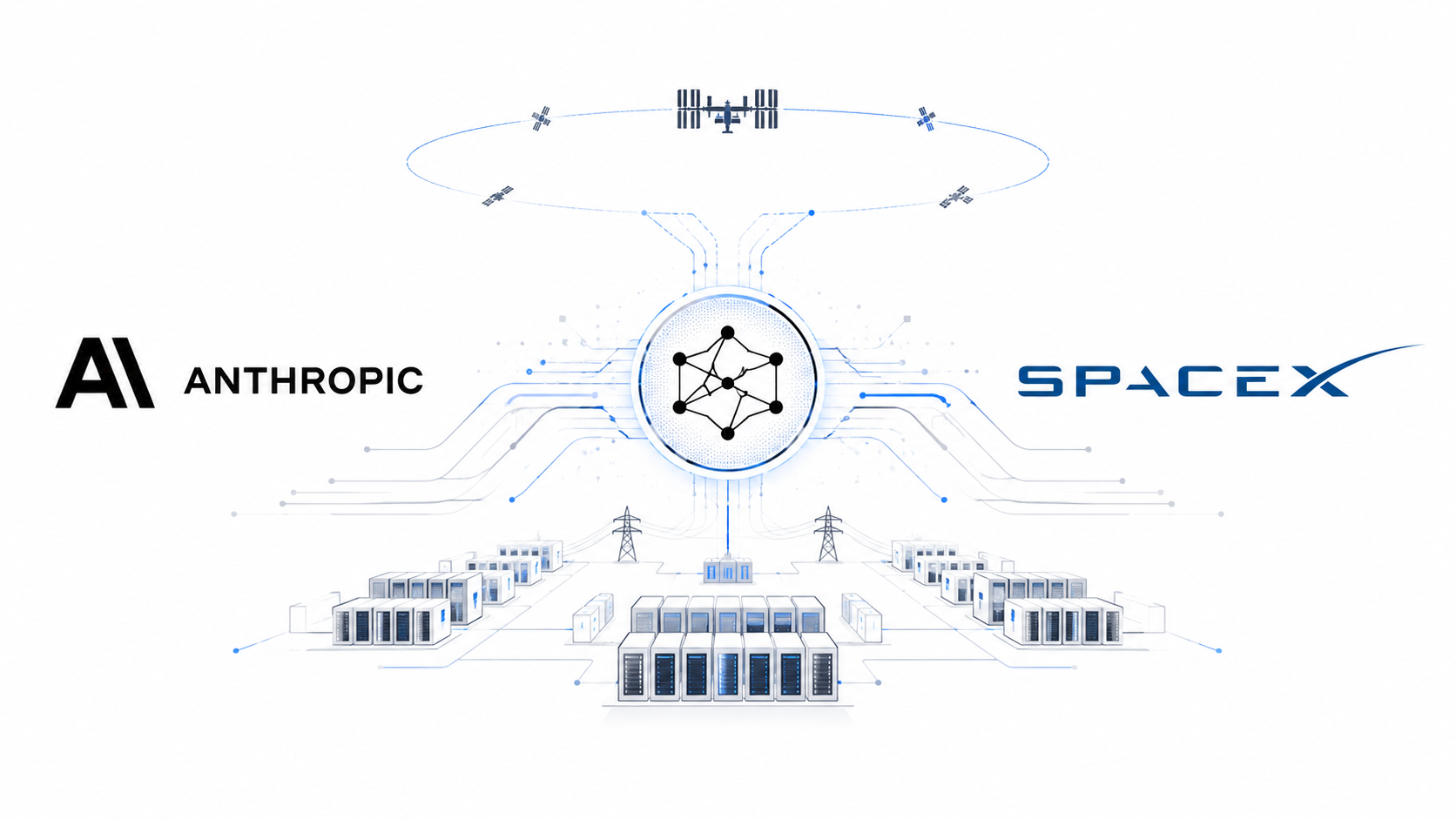

Anthropic announced today, May 6, 2026, that it is doubling Claude Code’s five-hour rate limits for Pro, Max, Team, and seat-based Enterprise plans, removing the peak-hours reduction, and substantially raising API rate limits for Claude Opus models. The capacity behind it: a new partnership giving Anthropic access to more than 300 megawatts at SpaceX’s Colossus 1 data center, equivalent to over 220,000 Nvidia GPUs within the month. Anthropic also flagged interest in multi-gigawatt orbital AI compute with SpaceX as a longer-term direction.
What Anthropic announced today
The official announcement, posted on anthropic.com/news/higher-limits-spacex on May 6, 2026, contains three concrete changes effective immediately and one strategic flag for the medium term.
1. Claude Code rate limits doubled. The five-hour usage windows that gate how much work a Pro, Max, Team, or seat-based Enterprise account can run through Claude Code are now twice their previous size. For heavy users running long agentic loops — multi-file refactors, end-to-end test runs, large code reviews — this is the single largest practical change to the product since the introduction of skills.
2. Peak-hours reduction removed. The previous policy throttled Pro and Max accounts during peak demand windows. That throttle is gone. The visible effect is fewer “rate limited” interruptions during US-business-hours bursts.
3. API rate limits raised for Claude Opus. Anthropic referenced an accompanying table of increases tied to the Opus 4.7 family on the API. The substantive claim: room for considerably higher concurrent agentic workloads on the most capable model tier without bumping into rate caps.
4. SpaceX Colossus 1 partnership announced. Anthropic now has access to “more than 300 megawatts of new capacity (over 220,000 Nvidia GPUs) within the month” through SpaceX’s Colossus 1 data center. The company also “expressed interest in partnering with SpaceX to develop multiple gigawatts of orbital AI compute capacity” as a forward-looking direction.
Two years ago, the binding constraint on AI model quality was talent. One year ago, it shifted to algorithmic ideas (post-training, reasoning). In 2026 the binding constraint is electrical power and GPU supply. Today’s announcement reads like Anthropic loosening that constraint, then immediately handing the headroom back to users. It’s the cleanest signal yet that capacity is no longer the bottleneck for paying Claude customers in mid-2026.
What changes for Claude users — concretely
If you are a paying Claude customer, the practical impact lands in three places.
Claude Code (Pro, Max, Team, Enterprise)
The five-hour usage budget that previously gated agentic work is doubled. For DTF’s own production workflow — Claude Code runs the editorial agent that drafts every article, including this one — this means roughly 2× more agent loops per session before the rate-limit message appears. Long-horizon refactors and multi-step builds that previously required splitting across two billing windows now fit in one. The peak-hours reduction is also gone, so the practical UX during US business hours improves materially.
API users on Claude Opus 4.7
Higher rate limits mean teams running production agents on Opus 4.7 — research assistants, document-processing pipelines, multi-agent stacks — can crank up concurrency without renegotiating limits with Anthropic sales. The exact ceiling depends on tier; check the developer console for your specific cap.
Free tier users (no immediate change announced)
The announcement targets paid plans. Free-tier users at claude.ai were not mentioned and should not assume changes apply. The headline pricing on the API has not changed in this announcement either; the unchanged variable is per-token cost. What moved is throughput.
The SpaceX angle — why this is the most interesting part
The compute partnership is more interesting than the rate-limit changes for what it signals about the AI infrastructure landscape in 2026.
The numbers: 300+ megawatts, 220,000+ Nvidia GPUs, available within a month. For context, that single deal supplies roughly the entire compute footprint that brought GPT-4 to market in 2023. It is about 15% the size of Anthropic’s full Amazon agreement (up to 5 GW), comparable to the early phase of the Google + Broadcom 5 GW agreement, and arrives faster than either. “Within the month” is the unusual phrase — most multi-hundred-megawatt agreements measure delivery in years.
The vehicle is also unusual. SpaceX is not a hyperscaler. It is a launch-services and satellite-broadband company that, as of this announcement, is operating data-center capacity at a scale comparable to top-tier cloud providers. Colossus 1 is the name; the announcement attributes it to SpaceX. (For careful readers: the same name has historically been associated with xAI’s Memphis facility, which is a separate Musk-owned company. Whether the SpaceX-attributed Colossus 1 is a different facility, a renamed asset, or a shared infrastructure relationship between SpaceX and xAI is not detailed in Anthropic’s announcement, and is one of the open questions this story raises.)
The forward-looking line — “multiple gigawatts of orbital AI compute capacity” with SpaceX — is the one that journalists will lead with for weeks. Orbital data centers are an old idea (low ambient temperatures, abundant solar, no real-estate constraints), and the constraints have been launch cost, radiation hardening, and downlink bandwidth. SpaceX, with Starship reaching cadence and Starlink as the largest broadband satellite operator, is the only Western counterparty currently positioned to attempt the launch-and-power side of that problem at scale. Anthropic flagging interest is not a build commitment; it is a directional signal that orbital compute is now part of frontier-lab strategic conversation.
Where this fits in Anthropic’s broader compute build-out
Today’s announcement is part of a sustained 2025–2026 push by Anthropic to secure long-dated power and GPU capacity ahead of demand. The full stack as of May 2026:
| Partner | Scale | Timeline | Type |
|---|---|---|---|
| Amazon (AWS, Trainium) | Up to 5 GW | ~1 GW by end of 2026; balance over multi-year | Hyperscaler partnership + custom silicon |
| Google + Broadcom (TPU) | 5 GW | Rollout begins 2027 | TPU-based capacity (see our coverage of the original deal) |
| Microsoft Azure + Nvidia | ~$30B Azure capacity commitment | Multi-year | Hyperscaler GPU capacity |
| Fluidstack (US) | ~$50B American infrastructure investment | Multi-year | Domestic GPU build-out |
| SpaceX (today’s announcement) | 300+ MW · 220k+ GPUs | Within the month | Near-term capacity + forward orbital interest |
Two patterns stand out. First, Anthropic is no longer single-vendor. Where competitors have historically anchored on a single hyperscaler (OpenAI–Microsoft, Google’s first-party stack), Anthropic’s compute supply now spans Amazon, Google, Microsoft, Fluidstack, and now SpaceX. The diversification reduces concentration risk and gives negotiating leverage on every renewal.
Second, the timeline shape changed. The Amazon and Google deals are long-dated build-outs measured in years. The SpaceX agreement is measured in weeks. That gap suggests Anthropic was facing genuine near-term capacity pressure — likely from Claude Code’s growth and from enterprise deployment of Claude Opus 4.7 — and needed something hyperscalers could not deliver fast enough.
What this means for the AI model race
Three reads of today’s news, all defensible.
Read 1: Anthropic is buying capacity to keep pace with OpenAI. OpenAI has reportedly committed to multi-hundred-billion-dollar Stargate-scale infrastructure with Oracle and SoftBank. To stay competitive on serving frontier models like Claude Opus 4.7, Anthropic needs power on the same order. The SpaceX deal closes a near-term gap.
Read 2: Anthropic is preparing for Claude Opus 5. A doubling of Claude Code limits plus higher Opus API rates plus 300 MW of new capacity is consistent with the company being ready to ship a more capable, more compute-hungry model later in 2026. Treat today’s announcement as a pre-positioning move.
Read 3: The compute landscape is consolidating around dual-use infrastructure. Hyperscalers, frontier labs, sovereign infrastructure, and now launch-and-satellite operators all run intersecting GPU fleets. Over the rest of 2026 expect more deals like this one — non-traditional counterparties (defense, energy, infrastructure) supplying frontier-lab compute as the demand outruns hyperscaler delivery cadence.
For a deeper take on Anthropic’s strategic positioning over the past 18 months, see our coverage of Anthropic’s advisor strategy and the Anthropic–Google TPU deal.
Risks and open questions
Five things to watch.
- The Colossus 1 attribution. Anthropic attributes Colossus 1 to SpaceX. The same brand has been associated with xAI’s Memphis facility. Whether this is a renamed or relabeled asset, a separate SpaceX-built facility, or an infrastructure-sharing arrangement across the Musk-controlled corporate group is not addressed in the announcement and is the most legitimate ambiguity in the news.
- Power-grid impact. 300 MW of GPU draw landing within a month is significant for whatever local grid hosts the facility. Expect local-utility regulatory questions and possibly community pushback similar to what Memphis, Northern Virginia, and Phoenix have already experienced around AI data centers.
- Concentration despite diversification. Anthropic’s compute supply now includes Amazon, Google, Microsoft, Fluidstack, and SpaceX — but two of those (xAI/SpaceX and Microsoft/OpenAI) sit inside corporate groups that also fund or own Anthropic competitors. Compute-supply ties to competitor investors is a structural feature of the AI economy, not unique to Anthropic, but worth tracking.
- Orbital compute as roadmap vs marketing. “Multiple gigawatts of orbital AI compute” is the headline-friendly part of the announcement. It is also the part with no committed timeline. Treat it as research direction, not deployment plan.
- EU data-residency exposure. Anthropic’s compute build-out is heavily US-based (Amazon, Google, Microsoft, Fluidstack, SpaceX). Enterprise customers under EU AI Act Annex III high-risk obligations or GDPR-strict data residency will continue to use Bedrock EU regions, Vertex AI Frankfurt, or Azure EU — which run Anthropic’s models on hyperscaler EU infrastructure rather than on the new US capacity.
Personal note: what this means for DTF Brain workflow
This site is built and shipped through Claude Code. The dtf-article skill — a markdown specification that encodes DTF’s editorial standards — drives every English and Polish article on the site, including this news-jacking piece you are reading. Five-hour rate limits are a real daily constraint when shipping 4–6 articles per day across three editors. Doubling them is not a marketing improvement; it is an actual capacity unlock for our 30-day content sprint that started this week.
If you are a paying Claude Code user running similar agentic workloads — long refactors, large eval suites, multi-agent research stacks — your effective output capacity per dollar moved up notably today. If you have been holding off on a Pro or Max upgrade because of rate-limit anxiety, the math is meaningfully different than it was 24 hours ago.
For a broader review of how Claude Code compares with other agentic coding tools right now, see our 2026 review of AI coding assistants. For the architectural framing of why this kind of capacity matters for long-running tasks, see our hub guide on AI agents.
What’s next — what to watch through May 2026
Three concrete watch-fors over the next four weeks.
First, actual delivery cadence. “Within the month” is a strong claim. Independent verification — through Claude Code latency improvements, third-party benchmarking, satellite imagery of the SpaceX-attributed facility — will land in trade press over May.
Second, Anthropic’s product roadmap signals. Capacity moves usually precede capability moves. If Claude Sonnet 4.7 or an Opus 5 announcement lands in the May–June window, today’s news was the pre-positioning move. If not, this was about catching up to existing demand.
Third, regulatory response. The EU AI Office has been signaling tighter scrutiny of frontier-lab compute under the GPAI obligations of the AI Act (Articles 51–55). Expect questions about transparency, energy reporting, and supply-chain disclosure tied to the new capacity.
For ongoing coverage of Anthropic releases, the Claude Opus 4.7 explainer, the Claude Design launch coverage, and the Claude Code free-tier overview remain the cleanest entry points to the Anthropic stack.
FAQ — Anthropic’s higher limits and SpaceX deal explained
What did Anthropic announce on May 6, 2026?
Three things. (1) Doubled five-hour rate limits on Claude Code for Pro, Max, Team, and seat-based Enterprise plans. (2) Removed peak-hours reduction on Claude Code Pro and Max. (3) Substantially raised API rate limits for Claude Opus models. Backed by a new compute partnership giving Anthropic access to more than 300 megawatts and over 220,000 Nvidia GPUs at SpaceX’s Colossus 1 data center within the month. Anthropic also expressed interest in multi-gigawatt orbital AI compute capacity with SpaceX as a longer-term direction.
How much more usage do Claude Code Pro and Max users get?
The five-hour rate-limit window is doubled. In practical terms, you can run roughly twice as many agent loops, multi-file edits, or long Composer-style sessions before hitting a rate-limit wall. The peak-hours reduction is also gone, so US business-hours UX improves further.
Is SpaceX building data centers now?
Per Anthropic’s announcement, SpaceX operates the Colossus 1 data center being used for the new capacity. The same name has historically been associated with xAI’s Memphis facility (a separate Musk-owned company). Whether the SpaceX-attributed facility is a separate asset, a renamed one, or an infrastructure-sharing arrangement across Musk-controlled entities is not detailed in Anthropic’s announcement and remains one of the open questions of this story.
What is “orbital AI compute” and is Anthropic actually launching satellites?
Orbital compute means data centers in space — using vacuum cooling, abundant solar, and no terrestrial real estate. Anthropic has expressed interest in partnering with SpaceX to develop multiple gigawatts of orbital AI compute capacity. There is no commitment, no timeline, and no announced launch plan. Treat it as a research and strategic direction, not a deployment plan.
Does this announcement change Claude API pricing?
No. The headline announcement covers rate limits (throughput) rather than per-token pricing. Standard Anthropic pricing for Opus 4.7 (~$15/$75 per 1M tokens), Sonnet 4.6 (~$3/$15), and Haiku 4.5 (~$0.80/$4) appears unchanged. What moved is how much you can run per unit of time.
How does this compare to Anthropic’s other compute deals?
Anthropic’s compute supply now spans Amazon (up to 5 GW, ~1 GW by end-2026), Google + Broadcom (5 GW from 2027), Microsoft Azure + Nvidia (~$30B commitment), Fluidstack (~$50B American infrastructure), and SpaceX (300+ MW within the month). The SpaceX deal is the smallest in raw scale but the fastest in delivery — measured in weeks rather than years.
Should I upgrade to Claude Pro or Max because of this?
If rate limits were a real bottleneck for your usage of Claude Code, the math improved materially today — roughly 2× the agentic throughput per session at the same price. If your usage was well below the previous cap, today’s announcement does not change your decision. As always, factor in the comparison with GPT-5.5, Gemini 3 Pro, and self-hosted alternatives covered in our model comparison guide.
Bibliography & sources
- Anthropic — Higher limits and SpaceX compute partnership (May 6, 2026). Primary source for all rate-limit and partnership facts.
- Anthropic — Expanding the Amazon partnership. Up-to-5-GW agreement with AWS / Trainium.
- Anthropic — Expanding use of Google Cloud TPUs. 5 GW agreement with Google + Broadcom.
- Anthropic — Microsoft, Nvidia, Anthropic strategic partnership. ~$30B Azure capacity commitment.
- Anthropic — Fluidstack American AI infrastructure investment. ~$50B domestic build-out.
- Anthropic — Claude Opus 4.7 model page. Pricing and capabilities reference.
- Anthropic — Claude Code product page. Plan structure and rate-limit framework.
- Anthropic — pricing page. Current API and consumer pricing.
- SpaceX — official site (background reference for Starship, Starlink, infrastructure).
- European Union — Regulation (EU) 2024/1689 (AI Act). GPAI obligations under Articles 51–55 relevant to compute and transparency reporting.
- European AI Office — GPAI Code of Practice. Transparency templates for frontier-model providers.
- Reuters AI infrastructure coverage — broader context for hyperscaler vs non-traditional compute supply through 2025–26.
- FT / Bloomberg — coverage of Stargate-scale OpenAI infrastructure deals (used as comparative reference for scale).
- DTF Brain — Anthropic–Google TPU deal explained. Prior coverage of the 5 GW Google + Broadcom agreement.
- DTF Brain — Anthropic advisor strategy explained. Strategic context.