

AI architecture for production is the system design that turns a model call into a reliable product: model routing, context engineering, retrieval, tools, evals, observability, security controls, human oversight, and cost governance. In 2026 the best production AI systems are not “one big prompt”; they are layered architectures where every model call has a typed contract, a trace, an evaluation target, and a fallback path. The practical rule is simple: treat the LLM as one replaceable component inside a controlled software system, not as the system itself.
What is AI architecture for production?
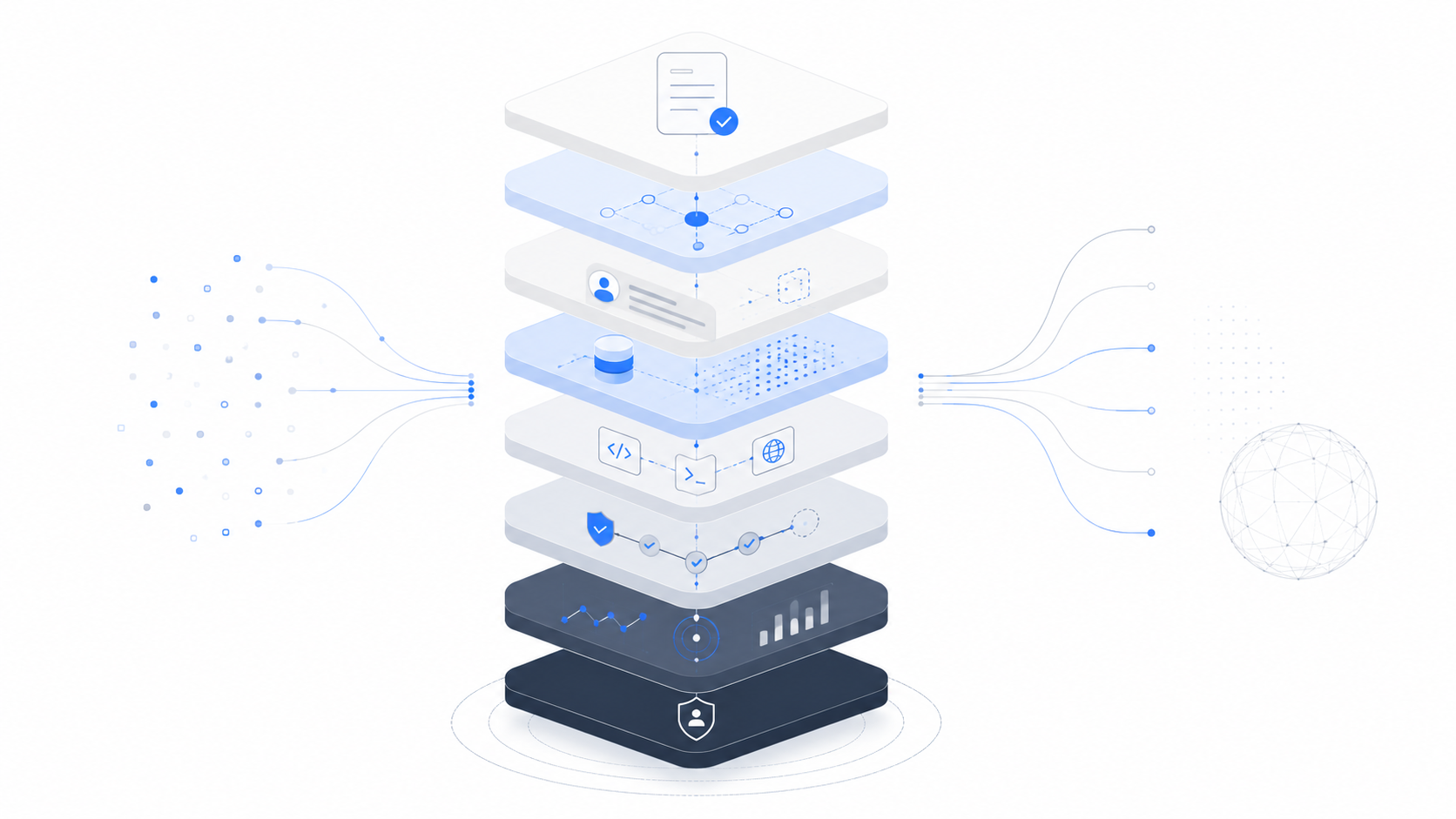
AI architecture for production is the technical structure that lets an AI feature keep working after real users, messy data, latency budgets, compliance reviews, and cost ceilings hit it. It includes the model, but it is not just the model. A production AI architecture usually contains eight layers: product contract, model routing, context and memory, retrieval, tool execution, evaluation, observability, and governance.
The phrase matters because the failure mode of most AI prototypes is architectural, not model-related. A demo can survive with one prompt and a single frontier model. A production system needs idempotent tool calls, versioned prompts, rollback, human review checkpoints, synthetic and online evals, trace sampling, PII controls, and a cost policy that does not collapse when traffic spikes. This is why strong teams talk less about “which model is best” and more about the control plane around the model.
For the agent-specific side of this stack, see AI Agent Architecture Explained, Agentic Workflows Explained, and Best AI Agent Frameworks 2026. This guide is broader: it covers the architecture pattern that applies whether you are building a support copilot, a RAG search product, a coding agent, a fraud analyst assistant, or a regulated decision-support workflow.
The highest-information-gain architecture question is not “which model should we use?” It is “where can this system be wrong, expensive, slow, non-compliant, or unobservable, and which layer owns that failure?” Production AI architecture is failure ownership made explicit.
The 8-layer production AI architecture
A durable AI system has layers that isolate change. Models can be swapped, retrieval can be re-indexed, prompts can be versioned, tools can be permissioned, and evals can be tightened without rewriting the whole product. The diagram below shows the reference stack I would use as a starting point in May 2026.
1. Product contract: define what the AI is allowed to be
The product contract is the top layer because every downstream choice depends on it. A production AI feature needs a written contract that answers five questions: what task is in scope, what output schema is accepted, what actions are allowed, what latency and cost budget apply, and what level of human review is required. Without that contract, teams keep solving architecture questions with prompts, and prompts are the weakest place to enforce product boundaries.
The most useful artifact is a one-page “AI feature spec” that looks more like an API contract than a prompt. For example: input: support_ticket, output: draft_reply, must cite: policy_doc_id, may not execute: refund, p95 latency: 6s, human gate: required above $100. This is boring software engineering, which is exactly why it works.
2. Model routing: stop treating one model as the architecture
Production systems should route work across models, not hard-code one model everywhere. The routing policy can be simple: cheap model for classification and extraction, strong model for synthesis and ambiguous decisions, fallback model when provider latency or refusal rate spikes, and cached answer when the input is repeatable. The point is not model maximalism; it is matching model cost to task risk.
This is where many “AI architecture” diagrams become too shallow. A model box is not enough. You need routing metadata: model name, version, temperature, max tokens, tool permission set, prompt version, fallback policy, retry limit, and an eval threshold that decides whether a cheap route escalates to a stronger route. The better the router, the less often you need to pay frontier-model prices for commodity work.
| Task class | Default model route | Escalate when | Architecture note |
|---|---|---|---|
| Classification | Small / mini model | Confidence below threshold or novel label | Use deterministic schema validation before accepting the class. |
| Extraction | Small model with structured output | Missing required fields, invalid JSON, low citation support | Most extraction failures are schema failures, not reasoning failures. |
| RAG synthesis | Mid-tier model | Answer lacks source coverage or conflicts with retrieved documents | Grounding quality matters more than raw model rank. |
| Planning / agent orchestration | Strong model | Plan exceeds step cap or uses forbidden tools | Keep the planner strong and the workers cheap when possible. |
| High-risk decision support | Strong model plus human gate | Always before irreversible action | Architecture should make review a state transition, not a Slack message. |
3. Context engineering: decide what the model gets to know
Context engineering is the discipline of choosing which tokens enter the model at inference time. Anthropic’s 2025 context engineering guidance frames the problem correctly: performance depends on the entire state available to the model, not just the wording of the user prompt. In production that state includes system instructions, developer policy, user input, retrieved documents, conversation history, tool results, memory, and temporary scratch context.
The hard part is not adding more context; it is removing the wrong context. Long context windows make teams lazy. If the model receives stale policy, irrelevant history, duplicated docs, and unranked search results, a larger context window simply gives it more ways to be confidently wrong. A strong architecture has a context budget per step and a packing policy: permanent instructions, task state, retrieved evidence, recent turn history, and only the memories that pass a relevance test.
For the retrieval-heavy version of this pattern, see RAG Explained and What Is Context Engineering?. The production point is that RAG is one context source, not the whole architecture.
4. Retrieval and grounding: freshness beats bigger prompts
Retrieval is the layer that keeps AI systems attached to current, local, or proprietary knowledge. A production retrieval layer needs more than a vector database. It needs source ingestion, chunking, metadata, access control, freshness policy, hybrid search, reranking, citation requirements, and a way to detect when the retrieved evidence is insufficient. If the answer requires a current regulation, a product price, or a customer record, the model should not be trusted to remember it.
The most common RAG failure is weak negative behavior. The system answers even when retrieval failed. Fix that in architecture: make “not enough evidence” a valid output, set a minimum source threshold, require citations for factual claims, and run an evaluator that checks whether the answer is supported by the retrieved passages. Hallucination reduction is mostly an evidence pipeline problem.
5. Tools and actions: every tool call needs a permission model
Tool use is where AI architecture becomes security architecture. If a model can send email, update a CRM, execute code, query production data, or issue refunds, then the model is no longer just generating text. It is operating a product surface. The tool layer must define schemas, permissions, rate limits, idempotency keys, dry-run modes, approval gates, and audit logs.
MCP matters here because it gives teams a standard host/server interface for tools, resources, and prompts. But MCP does not remove the need for authorization. A production tool should answer: who can call it, which agent can call it, what arguments are allowed, what data can it return, what side effects can it create, and how do we replay or undo the action? See What Is MCP? for the protocol layer; the architecture layer is the permission boundary around it.
Never expose a powerful tool just because the model might need it. Expose narrow task-specific tools, validate arguments with typed schemas, and require a human gate for irreversible actions. OWASP’s LLM Top 10 treats excessive agency and prompt injection as first-class application risks for a reason.
6. Evals and release gates: measure the system, not just the model
Agent and LLM evals are harder than ordinary unit tests because the output can be open-ended, multi-step, and tool-dependent. Anthropic’s 2026 eval guidance is useful because it separates simple single-turn checks from multi-turn agent evals that inspect tool calls, state changes, and final outcomes. For production architecture, the lesson is direct: every AI feature needs an eval layer before it needs another prompt rewrite.
A practical eval stack has four tiers. First, deterministic validators: schema, required fields, forbidden claims, citation presence. Second, golden-set regression: 100 to 1,000 representative cases with expected behavior. Third, model-graded evals where subjective quality matters, but only after calibrating the judge against human labels. Fourth, online monitoring: user corrections, escalation rate, route distribution, cost per successful task, refusal rate, and latency.
For benchmark methodology and why single-run scores are fragile, see AI Agent Benchmarks 2026. The production version is narrower: your evals should test your product’s failure modes, not whatever public leaderboard is fashionable this week.
7. Observability: if you cannot replay it, you cannot debug it
Traditional logs are not enough for AI systems. You need traces that preserve the run structure: user request, route decision, prompt version, model call, retrieved documents, tool calls, guardrail decisions, human approval, final output, latency, token usage, and cost. OpenTelemetry’s GenAI semantic conventions are important because they push the ecosystem toward a shared vocabulary for spans and attributes instead of every vendor inventing its own trace shape.
OpenAI’s Agents SDK documentation is a useful example of what production tracing should capture: LLM generations, tool calls, handoffs, guardrails, and custom events inside a single workflow trace. LangGraph’s durable execution docs add the missing reliability piece: if a workflow can pause, resume, and survive interruption, then traces and checkpoints become architecture primitives, not debugging extras.
{
  "workflow": "support_reply_draft",
  "prompt_version": "support-v17",
  "router_decision": "mid_model_rag",
  "model": "frontier-or-mid-tier-model",
  "retrieval_index": "policy_docs_2026_05",
  "tool_calls": ["search_policy", "draft_reply"],
  "human_gate": "required_if_refund_over_100",
  "evals": {
    "schema_valid": true,
    "citations_present": true,
    "policy_supported": true
  },
  "cost_usd": 0.018,
  "latency_ms": 4210
}
8. Governance and human oversight: compliance should be in the graph
Governance is not a PDF that appears after the system ships. For high-risk systems, the EU AI Act requires human oversight, transparency, logging, accuracy, robustness, and cybersecurity controls. Article 14 is especially architectural: humans must be able to monitor, understand, intervene, and override high-risk AI systems. That is easiest when the workflow graph has explicit review nodes and stop controls.
NIST’s AI RMF and Generative AI Profile are useful even outside the United States because they translate risk into operational categories: map, measure, manage, and govern. In practice, that means each production AI system should have a risk register, eval evidence, model and prompt versions, data lineage, incident handling, access control, and a review cadence. The architecture should make those artifacts cheap to produce; otherwise governance becomes manual theater.
Production AI architecture patterns by use case
Different products need different architecture shapes. The mistake is forcing every use case into a chatbot or every workflow into an autonomous agent. A good architecture starts from the task’s risk, repeatability, action space, and evidence requirements.
| Use case | Best architecture shape | Critical layer | Why |
|---|---|---|---|
| Internal knowledge search | RAG with citation evaluator | Retrieval and grounding | The model is secondary; source quality and freshness determine trust. |
| Customer support copilot | Workflow with draft-only output | Product contract | The system should draft and cite, not silently execute refunds or policy exceptions. |
| Codebase agent | Agentic workflow with sandboxed tools | Tools and observability | File edits, tests, and command execution require replayable traces and permission boundaries. |
| Fraud analyst assistant | Decision support with human gate | Governance and evals | False positives create customer harm; evidence and override controls are mandatory. |
| Document processing | Extraction pipeline with schema validation | Evals and routing | Most failures are invalid fields, ambiguous layouts, or low-confidence extraction. |
| Autonomous research | Orchestrator-workers with source audit | Context and observability | Subagents help with breadth, but source provenance decides whether the result is usable. |
Build vs buy: when a framework is worth it
You do not need a full agent framework for every AI feature. A single extraction call with schema validation can be 100 lines of application code. A multi-hour workflow with human review, retries, durable state, and tool calls should use a framework. The boundary is not ideological; it is operational.
Use direct API calls when the task is single-step, stateless, cheap to retry, and easy to validate deterministically. Use LangGraph, Microsoft Agent Framework, Pydantic AI, OpenAI Agents SDK, Claude Agent SDK, or another framework when you need durable execution, multi-step state, tool permissions, handoffs, or human-in-the-loop checkpoints. The framework earns its keep when it makes failure states inspectable.
A useful rule: if a failed run can be debugged from one log line, direct API calls are fine. If debugging requires knowing which model saw which context, which tool returned which value, which handoff happened, and which human approved the state, use a workflow or agent framework from day one.
Common architecture mistakes
- Using a frontier model to hide weak architecture. Stronger models can mask missing retrieval, missing evals, and vague product contracts, but the failure comes back when cost pressure forces routing to cheaper models.
- Logging only the final answer. Final answers are not enough. You need the prompt version, retrieved evidence, tool calls, route decision, and eval result to debug production incidents.
- Letting the model decide irreversible actions alone. Refunds, account changes, financial decisions, medical advice, and legal commitments need explicit human gates or narrowly constrained automation.
- Treating RAG as a magic hallucination fix. RAG without source thresholds, reranking, citation checks, and “insufficient evidence” behavior still hallucinates.
- Skipping cost governance until scale. Token cost is architecture. Route cheap work cheaply, cache repeatable outputs, and set per-workflow budgets before adoption succeeds.
- Shipping without regression evals. Every prompt change, model upgrade, retrieval change, or tool update can break behavior. Without golden-set evals, you discover regressions through users.
The production checklist
Before calling an AI system production-ready, I would require this checklist to pass. It is intentionally practical; every item maps to a failure that appears in real systems.
- Contract: The feature has a written scope, output schema, allowed actions, latency budget, cost budget, and human-review policy.
- Routing: Each model call has a named model, prompt version, fallback policy, retry policy, and escalation rule.
- Context: The system has a context-packing policy and does not blindly pass full histories or unranked documents.
- Retrieval: Answers that rely on external knowledge require citations and can return “not enough evidence.”
- Tools: Tool calls use typed schemas, narrow permissions, idempotency keys, and audit logs.
- Evals: The system has deterministic validators, a golden regression set, and online quality metrics.
- Observability: Runs are traceable end to end, including prompts, tools, retrieval, guardrails, latency, and cost.
- Governance: High-risk or irreversible actions have human gates, override controls, and documented incident handling.
That checklist is the difference between “we use AI” and “we operate an AI system.” The first is a feature claim. The second is an engineering capability.
What changes next
Through the rest of 2026, production AI architecture will move in three directions. First, tracing will standardize around OpenTelemetry-style GenAI spans because vendors and enterprises need portable observability. Second, model routing will become cost-aware by default because frontier models are too expensive to sit behind every request. Third, governance will move into orchestration frameworks: human gates, audit exports, prompt lineage, and policy checks will become default primitives rather than custom middleware.
The recommendation does not change: build the smallest architecture that owns the real failure modes. Do not start with an autonomous agent if a workflow solves the task. Do not start with a vector database if the product contract is undefined. Do not start with a stronger model if the system has no evals. Production AI is software engineering with probabilistic components, and the architecture exists to keep the probabilistic parts bounded.
FAQ
What is AI architecture for production?
AI architecture for production is the system design that turns model calls into a reliable product. It includes model routing, prompts, context engineering, retrieval, tools, evals, observability, human oversight, security, and cost controls. The model is one replaceable component inside the architecture, not the whole architecture.
What are the main layers of a production AI system?
The eight practical layers are product contract, model routing, context engineering, retrieval and grounding, tools and actions, evals and release gates, observability, and governance. Each layer owns a different failure class: scope drift, cost, wrong context, hallucination, bad actions, quality drift, debuggability, and compliance.
How is AI architecture different from LLMOps?
LLMOps usually refers to the operational practices around deploying, monitoring, evaluating, and managing LLM applications. AI architecture is broader: it includes the product contract, user workflow, tool permission model, retrieval design, human oversight, and governance structure. LLMOps is one operational discipline inside the architecture.
Do I need an agent framework for production AI?
Not always. Use direct API calls for single-step, stateless tasks that are easy to validate. Use an agent or workflow framework when you need multi-step state, durable execution, tool calls, handoffs, human-in-the-loop checkpoints, or replayable traces. The framework is worth it when it makes failure states inspectable and recoverable.
What is the biggest mistake in production AI architecture?
The biggest mistake is using a stronger model to compensate for missing architecture. Frontier models can hide weak retrieval, vague product scope, poor evals, and missing observability during demos, but production traffic exposes those gaps. The durable fix is to assign ownership to each failure mode: routing for cost, retrieval for evidence, evals for quality, traces for debugging, and governance for high-risk actions.
How should production AI systems handle compliance?
Compliance should be built into the workflow graph, not added after launch. High-risk or irreversible steps need human gates, stop controls, audit logs, model and prompt versioning, data lineage, and incident handling. EU AI Act Article 14 makes human oversight an architectural requirement for high-risk AI systems, while NIST AI RMF gives teams a practical map-measure-manage-govern risk structure.
What metrics matter most for production AI?
The useful metrics are task success rate, citation support, schema validity, escalation rate, human correction rate, refusal rate, latency, cost per successful task, route distribution, tool error rate, and incident count. Generic model benchmark scores are useful for selection, but production metrics should measure the specific workflow users rely on.
Bibliography & further reading
- Anthropic – Building Effective Agents (engineering essay, 19 December 2024). anthropic.com/engineering/building-effective-agents
- Anthropic – Demystifying evals for AI agents (9 January 2026). anthropic.com/engineering/demystifying-evals-for-ai-agents
- Anthropic – Effective context engineering for AI agents (29 September 2025). anthropic.com/engineering/effective-context-engineering-for-ai-agents
- Anthropic – Writing effective tools for AI agents (2025). anthropic.com/engineering/writing-tools-for-agents
- LangChain – Workflows and agents (LangGraph documentation). docs.langchain.com/oss/python/langgraph/workflows-agents
- LangChain – Durable execution (LangGraph documentation). docs.langchain.com/oss/python/langgraph/durable-execution
- OpenAI – Agents SDK tracing documentation. openai.github.io/openai-agents-python/tracing
- OpenTelemetry – GenAI semantic conventions. opentelemetry.io/docs/specs/semconv/gen-ai
- OWASP – Top 10 for LLM Applications 2025. genai.owasp.org/llm-top-10
- NIST – AI Risk Management Framework 1.0. nist.gov/itl/ai-risk-management-framework
- NIST – Artificial Intelligence Risk Management Framework: Generative Artificial Intelligence Profile (NIST AI 600-1, 26 July 2024). nist.gov/publications/artificial-intelligence-risk-management-framework-generative-artificial-intelligence
- European Union – Regulation (EU) 2024/1689: Artificial Intelligence Act. eur-lex.europa.eu/eli/reg/2024/1689/oj
- AI Act Service Desk – Article 14: Human oversight. ai-act-service-desk.ec.europa.eu/en/ai-act/article-14
- Model Context Protocol – Official specification. modelcontextprotocol.io
- AWS – Generative AI Lens: AWS Well-Architected Framework (document revision 19 November 2025). docs.aws.amazon.com/wellarchitected/latest/generative-ai-lens/generative-ai-lens.html
- Microsoft Learn – Monitoring and diagnostics guidance (Azure Architecture Center). learn.microsoft.com/en-us/azure/architecture/best-practices/monitoring