


Last updated: July 15, 2026
Short answer: an AI agent ROI calculator should divide the complete monthly cost of producing an accepted task by the number of accepted tasks, then compare that unit cost with a measured baseline. Include model and tool calls, retrieval, retries, infrastructure, monitoring, human review, rework, security and support. Payback is implementation cost divided by positive monthly net benefit; hours saved are not cash savings until the organisation actually avoids spend, adds measured contribution or redeploys capacity into tracked output.
What does an AI agent ROI calculator actually measure?
An AI agent ROI calculator is a decision model for a complete workflow, not a token-price widget. It asks whether one defined unit of work is produced with acceptable quality, within the required time, at a lower risk-adjusted cost than the current process. The unit might be a support ticket, KYC file, reconciliation item, claims summary, research brief or coding change. The model is useful only when the unit and its acceptance rule are fixed before you compare vendors.
This distinction matters because an agent may call a model several times, search a knowledge base, invoke a CRM tool, retry a failed action, wait for a human and still send an invalid answer to a reviewer. A successful HTTP response is not a successful business task. For the conceptual difference between a model call, a workflow and an agent, start with our agentic workflows explained guide. This page owns the economics that come after that definition.
| Metric | Formula | What it answers |
|---|---|---|
| Accepted-task rate | Accepted tasks / submitted tasks | How often the workflow produces a usable result |
| Cost per accepted task | Recurring run cost / accepted tasks | What one valid outcome costs before implementation payback |
| Monthly net benefit | Realised monthly value − recurring run cost | Whether the workflow creates measurable value each month |
| ROI | (Benefit − total cost) / total cost × 100 | Return over a named period, including implementation |
| Payback | One-time implementation cost / monthly net benefit | How many months recover the initial build cost |
Start with the accepted task, not the model
The most important input is a written task contract. Before choosing a model or framework, define what enters the workflow, what the system must return, which sources it may use, which actions are forbidden and who accepts the result. If you cannot describe the task without saying “the agent will handle it,” the business case is not ready.
Write an acceptance rubric
A support answer could be accepted only when it cites the current policy, uses the correct customer context, contains every required field, stays within the service-level target and does not promise an unauthorised refund. A reconciliation item could require exact arithmetic, a matching source record and a visible exception reason. A code change could require passing tests, a reviewable diff and no unauthorised dependency change.
Turn that contract into a binary or weighted rubric. Binary checks are useful for hard gates; weighted checks are useful when a reviewer must score clarity or completeness. Record a “reject” reason rather than only a score. Rejection reasons tell you whether the economics are being limited by retrieval, model reasoning, tool permissions, vague requirements or reviewer capacity.
| Input to baseline | Minimum question | Evidence to collect |
|---|---|---|
| Volume | How many tasks arrive per day and month? | Tickets, files, transactions or commits for at least two normal cycles |
| Effort | How many loaded minutes does a competent worker spend? | Sampled timestamps, not a manager’s best guess |
| Quality | What makes an output valid, and what errors are material? | Blind review of a labelled sample and an error taxonomy |
| Escalation | Which cases always go to a person or a specialist? | Exception codes, escalation minutes and queue ageing |
| Value | What spend, capacity or contribution can actually change? | Payroll, supplier invoices, staffing plan or measured conversion data |
Measure the baseline on the same task mix that the agent will receive. If the pilot sees only easy cases while production receives long-tail exceptions, the acceptance rate and payback estimate are biased upward.
Build the complete AI agent cost per accepted task
The token bill is usually the easiest line to find and one of the easiest to overemphasise. A defensible AI agent business case uses a monthly cost ledger. Attribute every recurring cost to the workflow, then divide by accepted outcomes. If a shared platform serves several workflows, allocate it by traces, compute time, requests, storage or an agreed capacity driver.
1. Model, reasoning and prompt costs
Record input, output, cached input, reasoning or thinking tokens where the provider exposes them, and the number of model turns. A single user request may create a planner call, a tool-selection call, a retrieval synthesis call and a final answer. Multiply each category by the correct price and keep model, version, region, context length and pricing mode in configuration rather than in business logic.
Long prompts, repeated system instructions and unbounded conversation history can make a cheap-looking task expensive. Caching can reduce input cost in some APIs, but cache hit rates depend on stable prefixes and the provider’s rules. Batch processing may be cheaper for offline work but may not meet a live service-level target. The relevant figure is the observed cost per accepted task under the workload’s actual latency and quality constraints.
2. Tools, retrieval and external services
Count every call outside the model: CRM lookups, ticket updates, payment or shipping APIs, web search, search-grounding, embeddings, vector storage, document parsing, OCR, code execution, browser sessions and message delivery. Include both per-request charges and minimum commitments. A workflow that searches three times per task has a different unit cost from one that searches once, even if the final answer uses the same model.
Retrieval cost is not only the embedding invoice. It also includes document ingestion, chunk refreshes, access-control filtering, index storage, stale-document cleanup and the engineering work needed to keep citations trustworthy. If a task fails because the source is outdated, add the expected correction or customer-support cost to the quality-adjusted ledger.
3. Human review and exception handling
Human-in-the-loop time belongs in the unit cost. Measure reviewer minutes for accepted tasks, rejected tasks, escalations and post-launch sampling. Use a loaded cost that includes salary or contractor payments, benefits, management overhead and the relevant location or shift premium. If one specialist reviews a high-risk subset, use a separate cost band rather than an average that hides the expensive tail.
Also count rework. A draft that takes two minutes to review but regularly creates a ten-minute correction is not a two-minute task. Track re-opened tickets, amended records, refunds, chargebacks, complaints, missed deadlines and downstream manual repair. When the consequence is uncertain, model an expected loss: probability of the event multiplied by its realistic financial impact.
4. Infrastructure, observability and operations
Allocate compute, containers, queues, databases, object storage, network egress, secrets management, backups and environments for development, evaluation and production. Add tracing, dashboards, log retention, alerting and evaluation runs. The AI agent observability guide is useful for designing the telemetry that lets finance distinguish a cheap accepted task from a cheap failed call.
Operations also includes on-call time, incident response, prompt or policy updates, vendor support, release testing, data labelling and model-change regression tests. A team that budgets only API spend will eventually pay the missing costs through outages, emergency engineering or manual fallback.
5. Security, privacy and control overhead
Least-privilege tool design, sandboxing, prompt-injection testing, content filtering, audit trails, approval queues, rate limits, budget alerts and a kill switch are economic inputs. The right question is not whether these controls add cost; it is whether the workflow can be approved without them. Security testing and evidence collection may be shared across a platform, so allocate a sensible fraction to each production workflow.
Do not treat “enterprise” as a cost category that proves compliance. Verify retention, training use, data-processing terms, region, subprocessors, deletion, access logging and audit rights for the actual deployment. A regional endpoint can carry a price uplift, and a hosted agent feature can have different retention or certification coverage from a direct model API.
6. One-time implementation and lifecycle cost
Separate recurring run cost from one-time implementation cost so that the payback calculation is interpretable. Implementation can include discovery, process redesign, data cleanup, integrations, authentication, evaluation sets, security review, procurement, legal review, staff training, migration and launch support. Add a lifecycle reserve for model replacement, schema changes and policy updates. A twelve-month ROI view should not pretend that the first deployment is free after month one.
Measure quality-adjusted and accepted-task economics
Quality is not a footnote to ROI. It changes the denominator and the numerator. If 10,000 calls produce 8,000 responses but only 5,500 pass the rubric, the cost per accepted task is based on 5,500. Counting 10,000 makes the system appear cheaper by hiding failed work.
Use a quality gate before calculating savings
Choose a minimum quality threshold that matches the baseline. For example, require 98% accuracy on a low-risk classification task, zero critical privacy failures and a reviewer override rate below a defined ceiling. The threshold should be measured on a representative sample and split by task type. A high average can conceal an unacceptable failure rate on one customer segment or exception category.
Useful operating measures include first-pass acceptance, final acceptance after correction, critical-error rate, reviewer override rate, escalation rate, rework minutes, citation or source validity, latency percentile and cost per accepted task. “Accepted after three rounds of manual repair” is a different product from “accepted on first review.” Report both.
| Measure | Definition | Why it affects ROI |
|---|---|---|
| First-pass acceptance | Outputs accepted without correction / submitted tasks | Shows whether the workflow really removes work |
| Final acceptance | Outputs accepted after permitted correction / submitted tasks | Prevents a hard denominator from hiding rework |
| Critical-error rate | Material or unsafe errors / submitted tasks | Creates expected loss and can block deployment |
| Override rate | Human reversals or edits / reviewed outputs | Reveals where nominal automation is still assisted drafting |
| Quality-adjusted cost | Run cost + review + rework + expected loss / accepted tasks | Compares economic outcomes, not model activity |
A compact quality-adjusted formula is:
Keep expected loss visible rather than burying it in a pessimistic discount. Finance, engineering and compliance can then challenge the probability and impact separately. For rare but severe events, show a downside case even when the expected value is small; a mean can hide a risk the organisation cannot tolerate.
Calculate realised value without double counting
The benefit side needs the same discipline as the cost side. A reduction in handling time is an operational observation. It becomes a realised financial benefit only when the organisation can connect it to a decision: fewer paid hours, avoided overtime, delayed hiring, reduced outsourcing, more completed work with measured contribution margin or a verified reduction in error-related cost.
Separate three kinds of benefit
| Benefit type | Count it as realised when | Do not count it as |
|---|---|---|
| Cash saving | Payroll, overtime, supplier or outsourcing spend actually falls | “Employees have more free time” |
| Incremental contribution | Extra work produces measured revenue less variable cost | Pipeline value or an untested conversion assumption |
| Capacity released | Capacity is redeployed to a tracked, valuable output | Profit by default |
| Error and cycle-time benefit | Baseline cost of errors, delays or missed SLA is measured and falls | A vendor’s generic accuracy claim |
Do not add labour savings and capacity-driven revenue if they describe the same hours. If a team keeps the same headcount and no additional work is booked, report the freed capacity separately. It may be strategically valuable, but calling it cash ROI will undermine the business case when finance asks what changed in the budget.
Payback is undefined when monthly net benefit is zero or negative. In that case, improve the workflow, change the task boundary or stop. Do not create a payback number by dividing by a theoretical saving.
Worked example: a support-ticket AI agent ROI calculator
The following calculation is explicitly illustrative. Every number is invented to show the method, not a vendor result, forecast or recommendation. Replace the assumptions with your own baseline and measured pilot data.
Baseline and pilot assumptions
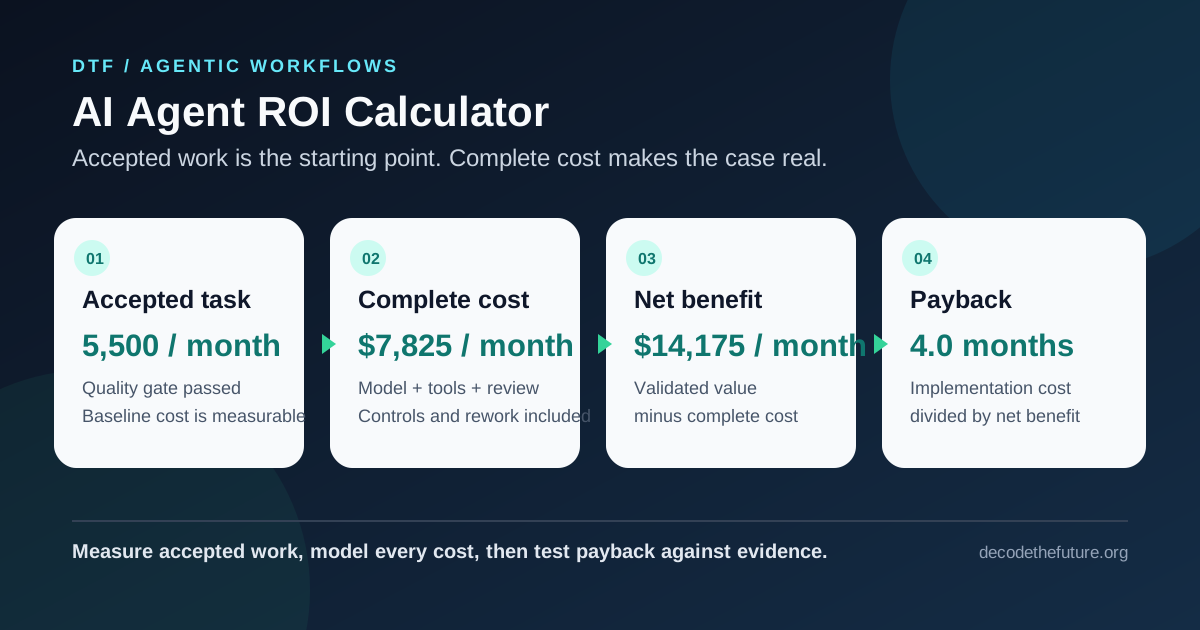
A support team handles 10,000 tickets per month. A competent agent spends eight minutes per ticket, and the loaded labour cost is $30 per hour. The baseline labour cost is therefore 10,000 × 8/60 × $30 = $40,000 per month.
During a hypothetical pilot, 5,500 tickets produce an accepted agent-assisted result and require 1.5 minutes of human review. The other 4,500 tickets remain on the baseline path. The baseline cost of the assisted subset would have been 5,500 × 8/60 × $30 = $22,000. In this example, that $22,000 is the realised monthly value only if the organisation actually reduces payroll, overtime or outsourcing, or documents additional throughput that is assigned to this workflow and produces measurable contribution. If the team simply has more spare time while headcount and spend stay unchanged, the value is capacity-only, not cash saving.
| Illustrative line item | Monthly amount | How it is used |
|---|---|---|
| Realised value of the assisted subset | $22,000 | Baseline value: 5,500 × 8 minutes × $30/hour; cash only when the realisation condition is met |
| Recurring fixed platform and control cost | $3,700 | Model, tools, infrastructure, observability, QA and operations held fixed at this pilot volume |
| Variable review cost | $4,125 | 1.5 minutes × 5,500 × $30/hour = $0.75 per accepted task |
| Other variable costs | $0 in this simplified base | Any volume-based search, tool, model or rework cost must be added as a separate line |
| Complete recurring cost | $7,825 | $3,700 fixed + $4,125 variable review cost |
| Monthly net benefit | $14,175 | $22,000 realised value − $7,825 complete recurring cost |
| One-time implementation | $56,700 | Hypothetical build, integration, evaluation and launch |
The variable review cost is $4,125 / 5,500 = $0.75 per accepted task. The comparable baseline unit cost is $40 / 10 = $4.00 per ticket. The fixed $3,700 is deliberately kept outside the variable-task denominator; it is recovered through volume, while review cost rises with accepted tasks. This split is more useful for break-even than one blended average.
Simple payback is $56,700 / $14,175 = 4.0 months. Using one consistent ROI convention, six-month realised value is 6 × $22,000 = $132,000 and six-month total cost is $56,700 + (6 × $7,825) = $103,650. Six-month ROI is therefore ($132,000 − $103,650) / $103,650 = 27.4%. Over twelve months, realised value is 12 × $22,000 = $264,000 and total cost is $56,700 + (12 × $7,825) = $150,600, producing ($264,000 − $150,600) / $150,600 = 75.3%. Both results assume the $22,000 value is genuinely realised under the condition stated above.
There is an important allocation rule: if the $3,700 already includes human review, move that amount out of the separate $4,125 review line; if model, search or tool charges rise with accepted volume, add them as explicit variable costs. Do not count any line twice. A finance review should be able to reproduce the result from task logs, timesheets and invoices.
Break-even volume
For a simple volume test, suppose $3,700 is genuinely fixed monthly platform and control cost, variable review is $0.75 per accepted task, there are no other variable costs in this simplified base, and the baseline unit cost remains $4.00 with comparable quality. The illustrative break-even volume is:
This formula is valid only under those explicit assumptions. If search, model, tool, rework or infrastructure charges scale with volume, use $3,700 / ($4.00 − ($0.75 + other variable cost per accepted task)) and recalculate. If the denominator is zero or negative, there is no operating break-even at that quality level. Implementation payback is separate: the base case still requires four positive months to recover $56,700.
Sensitivity cases a decision memo should show
| Case | Change to the illustrative assumptions | Complete recurring cost | Approx. monthly net benefit | Payback |
|---|---|---|---|---|
| Base | 5,500 accepted; $22,000 realised value; 1.5-minute review | $7,825 | $14,175 | 4.0 months |
| Lower acceptance | 3,500 accepted; $4.00 realised value per accepted task; 1.5-minute review | $6,325 | $7,675 | 7.4 months |
| Longer review | 5,500 accepted; three-minute review; same $22,000 realised value | $11,950 | $10,050 | 5.6 months |
| 50% fixed-cost shock | Fixed platform/control cost rises from $3,700 to $5,550 | $9,675 | $12,325 | 4.6 months |
| No realised cash saving | Headcount and outsourced work do not change; capacity is not monetised | $7,825 | −$7,825 | No payback |
| Quality downside | Additional $2,000 monthly rework/incident provision | $9,825 | $12,175 | 4.7 months |
Each row uses the same convention: realised value minus complete recurring cost gives monthly net benefit, and implementation divided by that positive net benefit gives payback. For a serious approval, show p10, p50 and p90 scenarios for volume, acceptance, review minutes, incident cost and provider price. The p50 case answers “what is likely?”; the p10 case answers “what must we survive?” A workflow with attractive p50 ROI but an unaffordable p10 downside needs a smaller pilot, stronger controls or a different task boundary.
Provider inputs: a dated price and limits snapshot
Provider prices are inputs, not an AI agent ROI conclusion. The table below is a dated example snapshot checked on July 15, 2026. Prices are USD per one million tokens unless stated otherwise, and can vary by context length, processing mode, region, account and product surface. Use the detailed LLM inference cost comparison for token, cache and batch methodology, then pull current values into your own configuration.
| Example input | Standard input / output | Other cost variables | Business-case warning |
|---|---|---|---|
| OpenAI gpt-5.5 | $5 / $30 short context | Cached input listed at $0.50; Batch short-context example $2.50 / $15; eligible regional processing may add 10% | Count every turn and tool-related usage; account rate limits are not an SLA |
| Anthropic Claude Sonnet 4.6 | $3 / $15 | Cache hits listed at $0.30; Batch $1.50 / $7.50; web search $10 per 1,000 searches plus tokens | Search count, cache behaviour and endpoint choice can change unit cost |
| Google Gemini 3.1 Pro Preview | $2 / $12 up to 200k prompt tokens; $4 / $18 above | Batch/Flex $1 / $6 up to 200k; Search grounding has 5,000 shared free prompts, then $14 per 1,000 queries | Preview status, prompt size and multiple grounding queries need monitoring |
The examples show why a raw input-price ranking is misleading. A workflow with more reasoning turns, larger context, web search, stricter regional processing or higher review time can cost more even when its nominal token rate is lower. OpenAI’s Agents SDK usage fields, for example, expose request, input, output, cached and reasoning details that can be aggregated at run level. The correct accounting object is the trace or accepted task, not the provider’s headline rate.
Keep model IDs, prices, cache assumptions, quotas and fallback rules versioned. When a vendor changes a model, preview label or limit, rerun the sensitivity cases. Published RPM, TPM, daily quotas and spend caps are ceilings or account settings; they are not throughput guarantees. A vendor comparison is useful for procurement, but it is not independent evidence of quality or savings.
Architecture choices that change ROI
Architecture can change cost more than model selection. A planner that calls a second model for every ticket may improve flexibility while erasing the unit saving. A retrieval layer may reduce hallucinations while adding ingestion and storage work. A human approval step may increase cost while making a regulated use legally and operationally viable. Draw the path from input to accepted output before assigning a budget.
Use the AI agent architecture guide to map the control plane, memory, tools, guardrails and boundaries. Then ask four economic questions: which calls are required for every task, which calls are conditional, which actions can be deterministic, and which failures trigger a fallback? Deterministic validation, schema checks and policy rules should do the work they can do reliably; an LLM should not be paid to rediscover arithmetic or permission logic that code can enforce.
Build versus buy
A platform subscription can reduce integration time and provide tracing, approvals or hosted environments. Building in-house can improve control or reduce variable fees at scale. Compare both on accepted-task economics, data controls, exit cost and operational burden. For an implementation-choice survey, see our overview of AI agent frameworks; this ROI page does not turn that comparison into a framework ranking.
Ask vendors to provide measurable definitions: what counts as a task, what is included in usage, how retries are billed, which tools are charged separately, what happens during an outage, and which telemetry can be exported. Treat vendor-reported savings and accuracy as directional material, not an audited performance guarantee. Your own shadow-mode baseline should decide the case.
Risk-adjusted ROI for finance and regulated work
Regulated workflows need a wider cost boundary. Add legal classification, model-risk review, data protection, vendor due diligence, resilience testing, audit evidence, human oversight, incident response and remediation. These controls may make a narrow workflow worthwhile even when an unconstrained agent would look cheaper. They also make autonomous approval a separate project from assisted preparation.
Good first candidates
Start with reversible, reviewable work: document triage, internal policy search, draft narratives, reconciliation suggestions, evidence collection, exception routing and meeting or case summaries. The agent can prepare a recommendation while a deterministic system verifies fields and an authorised person makes the consequential decision. Use an audit trail that connects source documents, model version, tool calls, reviewer action and final outcome.
In my own CFD workflow, automation is most defensible around research notes, journaling, reconciliation and alert organisation. It is not a licence to let a language model decide suitability, leverage or a customer’s risk without explicit rules and accountable human review. A trading assistant can be fast and still be economically negative if a single unchecked error creates a loss larger than months of saved time.
High-impact decisions need a separate control track
For organisations and uses within the EU AI Act’s scope, systems used to evaluate a natural person’s creditworthiness or establish a credit score are listed as high-risk in Annex III point 5(b), with an exception for financial-fraud detection. Article 27’s fundamental-rights-impact-assessment requirement is relevant to deployers of systems in the specified Annex III points 5(b) and 5(c) cases; it does not apply to every “finance agent” or every company globally. The intended purpose matters.
Article 14 addresses effective human oversight, including the ability to understand limitations, interpret outputs, override or reverse results and intervene or stop the system. A reviewer who simply clicks approve, cannot access the evidence or has no time to challenge the output is not meaningful oversight. Measure override rate, review time, error discovery and escalation quality.
For organisations within the Regulation’s scope, Article 113 says the AI Act applies from August 2, 2026, while Chapters I and II apply from February 2, 2025 and selected provisions apply from August 2, 2025. Those staged dates do not mean every obligation begins on one date. DORA applies to in-scope EU financial entities and their ICT third-party arrangements; it keeps the financial entity responsible for compliance and requires ICT third-party risk management and written contractual provisions. It is not a general rule for every finance software company. Within the GDPR’s territorial and material scope, Article 22 addresses solely automated decisions with legal or similarly significant effects and sets safeguards in relevant exceptions; it is not a global rule for every company or finance agent.
This is operational education, not legal, accounting, investment, credit or trading advice. Confirm the classification, supervisory expectations and contractual controls with qualified counsel, compliance and risk owners before a regulated launch. See our practical guide to agentic workflows in finance for use-case boundaries, and AI compliance workflows for the governance and procurement layer.
Include downside costs in the model
| Risk | Cost to model | Control or evidence |
|---|---|---|
| Outage or provider change | Fallback labour, missed SLA, migration and regression testing | Rollback path, exportable traces and tested alternative |
| Vendor concentration | Exit engineering, duplicate integration and contract review | Portability plan, quota monitoring and exit assumptions |
| Data or privacy incident | Investigation, notification, remediation, claims and lost work | DPA review, minimisation, retention rules and access logs |
| Excessive agency | Unauthorised action, reversal, customer remediation and audit cost | Least privilege, downstream authorisation and human approval |
| Unbounded consumption | Unexpected token, search or tool charges and service exhaustion | Budgets, quotas, timeouts, rate limits and anomaly alerts |
OWASP’s guidance on unbounded consumption and excessive agency is a useful security input: runaway loops, denial-of-wallet behaviour, excessive permissions and irreversible actions have direct financial consequences. A risk-adjusted ROI model should show both expected loss and a hard stop for risks the organisation will not accept, regardless of the average calculation.
Pilot-to-production checklist
A pilot should be designed to produce a decision, not merely a demo. Use this checklist in the approval memo and keep evidence beside every answer.
| Gate | Pass condition |
|---|---|
| Task boundary | One named task type, owner, volume range and explicit out-of-scope cases |
| Baseline | Two to four weeks of volume, handling time, quality, escalation and cost evidence |
| Truth set | Representative labelled examples, including difficult and high-risk cases |
| Acceptance rubric | Required fields, evidence, safety, accuracy, SLA and rejection reasons are defined |
| Shadow mode | The agent runs without changing customer or financial outcomes while humans compare results |
| Quality gate | First-pass acceptance and critical-error thresholds are met by task segment |
| Cost telemetry | Every run records model, tokens, tools, retries, latency, reviewer minutes and final status |
| Control boundary | Least-privilege tools, deterministic checks, human override and a kill switch are tested |
| Budget | Per-task and monthly spend caps, anomaly alerts and fallback staffing are approved |
| Security and privacy | Data mapping, retention, residency, prompt-injection tests and incident ownership are documented |
| Scenario range | p10, p50 and p90 cases cover volume, acceptance, price, review time, outage and rework |
| Production gate | Finance, product, security, legal or compliance owners sign a named decision with a review date |
Run the pilot long enough to capture normal variation, not just a favourable week. Compare the agent with a control group or a blinded baseline sample where possible. Record who accepted each output and why. At 30, 60 and 90 days after launch, rerun the same accepted-task calculation and check whether the benefit became cash, measurable contribution or only available capacity.
Scale only when the workflow clears its quality threshold, its complete quality-adjusted unit cost is lower than the baseline or creates verified incremental contribution, and its p10 downside fits the organisation’s risk appetite. Otherwise keep it in shadow mode, narrow the task or stop.
Key takeaways
An AI agent ROI calculator is credible when it follows an accepted task from input to final outcome. Start with a baseline and a rubric, then count model turns, tool and retrieval charges, review, rework, expected loss, infrastructure, observability, controls and maintenance. Use realised savings and measured contribution rather than converting every freed hour into profit. Calculate payback only from positive monthly net benefit, and show the sensitivity to acceptance, review time, price, outage and no-savings cases.
For regulated work, a human approval button is not enough: the person must have evidence, time, authority and the ability to override or stop the workflow. A narrow, reversible finance workflow can be a sensible pilot; autonomous credit, insurance, AML disposition or trading decisions require a distinct legal and control review. Treat this page as an operational framework, keep provider assumptions dated and make the final decision from your own traces and baseline data.
Frequently Asked Questions
How do you calculate AI agent ROI?
Define an accepted task, measure the baseline cost and quality, record the workflow’s complete recurring cost, and calculate realised value over a named period. ROI is (total realised benefit minus total cost, including implementation) divided by total cost, multiplied by 100. Do not use token price or theoretical hours saved as a substitute for accepted-task evidence.
What costs belong in an AI agent ROI calculator?
Include model and reasoning tokens, retries, tools, retrieval, search or grounding, embeddings, storage, execution, infrastructure, monitoring, evaluation, human review, exceptions, rework, security, support and maintenance. Keep one-time implementation and lifecycle costs separate so payback and recurring unit cost remain clear.
Are AI agents cheaper than employees?
Not automatically. Compare the complete cost of a quality-accepted task, including reviewer time, failed work, controls and expected loss, with the loaded baseline cost. An agent may release capacity without reducing payroll, so report that capacity separately unless staffing, outsourcing, overtime or measurable throughput actually changes.
How many tasks are needed to break even?
When quality is comparable and the denominator is positive, divide fixed monthly cost by baseline unit cost minus validated variable agent unit cost. In this article’s simplified base, that is $3,700 divided by ($4.00 minus $0.75), or approximately 1,139 accepted tasks per month. Recalculate if review, search, infrastructure or escalation costs rise with volume. Break-even volume does not by itself recover one-time implementation cost; payback is a separate calculation.
Can an AI agent make lending or trading decisions autonomously?
Do not generalise from a calculator to permission. Intended purpose, jurisdiction and sector rules determine the control requirements. Creditworthiness and other high-impact decisions may trigger high-risk or automated-decision safeguards; use an agent first for reviewable preparation, evidence collection or routing, and obtain legal, compliance and risk approval before any consequential automation.
What happens if a model price or rate limit changes?
Version the model, price, cache, quota and region assumptions, monitor actual cost per accepted task, and rerun p10, p50 and p90 scenarios. Keep provider limits in configuration and treat published quotas as account-dependent ceilings rather than guaranteed throughput. Maintain a fallback or rollback path for material provider changes.
This article is operational education, not legal, accounting, investment, credit or trading advice. Vendor prices, model status, limits and regulatory implementation details can change. Confirm the current primary source and obtain qualified review before relying on a business case or deploying a regulated workflow.
Bibliography (16 sources)
Sources prioritise primary regulation, official API documentation and security guidance. Vendor performance metrics are treated as vendor-reported unless independently audited. Links accessed July 15, 2026.
- OpenAI — API Pricing, current model, cache, batch and regional-processing inputs. Official pricing documentation
- OpenAI — Rate limits, organisation and project quota dimensions. Official rate-limit guide
- OpenAI — Agents SDK overview, tools, guardrails, sessions, human review and tracing. Agents SDK documentation
- OpenAI — Agents SDK usage, request and token telemetry. Usage documentation
- Anthropic — Claude Platform pricing, caching, batch, context and web-search inputs. Official pricing documentation
- Anthropic — API rate limits, spend caps and endpoint quota caveats. Official rate-limit documentation
- Anthropic — Claude Managed Agents overview, beta and governance considerations. Managed Agents documentation
- Google AI for Developers — Gemini API pricing, context, batch, caching and grounding. Official pricing documentation
- Google AI for Developers — Gemini project rate limits and batch ceilings. Official rate-limit documentation
- Google AI for Developers — Interactions API, generally available status and agent workflows. Interactions API documentation
- European Union — Regulation (EU) 2024/1689, the EU AI Act, including Articles 14, 26, 27 and 113 and Annex III. EUR-Lex text
- European Union — Regulation (EU) 2022/2554, DORA, including ICT third-party risk and contracts. EUR-Lex text
- European Union — Regulation (EU) 2016/679, GDPR Article 22 on automated individual decision-making. EUR-Lex text
- National Institute of Standards and Technology — AI Risk Management Framework 1.0 and revision information. NIST AI RMF
- OWASP GenAI Security Project — LLM10:2025 Unbounded Consumption. OWASP guidance
- OWASP GenAI Security Project — LLM06:2025 Excessive Agency. OWASP guidance