
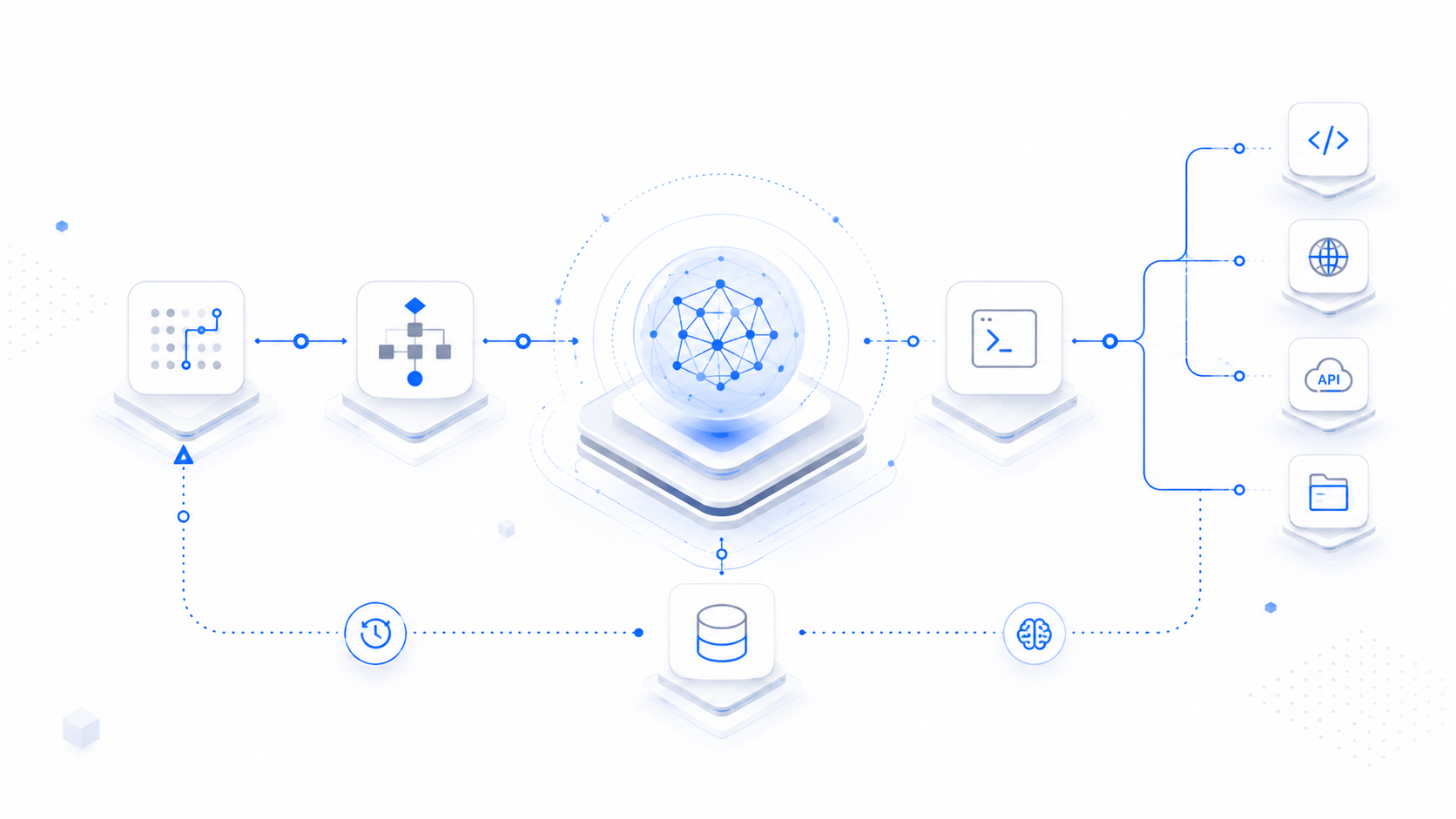

An AI agent is a software system that uses a large language model to perceive its environment, plan a sequence of actions, use tools to execute them, and adapt based on results — without step-by-step human supervision. Unlike a chatbot (which only replies) or a RAG system (which only retrieves), an agent acts: it reads files, calls APIs, runs code, browses the web, and iterates until a goal closes. In 2026, agents are the dominant deployment pattern for frontier models.
What exactly is an AI agent?
An AI agent is a system built around a large language model (LLM) that can autonomously decide what to do next to achieve a goal. It doesn’t just answer questions — it plans, takes actions in the real world (calling APIs, editing files, sending emails, querying databases), reads the results, and iterates until the goal is reached or it gives up.
The shortest formal definition that holds up under stress: an AI agent is an LLM in a loop with tools. The LLM decides; the tools act; the loop persists until completion. Everything else — frameworks, multi-agent setups, memory systems — is implementation detail layered on that core.
This makes the agent fundamentally different from earlier AI categories. A search engine retrieves; a chatbot replies; a RAG system retrieves and replies; an agent retrieves, decides, acts, observes, and tries again. The shift from one-shot answers to multi-step autonomous action is what justifies the new vocabulary.
AI agent vs chatbot vs RAG vs LLM — what’s the difference?
Four overlapping but distinct categories. Confusing them produces bad architecture decisions.
| System | What it does | Multi-step? | Tool use? | Example |
|---|---|---|---|---|
| LLM | Generates text from a prompt | No | No | Raw GPT-5.5 API call |
| Chatbot | LLM with conversation history and personality | Within conversation only | Limited | Default ChatGPT, Claude.ai |
| RAG system | Retrieves documents, then LLM answers grounded in them | One retrieve → one answer | Retrieval only | Customer-support knowledge base |
| AI agent | LLM plans, calls tools, reads results, iterates | Yes — many steps | Yes — arbitrary tools | Claude Code, Cursor Composer, Devin, Operator |
The key is the loop. A chatbot answers and stops. An agent answers, sees that the answer requires running a test, runs the test, sees the test failed, decides to read a different file, reads it, makes a fix, runs the test again, sees it pass, declares victory. That’s five turns of LLM inference, each conditioned on what happened in the previous turn. The system isn’t smarter than the underlying LLM — it’s just doing more with it.
For deeper context on how the underlying retrieval-and-generation systems differ, see our explainer on the LLM wiki Karpathy pattern and our 2026 review of AI coding assistants — coding tools were the first category to fully embrace the agentic pattern at scale.
How does an AI agent actually work?
The dominant 2026 architecture has four functional roles. Frameworks call them by different names, but the roles are the same.
- Planner — breaks the goal into a sequence of subgoals. Sometimes the same LLM call as the executor; in advanced agents, a separate “thinking” model that produces a plan once and hands it off.
- Executor — the LLM that picks the next tool to call given the current state. This is where most token spend lives.
- Memory — short-term (the conversation buffer the model sees) and long-term (vector stores, structured DBs, files the agent re-reads).
- Critic / verifier — checks the executor’s output. Can be the same model called with a different system prompt, a separate model (often cheaper), or a deterministic check (test runner, schema validator, type checker).
The loop ties them together. Pseudocode any practitioner will recognize:
In code, the simplest possible agent is roughly fifteen lines:
def run_agent(goal, tools, max_steps=20):
    history = [{"role": "user", "content": goal}]
    for step in range(max_steps):
        response = llm.complete(history, tools=tools)
        if response.is_done:
            return response.final_answer
        for tool_call in response.tool_calls:
            result = tools[tool_call.name](**tool_call.args)
            history.append({"role": "tool", "content": result})
        history.append({"role": "assistant", "content": response.text})
    return "max_steps_exceeded"
Every production agent — Claude Code, Cursor Composer, Operator, Devin, AutoGPT’s descendants — is a more elaborate version of this loop. The differences are in how tools are described to the model, how long-term memory is structured, which verifier sits in the loop, and how the system handles failures.
What types of AI agents exist in 2026?
Three useful taxonomies cut across the field.
By autonomy level
- Single-turn agents — one tool call, one response. Often called “tool use” rather than “agent.” The line is fuzzy.
- Multi-step agents — bounded loop, fixed task. Most coding assistants and RPA-style workflows.
- Long-running agents — task persists for hours or days. Devin, Operator-style browser agents, autonomous research assistants.
- Multi-agent systems — several agents collaborate (planner-executor split, debate patterns, swarm topologies). Higher capability, higher cost.
By environment
- Code agents (Claude Code, Cursor Composer, Devin) — operate on filesystems and dev tooling.
- Browser agents (Operator, Browserbase-driven systems) — control a web browser.
- OS agents (Claude with computer use, OSWorld systems) — full desktop control.
- Domain agents — finance, customer support, marketing, legal — wrappers around specific business APIs.
By orchestration pattern
- ReAct — single LLM that alternates “thought” and “action” tokens (Yao et al. 2022, the foundational pattern).
- Plan-and-execute — separate planning phase produces a static plan, then executor follows it.
- Reflection — agent judges its own outputs and revises.
- Tree-of-thoughts / search — explores multiple branches, backtracks.
- Hierarchical / supervisor-worker — coordinator agent dispatches subagents.
What are the best AI agent frameworks in 2026?
Five frameworks dominate the production landscape. Each makes different bets on how much structure to impose vs how much to leave to the model.
| Framework | Maker | Best for | Key bet |
|---|---|---|---|
| LangGraph | LangChain | Production multi-agent workflows | Explicit state graph; deterministic control flow |
| CrewAI | CrewAI Inc. | Role-based multi-agent simulations | Agents = roles with goals; high abstraction |
| AutoGen | Microsoft Research | Conversational multi-agent research | Agents talk to each other; chat-like topology |
| Pydantic AI | Pydantic team | Type-safe production agents | Type-safety, structured outputs, minimal magic |
| Anthropic Agent SDK + MCP | Anthropic | Claude-native agents with full MCP access | Open protocol; least lock-in to a framework abstraction |
The honest meta-point: most production agents in 2026 use no framework at all. They use the provider SDK (Anthropic, OpenAI, Google) directly, hand-roll the loop, and treat tools as plain functions. Frameworks add value when you outgrow that — typically when you have 5+ tools, multiple agent roles, or a long-running task that needs durable state. Picking a framework before that point is premature.
For deeper coverage of the protocol layer that ties tools to agents regardless of framework, see our review of AI coding assistants — every assistant on that list is, under the hood, an agent built on Model Context Protocol or a similar tool layer.
How are AI agents benchmarked in 2026?
Single-turn benchmarks like MMLU say nothing about agent capability. Three families of agentic benchmarks matter:
Software engineering
SWE-Bench Verified — real GitHub issues from 12 popular Python repos. The agent must read the codebase, fix the issue, and pass the hidden test suite. 2026 frontier ~80% (Claude Opus 4.7).
Aider polyglot — 225 hard exercises across Python, JavaScript, Rust, Go, C++, Java with hidden tests. Measures cross-language coding under agent loop pressure.
Terminal-Bench 2.0 — end-to-end shell tasks (build a project, debug a deployment, configure tools). Measures tool-use realism.
General assistants
GAIA (Hugging Face / Meta) — 466 questions requiring reasoning, multimodality, web browsing, tool use. Designed so humans score ~92% and 2023-era LLMs scored ~30%. Frontier agents in 2026 reach the 50–70% range depending on tools allowed.
OSWorld — agent operates a real Linux desktop and completes 369 multi-step tasks (file management, browser, office apps). Measures “computer use” capability.
Customer-service / business
Tau²-Bench (Sierra) — agent handles realistic customer interactions (airline rebooking, retail returns) where it must follow domain policies, use APIs, and cope with adversarial users. Designed by ex-Google/Salesforce researchers specifically to measure production agent reliability.
GDPval (OpenAI) — 44 knowledge-work professions, expert evaluators rate model outputs against task baselines. Less an “agent benchmark” than a knowledge-work realism test that frontier models now approach expert parity on.
Benchmark scores correlate with capability but don’t predict your agent’s reliability on your task. Three reasons. First, benchmarks have hidden tests — your task doesn’t. Second, benchmark agents are heavily prompt-engineered for the benchmark; production agents aren’t. Third, real-world failures cluster in the long tail (weird inputs, infrastructure flakes, tool errors) that benchmarks don’t probe. Treat scores as floor-class indicators, not contract guarantees.
What can AI agents actually do in 2026? Real use cases
Five applications that have moved from demo to production economic value:
Software engineering
The first commercial home of the agent pattern. Claude Code, Cursor Composer, Cognition’s Devin, GitHub Copilot agent mode, and Codex CLI all run multi-step coding agents that ship pull requests, fix bugs, and refactor across files. Productivity gains in published studies range from 10% to 55% depending on developer experience and task complexity.
Customer service
Tier-1 ticket resolution — return processing, account changes, troubleshooting — has been moving to agents at scale through 2025–26. Sierra, Decagon, and several enterprise-internal builds reach 60–80% containment on contact volume in well-scoped domains. The hard part is not the agent; it’s the policy/data wiring around it.
Research and analysis
“Deep Research” modes (OpenAI, Anthropic, Perplexity) are agents that browse the web, read 50–100 pages, and synthesize multi-page reports. They genuinely save hours per analyst-grade query. They also produce confident errors at a rate that requires expert review — the same failure mode as a strong but green junior researcher.
Trading and finance
Algorithmic trading is older than the LLM era, but agentic LLMs are entering as research assistants (synthesizing analyst reports, news, regulatory filings) and as execution monitors (flagging anomalies in trade flow). They are not “AI traders” in the sense retail headlines imply. For the framework around this, see algorithmic pricing in fintech and AI credit scoring under the EU AI Act.
Personal productivity
Writing assistants that schedule meetings, summarize inboxes, and act on email are moving from beta to default. Microsoft 365 Copilot, Google Workspace Gemini, and Anthropic’s Claude Workspaces all ship variants. The clearest economic story is calendar and inbox triage — measurable hours saved per knowledge worker per week.
Where do AI agents fail? The honest list
Agent demos are seductive; agent production is humbling. Six failure modes every team encounters:
- Drift over long horizons. Agents that run 50+ steps tend to lose the thread, repeat earlier mistakes, or fixate on the wrong subgoal. Mitigation: shorter loops, explicit checkpoint summaries, plan-and-execute split.
- Prompt injection and indirect injection. A malicious file, web page, or email can hijack the agent. The OWASP LLM Top 10 ranks this as the dominant category. Mitigation: tool-permission scoping, input sanitization, never let untrusted content reach the executor unfiltered.
- Tool description ambiguity. Models pick the wrong tool when descriptions overlap or contradict. Mitigation: strict tool naming conventions, mutually exclusive descriptions, verify with eval set before shipping.
- Cost blow-ups. A “stuck” agent can chew through thousands of tokens per minute. Mitigation: hard budget caps per task, circuit breakers on consecutive failures, alerting on token-velocity anomalies.
- Verification gap. The agent says “done” when it isn’t. Mitigation: deterministic verifiers (tests, schema checks, type checks) in the loop, not just LLM-as-judge.
- Permission and impersonation risks. An agent with write access to email, your calendar, or your codebase can do real damage on a wrong turn. Mitigation: principle of least privilege, audit logs, dry-run modes, human approval for destructive actions.
For an in-depth taxonomy of agent failure modes, see DeepMind’s AI agent traps framework, which we covered earlier. The framing: agents fail because optimizing for goals is harder than completing tasks, and reward hacking applies to LLM agents the same way it applied to RL agents in 2018.
How does the EU AI Act treat AI agents?
Regulation (EU) 2024/1689 — the AI Act — does not name “agents” as a category. But it covers them through three angles that matter for any 2026 deployment.
Recital 12 (interpretive context for the regulation) describes AI systems with degrees of autonomy as exactly what the Act intends to govern. The more autonomous the system — the more it acts in the world without human steering — the more weight the deployer obligations carry.
Article 14 (human oversight) requires that high-risk AI systems be designed for effective human oversight. For an agent, this translates to: kill switch, pause/resume, audit log, ability for a human to intervene before consequential actions.
Annex III high-risk categories — the eight domains where deployer obligations apply — include credit scoring, biometric identification, employment screening, education evaluation, critical infrastructure, law enforcement, migration, and administration of justice. If your agent operates in any of these, you carry Article 26 deployer obligations: risk management, human oversight, logging, conformity assessment, post-market monitoring.
Article 5 (banned practices) applies regardless of agent vs non-agent: no social scoring, no real-time biometric ID in public spaces (with carve-outs), no exploitation of cognitive vulnerabilities. An agent automating these doesn’t escape the ban; it just makes it more efficient — and therefore more enforceable.
Beyond the AI Act, the GDPR’s Article 22 (automated decision-making with legal or similarly significant effects) is the older sibling that applies to many agentic deployments touching personal data. Most enterprise teams in 2026 build a combined AI Act / GDPR compliance pack rather than treating them as separate regimes.
Personal note: how I use AI agents every day
I’m a high-school student in Kraków running this site, preparing for the Polish AI Olympiad, and trading CFDs as a teenage market participant. My production stack uses agents in three places.
Claude Code writes and ships every article on DTF (this one included), with a custom dtf-article skill that encodes our editorial standards. The skill is loaded automatically when I ask for an article; the agent crawls the WordPress sitemap, reads the relevant source files, drafts the article, runs the SEO validator, and updates the source library. End-to-end, an article that used to take me a full day now takes 3–4 hours of supervised work.
A small Python research agent built on Pydantic AI pulls daily AI/finance news, deduplicates it, and produces a 1-page brief with links to primary sources. About 80 lines of code, $0.50/day in API spend, 30 minutes saved per morning.
Trading research — not trading itself — uses Claude Opus 4.7 with web access to summarize CFTC/ESMA notices, FCA enforcement actions, and quarterly broker disclosures. The agent never places trades; it produces structured notes I read myself before any decision. The non-negotiable rule for any reader following along: do not connect an LLM agent to a brokerage execution API on retail capital. The failure modes covered above are not theoretical, and trading capital is the worst possible place to learn that an agent went off the rails.
How will AI agents evolve through late 2026 and 2027?
Three plausible directions visible in early-2026 research and product roadmaps.
First, longer task horizons. Devin and Cognition’s later releases pushed the unit of work from “complete this function” to “open and merge this PR over hours of work.” Expect that horizon to keep extending — overnight tasks are already shipping in pilot, and multi-day project management is plausible by 2027.
Second, multi-agent as default. Single-agent designs are limited by the LLM’s context window and reasoning depth. Splitting a task across a planner, executor, critic, and specialist subagents — each with its own model and tools — extends what the system as a whole can do. The question is orchestration overhead: by 2027, frameworks will hide most of it from product builders.
Third, regulatory and safety pressure. As agent capability grows, so does the surface for misuse. Expect the AI Act’s GPAI obligations under Articles 51–55 to be cited in agent-specific enforcement actions; expect at least one major incident involving an autonomous agent acting badly to drive a public conversation about kill-switch standards. The technical answer (sandboxing, capability tokens, principle of least privilege) is mature; the policy answer is still forming.
FAQ — what you actually need to know about AI agents
What is an AI agent in simple terms?
An AI agent is software that uses a language model to act, not just answer. It plans steps, calls tools (APIs, files, code), reads the results, and keeps going until the goal is reached. The simplest mental model: an LLM in a loop with tools.
What’s the difference between an AI agent and a chatbot?
A chatbot replies; an agent acts. A chatbot answers your question and stops. An agent answers, then runs the test, sees the test failed, opens a different file, makes a fix, runs the test again, and reports back when it passes. The agent does many turns of LLM inference per user request, each conditioned on what happened before.
Are AI agents dangerous?
“Dangerous” depends on permissions and verification. An agent with read-only access to a sandbox is essentially harmless. An agent with write access to your email, calendar, codebase, or bank account can do real damage on a wrong turn. The mitigations are mature (least privilege, audit logs, kill switches, deterministic verifiers, human approval for destructive actions), but they require deliberate engineering — not defaults.
Do AI agents replace human workers?
Some tasks, yes — Tier-1 customer support, junior code review, document summarization, parts of paralegal work, basic data entry. Whole jobs, mostly no — because most jobs are bundles of tasks, not single tasks, and the bundles include judgment, accountability, and relationships agents don’t yet handle well. Through 2026, the dominant pattern is augmentation: one human supervising several agents on tasks that would have been entry-level work.
What’s the best AI agent framework for production in 2026?
For most teams: LangGraph for explicit graph-based control flow, or Pydantic AI for type-safe minimalism. For Claude-native shops: the Anthropic Agent SDK + MCP server ecosystem. For role-based simulations: CrewAI. The unfashionable answer: many production agents use no framework at all and just call the provider SDK directly. Pick a framework when the boilerplate hurts, not before.
How much does it cost to run an AI agent?
Highly variable. A simple multi-step agent on Claude Sonnet 4.6 or GPT-5.5 standard costs ~$0.05–$0.50 per task. A long-running agent on Claude Opus 4.7 or GPT-5.5 Pro can cost $3–$15 per task. Multi-agent systems with several rounds of debate scale linearly with rounds. Self-hosted Qwen 3 or Kimi K2 on your own GPUs cost effectively only the electricity and capital depreciation. Always budget with hard token caps per task and circuit breakers on failure loops.
Are AI agents legal under the EU AI Act?
Yes, generally. The AI Act doesn’t ban agents as a category — it imposes obligations based on how they’re used. If your agent is in an Annex III high-risk domain (credit scoring, biometric ID, employment screening, education evaluation, critical infrastructure, law enforcement, migration, administration of justice), Article 26 deployer obligations apply: risk management, human oversight (Article 14), logging, conformity assessment, post-market monitoring. Article 5 banned practices (social scoring, exploitation of cognitive vulnerabilities) apply regardless of how the agent is built.
Bibliography & sources
- Yao, S. et al. — ReAct: Synergizing Reasoning and Acting in Language Models (NeurIPS 2022). The foundational reasoning-and-acting pattern for modern agents.
- Anthropic — Building Effective Agents (engineering blog). Workflow vs agent distinction; production-grade design patterns.
- Anthropic — Model Context Protocol announcement (Nov 2024). Open standard for tool integration.
- Model Context Protocol — official specification.
- OpenAI — Computer-Using Agent / Operator announcement (Jan 2025). Browser-control agent design.
- Cognition — Devin product page. Long-running autonomous coding agent.
- Hugging Face / Meta — GAIA benchmark. General assistant evaluation across reasoning, multimodality, web, tools.
- OSWorld team — OSWorld benchmark. Real Linux desktop tasks for OS-level agents.
- Sierra — Tau²-Bench. Agent reliability in customer-service domains.
- SWE-Bench — Verified leaderboard. Real GitHub-issue resolution by agents.
- OpenAI — GDPval benchmark. Knowledge-work professional evaluation.
- LangChain — LangGraph documentation. Graph-based agent orchestration.
- CrewAI — CrewAI documentation. Role-based multi-agent framework.
- Microsoft Research — AutoGen framework. Conversational multi-agent research.
- Pydantic — Pydantic AI documentation. Type-safe agent framework.
- OWASP — LLM Top 10. Prompt injection and agent security risks.
- Google DeepMind — research publications on agent traps and reward hacking. Foundational safety framings.
- European Union — Regulation (EU) 2024/1689 (AI Act). Articles 5, 14, 26, 51–55, Annex III, Recital 12.
- European Data Protection Board — Article 22 GDPR guidance. Automated decision-making with legal effects.