


Last updated: 27 July 2026. Regulatory scope checked: 27 July 2026.
The US system uses a different vocabulary from the European one. The credential discussed here is an FAA Private Pilot Certificate, not an EASA PPL(A). The broad learning journey is similar — theory, supervised flying, solo work and a final test — but the regulator, paperwork, hour breakdown and training structures are different.
This guide is for the airplane category and a private, non-commercial flying goal. It is not a substitute for current FAA regulations, an instructor’s endorsements or an aviation medical examiner’s decision.
1. What does a US private pilot certificate do?
A private pilot certificate allows a pilot to exercise private pilot privileges within the limits of the certificate, ratings, aircraft, medical status, currency and operating rules. It does not make the holder a commercial pilot and does not authorise paid airline operations.
The FAA’s own “Become a Pilot” pathway separates student, recreational, private, commercial and airline transport certificates. The first decision is therefore not simply “how do I get a licence?” but “what aircraft and type of flying do I want to do?” FAA requirements differ by aircraft category and class.
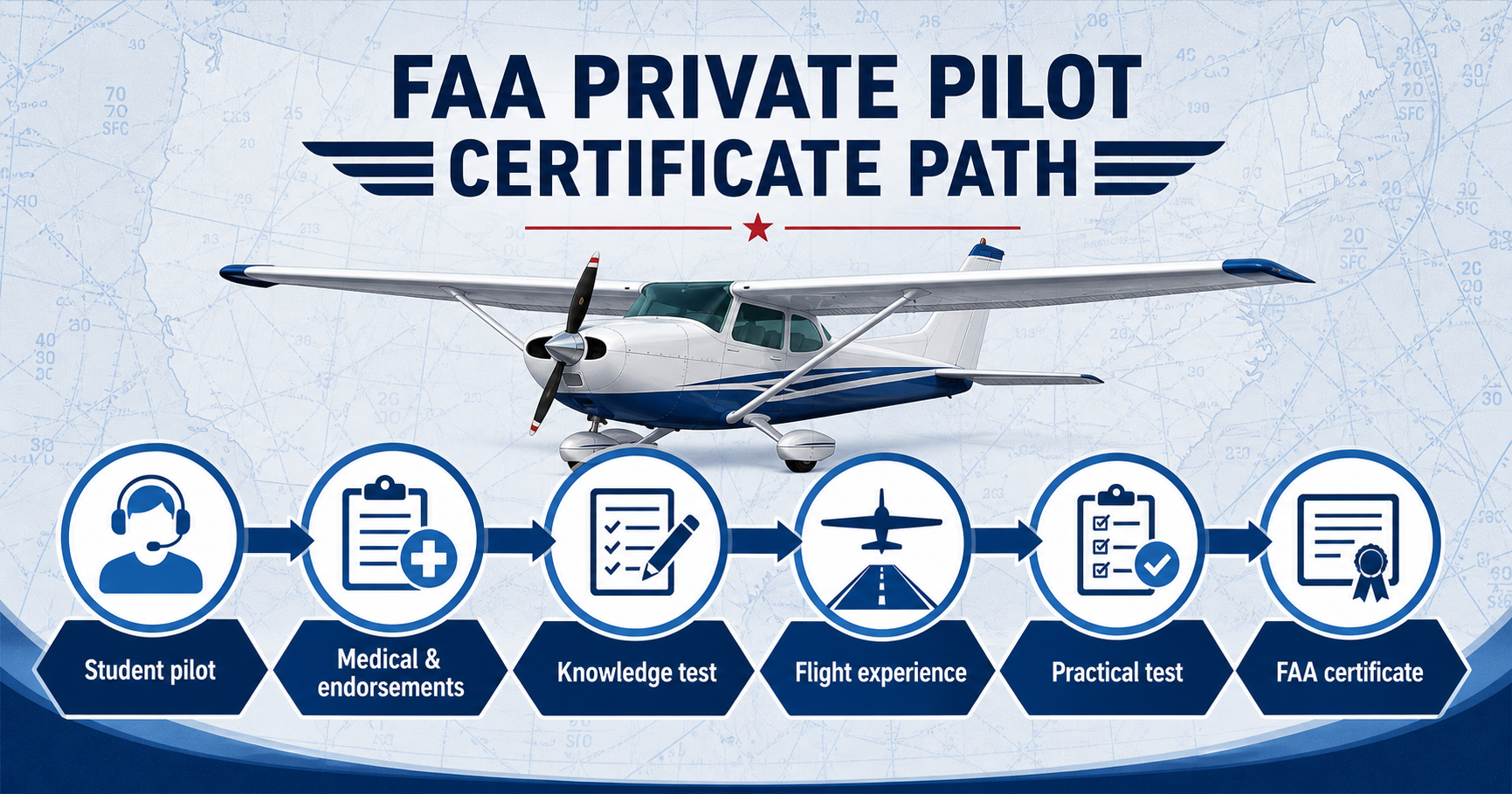
2. The FAA route at a glance
| Stage | What it covers | Typical question |
|---|---|---|
| Choose the category and class | For this article: airplane category, with the applicable class rating. | What exactly do I want to fly? |
| Student pilot status | Obtain the student pilot certificate before solo operations. | Which authority or authorised person will process it? |
| Medical | Obtain the medical certification required for the intended operation. | Should I see an AME before spending heavily on training? |
| Ground training | Learn aeronautical knowledge and prepare for the knowledge test. | Can I explain the rules, weather and aircraft limits? |
| Flight training | Build dual, solo, cross-country, night and instrument experience as required. | Can I plan and execute a safe flight? |
| Practical test | Demonstrate competence to an FAA inspector or designated pilot examiner. | Are my logbook, endorsements and documents complete? |
3. Student pilot certificate and medical certification
The FAA states that a student pilot certificate is needed before flying solo, but not simply to take lessons with an instructor. The application can be processed through an FAA Flight Standards District Office, an FAA-designated pilot examiner, an airman certification representative at an approved school, or a certificated flight instructor, depending on the route.
Solo endorsements live in the student’s logbook. The FAA also notes that an endorsement to solo does not by itself authorise solo cross-country flying; a separate cross-country endorsement is required.
For medical certification, the FAA identifies third-class certification as the usual class associated with student, recreational and private pilot privileges, subject to the rules and exceptions that apply to the operation. BasicMed introduces a separate framework for eligible pilots. It should not be described as a universal replacement for every medical requirement.
The safest order is to discuss your intended training and operation with an aviation medical examiner early. Do not rely on a forum post, another pilot’s medical history or an online vision test to predict your outcome.
4. Part 61 or Part 141?
US flight training is often described through Part 61 and Part 141. The practical difference is the structure and approval framework of the training programme, not a simple “good versus bad” ranking.
| Question | Why it matters |
|---|---|
| How structured is the course? | A structured school programme may suit a student who wants defined stages, while a more flexible route may suit someone training around work. |
| What is the school’s approval and syllabus? | Ask the school how its programme maps to the applicable FAA requirements. |
| How available are instructors and aircraft? | Schedule gaps can increase cost and slow skill development. |
| What does the quote include? | Aircraft, instructor, fuel, written test, examiner, headset, landing fees and extra hours may be handled separately. |
Choose the programme that matches your schedule, learning style, budget and long-term goal. A fast-looking syllabus is not useful if aircraft availability prevents regular practice.
5. FAA ground training and the knowledge test
Ground training covers aeronautical knowledge needed for safe operation. The student should be able to reason through regulations, weather, airspace, aircraft systems, performance, navigation, human factors and risk management — not merely recognise answers in a question bank.
The FAA knowledge test is one part of the certification process. The practical test later examines how the applicant applies knowledge and skills in an aircraft, including an oral component conducted by the examiner.
How to study
- Use a current FAA handbook, school syllabus or instructor-approved source.
- Connect each rule to a real decision in the cockpit.
- Practise calculations and charts, not only multiple-choice questions.
- Keep a list of errors and review them with your instructor.
- Check revisions before relying on an old PDF or app.
6. The 40-hour minimum and real training time
The FAA states that a person applying for a private pilot certificate in airplanes must log at least 40 hours of flight time. The FAA’s high-level breakdown includes at least 20 hours of flight training from an authorised instructor and 10 hours of solo flight training, along with specific cross-country, night and instrument experience.
The same FAA guidance says that the US average for applicants without hearing impairment completing private pilot requirements is approximately 75 hours. The lesson is important: 40 hours is a regulatory minimum, not a forecast for an individual student.
Progress depends on frequency, weather, aircraft type, instructor continuity, previous experience, preparation between flights and the student’s ability to make safe decisions. Training that is interrupted for months can require review even when the logbook already contains many hours.
7. Solo, cross-country, night and instrument experience
Solo flying is authorised by an instructor through logbook endorsements and aircraft-specific conditions. A student must understand exactly what the endorsement permits and what additional endorsement is needed for cross-country solo work.
Cross-country training expands the planning task: fuel, alternates, weather, airspace, navigation, communications and diversion decisions. Night and instrument experience build different skills and should be treated as deliberate training blocks, not hours to collect without understanding.
The best question after a lesson is not only “how many hours did I log?” but “what decision can I now make more safely, and what still requires supervision?”
8. The FAA practical test
The practical test may be conducted by an FAA inspector or an FAA-designated pilot examiner. The FAA says the applicant should have the required application, knowledge-test result, medical certificate when required, student pilot certificate with relevant endorsements, logbook and other supporting evidence available.
The aircraft must also be airworthy and supplied with the relevant documents and records. That means test preparation includes an aircraft and paperwork review, not only practising steep turns, stalls, navigation and landings.
The practical test includes an oral examination and a flight evaluation against the applicable practical test standards. The instructor’s recommendation should reflect readiness, but the examiner makes the independent assessment.
9. How much does private pilot training cost in the USA?
Training costs vary by region, aircraft, fuel, school, airport fees, instructor rates and the number of hours needed. Avoid a budget that multiplies 40 hours by an aircraft rate and calls the result complete.
| Budget line | Include |
|---|---|
| Aircraft and instructor | Aircraft rental, wet/dry pricing, instructor time and briefing/debriefing policy. |
| Airport operations | Landing, ramp, cross-country and navigation fees where applicable. |
| Knowledge and practical tests | Testing centre, examiner, aircraft hire and any retest or preparation costs. |
| Medical and equipment | AME visit, headset, charts, logbook and other school requirements. |
| Extra training | Review after weather gaps, instructor changes, aircraft changes or a failed test. |
Ask the flight school for two scenarios: a regulatory-minimum scenario and a realistic contingency scenario. Also ask which charges continue when a flight is cancelled, repositioned or delayed.
10. What can you do with a private pilot certificate?
Private pilot privileges are not the same as commercial pilot privileges. The certificate supports private flying within the applicable rules, ratings, currency and operating limitations. Carrying passengers, flying at night, operating in instrument conditions, sharing expenses and using BasicMed can each involve conditions that need to be checked for the actual flight.
If your goal is professional flying, plan the next steps early: instrument training, commercial requirements, flight-hour building, medical strategy and the route toward airline qualifications. A private certificate can be a foundation, but it does not by itself create an airline career.
11. Beginner checklist
- Define the aircraft category and the type of flying you want to do.
- Discuss medical certification with an AME before a major financial commitment.
- Compare schools on total cost, aircraft availability and instructor continuity.
- Ask whether training is under Part 61, Part 141 or another approved structure.
- Learn what endorsements are required for solo and solo cross-country flight.
- Budget beyond the 40-hour minimum.
- Keep your logbook and test documents organised from the first lesson.
- Use current FAA material as the final reference for rules and test requirements.
FAQ
How many hours do you need to become a private pilot in the USA?
The FAA states a minimum of 40 hours for an airplane private pilot applicant, including instructor and solo requirements. Many applicants need more; the FAA cites an approximate average of 75 hours in its guidance.
Do you need a student pilot certificate before taking lessons?
The FAA says you need it before flying solo, not simply to take lessons with an instructor.
What medical certificate does a private pilot need?
Third-class medical certification is the usual FAA class associated with student, recreational and private pilot privileges, but the actual rule depends on the operation and applicable exceptions. Ask an FAA aviation medical examiner.
What is the difference between Part 61 and Part 141?
They are different training and approval frameworks. The best choice depends on school structure, schedule, long-term goal, aircraft access and how the course is delivered.
What happens during the practical test?
The examiner reviews eligibility and documents, conducts an oral examination and evaluates flight performance against the applicable practical test standards.
Can a private pilot carry passengers?
Private pilot operations may allow passengers within the applicable rules, currency, aircraft and operating conditions. Confirm the current requirements before the flight.