
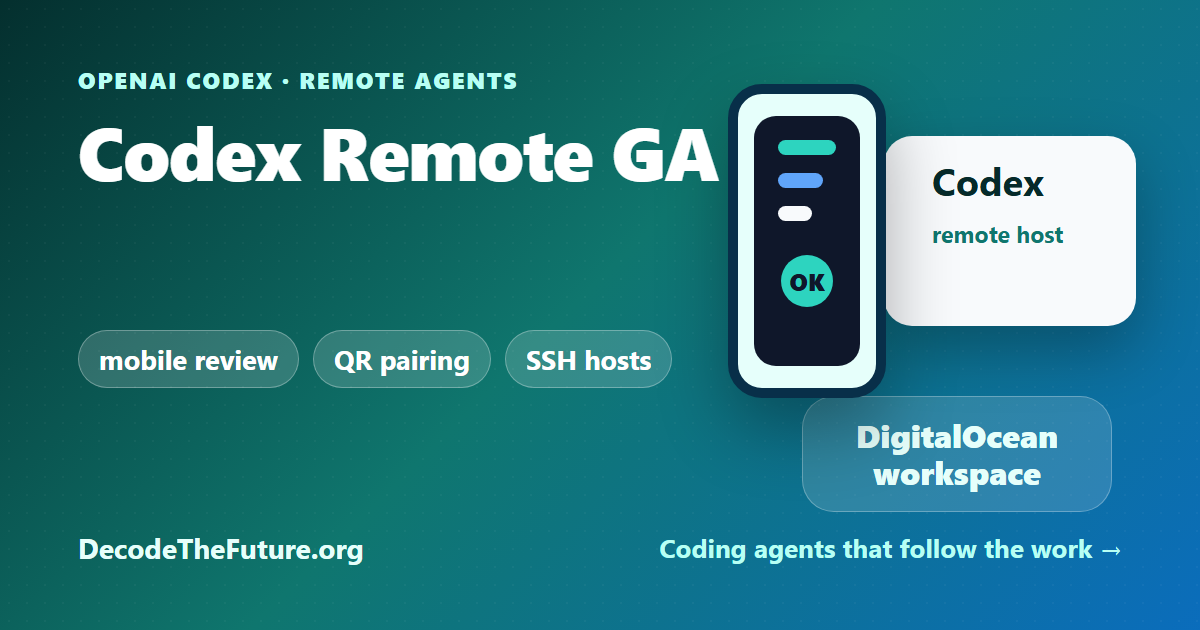

Codex Remote became generally available on all ChatGPT plans on June 25, 2026. The important change is not “Codex on a phone”; it is remote control of long-running coding work. From the ChatGPT mobile app, users can start or continue Codex work on a connected Mac or Windows host, review diffs, terminal output, tests and screenshots, approve actions, answer questions and switch between hosts. Remote Control now uses authenticated one-to-one QR pairing, and the new DigitalOcean plugin lets Codex provision a Droplet, configure SSH access and connect it as a remote workspace. OpenAI says users should update both the ChatGPT mobile app and Codex app before connecting.
What did OpenAI launch?
OpenAI’s June 2026 Codex changelog and remote-connection docs make the product shift clear: Codex Remote turns a coding agent into supervised work that can move across devices and hosts. In plain English: you can keep a coding agent running on a real development host, then supervise it from another device instead of staying glued to the machine where the repo is open.
The developer docs describe three remote modes: controlling a Codex App host from the ChatGPT mobile app, continuing work from another Codex App device, and connecting to projects on remote machines over SSH. This makes Codex less like a single IDE panel and more like an agent operations surface.
For background, see OpenAI Model Spec Explained, Best AI Coding Assistants 2026 and AI Agent Architecture Explained.
Codex Remote is a supervision layer, not an unsupervised autopilot
The best mental model is “remote pair-programming with an agent that can keep working.” You still decide what repository it may access, which actions it may approve, which host it runs on and when to stop it. The mobile app simply changes where the human reviewer sits.
That matters because coding agents fail in boring, practical ways: they need a clarification, a command approval, a test log read, a screenshot check or a direction change. Codex Remote reduces the dead time between those human checkpoints. It does not remove the need for checkpoints.
The unit of work is no longer “ask a model in the IDE.” It is “delegate a task to a host, monitor state, approve risky actions, and resume from wherever you are.”
The new DigitalOcean plugin changes the workspace story
The same release adds a DigitalOcean Droplet Workspace plugin. OpenAI says the plugin can provision a Droplet, configure SSH access and connect it to the Codex App as a remote workspace. That is a small sentence with large implications: the agent can move from your laptop into a disposable or dedicated cloud machine.
For serious teams, remote workspaces are cleaner than running everything on a personal laptop. They can isolate credentials, run heavier tests, keep long tasks alive, and separate experimental agent work from the developer’s primary machine. The trade-off is governance: secrets, network egress, logs and cloud spend need policy before engineers start spinning up agent hosts casually.
What changed technically?
| Capability | What OpenAI says | Practical meaning |
|---|---|---|
| Mobile control | Start or continue Codex work from ChatGPT mobile | Engineers can unblock long runs away from the desk. |
| Host pairing | Authenticated one-to-one QR pairing | Each supported mobile device pairs to each host deliberately. |
| Review surface | Diffs, tests, terminal output, screenshots and outputs | The phone is for supervision, not writing every line manually. |
| SSH projects | Connect Codex App to projects on SSH hosts | Remote machines become first-class agent workspaces. |
| DigitalOcean plugin | Provision Droplet, configure SSH, connect workspace | Cloud agent sandboxes get easier to create. |
Security and admin implications
The QR pairing change is the right direction: a remote-control feature needs a clear device-to-host trust boundary. But QR pairing is not the whole control model. Teams still need to define which repos can be opened, whether production secrets are mounted, what network endpoints the host can reach, which commands require approval and how long remote hosts live.
For regulated or enterprise environments, the DigitalOcean plugin should be treated like infrastructure automation. A Droplet created by a coding agent is still infrastructure. It needs cost controls, image standards, SSH key rotation, logging and teardown policy.
OpenAI also notes that signing out turns off Remote Control without removing existing pairings. That is convenient, but it is not a full device-management policy. Teams should still document how hosts are paired, who can approve actions, and when stale pairings or cloud workspaces are removed.
Who should care?
Codex Remote matters most for developers already delegating tasks longer than one prompt: dependency upgrades, failing-test investigation, refactors, docs migrations, small feature branches, issue reproduction and code review follow-ups. If your average agent task takes 30 seconds, mobile supervision barely matters. If it takes 20 minutes and pauses twice for permission, it matters a lot.
It also matters for teams comparing agent platforms. GitHub is pushing Copilot deeper into IDEs and cloud agents. Anthropic is pushing Claude Code and Sonnet 5. Cursor is pushing agentic IDE workflows. OpenAI’s angle is becoming clear: Codex is not only a model call; it is a managed agent workspace that can follow you across devices.
FAQ
What is Codex Remote?
Codex Remote is OpenAI’s remote-control workflow for Codex. It lets users supervise Codex work on a connected host from another device, including the ChatGPT mobile app.
Is Codex Remote generally available?
OpenAI’s ChatGPT release notes say Codex Remote became generally available on all ChatGPT plans on June 25, 2026.
What can you do from mobile?
You can start or continue work, answer Codex questions, steer active work, approve commands and actions, review diffs, tests, terminal output and screenshots, and switch between connected hosts.
What is the DigitalOcean Codex plugin?
OpenAI says the plugin can provision a DigitalOcean Droplet, configure SSH access and connect it to the Codex App as a remote workspace.
Does Codex Remote replace code review?
No. Codex Remote makes supervision easier, but engineers still need to review diffs, tests, permissions, secrets, network access and final merge decisions.
Bibliography (11 sources)
- OpenAI release notes – Codex Remote GA and DigitalOcean plugin
- OpenAI Developers – Codex cloud tasks
- OpenAI Developers – Codex remote connections
- OpenAI Developers – Codex changelog
- OpenAI Developers – Codex IDE extension
- OpenAI Developers – Codex authentication
- OpenAI Developers – Codex CLI
- OpenAI Developers – Codex documentation bundle
- OpenAI Developers – Codex plugins
- OpenAI Developers – Run long-horizon tasks with Codex
- OpenAI Developers – Codex subagents