

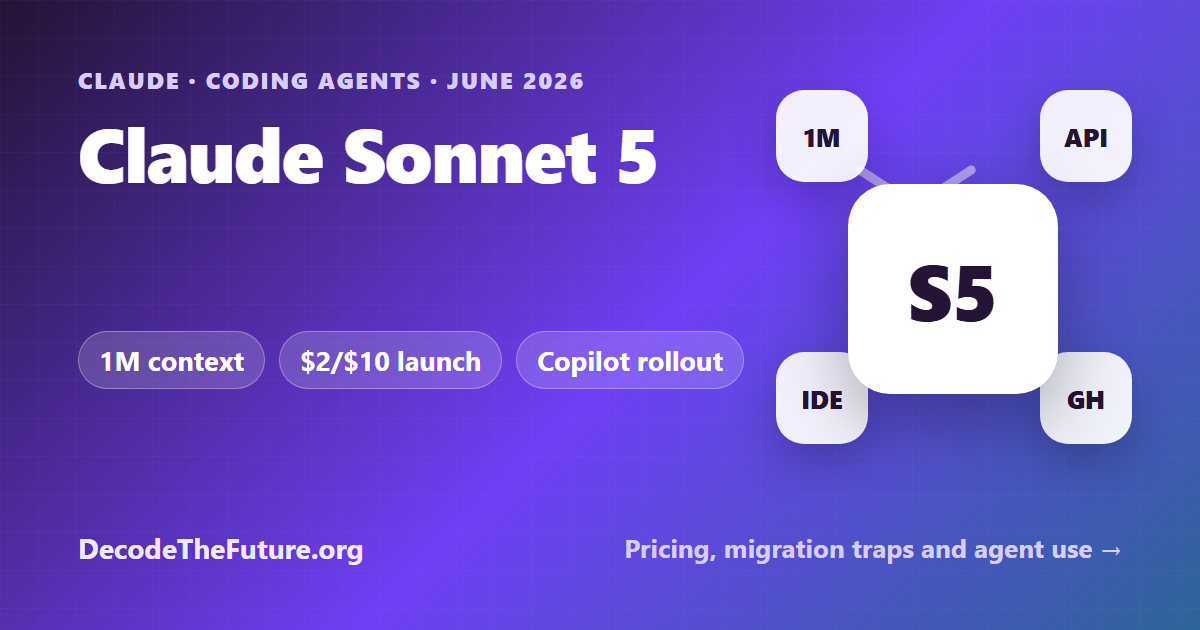

Claude Sonnet 5 is Anthropic’s June 30, 2026 Sonnet upgrade for coding, tool use and everyday agents. The practical story is cost-performance: it brings some Opus-class agent behavior into the lower-cost Sonnet tier, launches as the default model for Claude Free and Pro users, reaches Claude Code and the Claude API as claude-sonnet-5, supports a 1M-token context window and 128k max output, and has introductory API pricing of $2 input / $10 output per million tokens through August 31, 2026 before moving to $3 / $15. The migration traps are real: adaptive thinking is now default, manual extended thinking is removed, non-default sampling parameters can return 400 errors, and Anthropic says the new tokenizer can produce up to about 35% more tokens depending on content.
What changed with Claude Sonnet 5?
Claude Sonnet 5 is not just a normal model refresh. Anthropic is positioning it as the lower-cost execution layer for agentic work: planning, coding, browsing, terminal use and multi-step knowledge work that previously pushed teams toward Opus-class models.
The announcement says Sonnet 5 is close to Claude Opus 4.8 on some agentic tasks at a lower price. That does not mean it replaces Opus for every hard problem. It means the default tier for everyday agents just moved upward, especially for codebase work where the model has to hold a plan, call tools, check its work and recover from intermediate failures.
For the existing DTF stack, this sits between Claude Models 2026, Claude Opus 4.8 and Cursor vs Claude Code. Opus remains the high-autonomy ceiling; Sonnet 5 is the model many teams will actually put on volume.
Claude Sonnet 5 facts that matter
| Decision point | Claude Sonnet 5 | Why it matters |
|---|---|---|
| API model ID | claude-sonnet-5 | Use the new ID directly; do not assume an older Sonnet alias upgrades automatically. |
| Launch date | June 30, 2026 | This is a fresh news event, not an old Sonnet 4.x refresh. |
| Context window | 1M tokens | Large repos, long traces and tool transcripts can stay in-window longer. |
| Max output | 128k tokens | Large patch plans, migration reports and generated docs can be produced in one turn. |
| Intro pricing | $2 input / $10 output per MTok through Aug. 31, 2026 | Good short-term window for benchmarking agent workloads. |
| Standard pricing | $3 input / $15 output per MTok from Sept. 1, 2026 | Same price band as recent Sonnet models, but stronger agent behavior. |
| Copilot availability | Pro, Pro+, Max, Business and Enterprise rollout | GitHub is putting Sonnet 5 into mainstream developer surfaces. |
The cost-performance story
Anthropic’s core claim is that Sonnet 5 narrows the gap with Opus 4.8 while staying in the Sonnet price class. That is important because coding agents are not priced by list price alone; they are priced by long traces, repeated tool calls, failed attempts, test output and repo context. A small difference in tokens-per-task can become a large difference in monthly spend.
The introductory price makes the launch period unusually useful. Teams can run real evaluation suites during July and August 2026, compare Sonnet 5 against Sonnet 4.6 and Opus 4.8, and decide whether to move routine agent loops to Sonnet 5 before the standard $3/$15 rate begins.
Do not benchmark Sonnet 5 with one-off prompts. Use full agent traces: issue triage, repo search, patch generation, test execution, failure recovery and final diff review. The model is being sold on follow-through, not chat completion.
The migration traps
The release notes make three changes worth flagging before anyone changes model IDs in production. First, adaptive thinking is now on by default. Second, manual extended thinking with a fixed token budget is removed for Sonnet 5 and can return a 400 error. Third, non-default temperature, top_p or top_k can also return a 400 error. If your wrapper sets sampling parameters by habit, remove them before rollout.
The tokenizer note is just as important. Anthropic says the updated tokenizer can map the same input to roughly 1.0x to 1.35x as many tokens depending on content. That does not automatically mean every bill goes up 35%, because better task completion may reduce turns, retries or wasted context. But it does mean you should compare complete task cost, not only per-million-token pricing.
There is also a safety and cybersecurity nuance. Anthropic says Sonnet 5 is safer overall than Sonnet 4.6 in agentic contexts, but it still ships with cyber safeguards and Anthropic continues to recommend Opus-class models for advanced cybersecurity work that requires reduced guardrails. Treat Sonnet 5 as a high-volume software-engineering model, not as a replacement for specialized security review.
Why the GitHub Copilot rollout matters
GitHub’s June 30 changelog says Claude Sonnet 5 is coming to the model picker across VS Code, Visual Studio, Copilot CLI, GitHub Copilot cloud agent, GitHub Copilot App, github.com, GitHub Mobile, JetBrains, Xcode and Eclipse. That makes the launch bigger than the Claude API alone.
The strategic reading is simple: Sonnet 5 is designed to be everywhere developers already work. It is the model you can try without changing your whole toolchain, especially if your team already uses Copilot model policies. For a broader buyer view, see Best AI Coding Assistants 2026 and Best AI Agent Frameworks 2026.
Should you switch?
Switch to Sonnet 5 first for volume agent loops: code review drafts, bug reproduction, migration planning, doc generation, data extraction from long internal docs and agent runs that need a large context window but do not justify Opus on every turn. Keep Opus 4.8 for unusually ambiguous architecture work, high-risk production incidents and deep autonomy where one failed chain costs more than the model bill.
The safest rollout is not a flag flip. Put Sonnet 5 behind a router, log task-level cost and success, and compare it against your current Sonnet and Opus routes for two weeks. The right metric is cost per merged fix or accepted task, not tokens per prompt.
FAQ
What is Claude Sonnet 5?
Claude Sonnet 5 is Anthropic’s June 30, 2026 Sonnet model for coding, tool use, browsing, terminal work and everyday agents. It is designed to bring stronger agentic behavior into the lower-cost Sonnet tier.
How much does Claude Sonnet 5 cost?
Anthropic lists introductory API pricing of $2 per million input tokens and $10 per million output tokens through August 31, 2026. Starting September 1, 2026, standard pricing is $3 input and $15 output per million tokens.
Does Claude Sonnet 5 have 1M context?
Yes. Anthropic’s API release notes say Claude Sonnet 5 supports a 1M-token context window and 128k maximum output tokens.
Is Claude Sonnet 5 available in GitHub Copilot?
Yes. GitHub says Sonnet 5 is rolling out to Copilot Pro, Pro+, Max, Business and Enterprise users across its model picker surfaces, including VS Code, Copilot CLI, cloud agent, mobile, JetBrains and Xcode.
What breaks when migrating from Sonnet 4.6?
The main issues are default adaptive thinking, removal of manual extended thinking budgets, rejection of non-default sampling parameters, and a new tokenizer that Anthropic says can produce up to about 35% more tokens depending on content.
Bibliography (10 sources)
- Anthropic – Introducing Claude Sonnet 5
- Anthropic API release notes – Claude Sonnet 5
- Anthropic pricing – Sonnet 5 introductory and standard pricing
- Claude Platform Docs – model pricing table
- Claude Platform Docs – models overview
- Claude Platform Docs – context windows
- GitHub Changelog – Claude Sonnet 5 for Copilot
- GitHub Docs – Copilot models and pricing
- Claude apps release notes – Sonnet 5 launch
- Claude Platform Docs – Opus 4.8 context for comparison