


Last updated: October 3, 2026
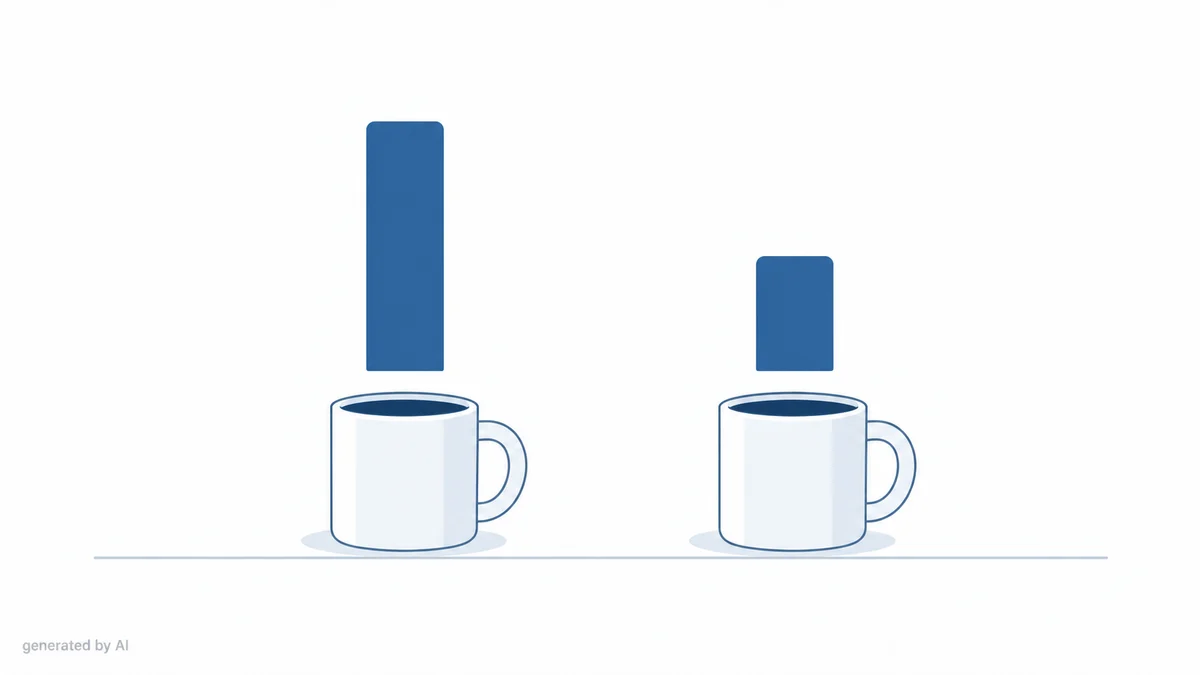
The endowment effect is the tendency to value something more highly simply because you own it. In the classic 1990 experiment by Kahneman, Knetsch and Thaler, students given a Cornell coffee mug asked a median $7.12 to sell it, while students without one would pay only $2.87 to buy the same mug, a gap of more than two to one. The effect is usually explained by loss aversion, since giving up an owned item feels like a loss, and it shrinks sharply for experienced traders and goods bought purely for resale.
Why does the mug in your hand feel worth more than the identical mug on the shop shelf? Standard economics says it should not: a rational person should be willing to sell an item for about the same price they would pay to buy it. Behavioral economists have shown for four decades that people systematically break that rule. This guide explains what the endowment effect is, the experiments behind it, how strong it really is, where it shows up in investing, housing and marketing, and the evidence that limits it.
What is the endowment effect?
The endowment effect is the finding that people demand more to give up an object than they would pay to acquire it. Economists measure it as the gap between willingness to accept (WTA, the lowest price at which you would sell) and willingness to pay (WTP, the highest price at which you would buy). Without the effect, WTA and WTP for the same cheap item should be roughly equal. With it, WTA is typically about twice WTP in laboratory studies.
The term was coined by Richard Thaler in 1980, in his paper “Toward a Positive Theory of Consumer Choice”, where he used it to describe the extra value people attach to goods they already have. Thaler later received the 2017 Nobel Prize in Economics partly for this line of work.
What did the mug experiment show?
Ownership alone roughly doubled the price people put on a mug. In their 1990 study “Experimental Tests of the Endowment Effect and the Coase Theorem”, Daniel Kahneman, Jack Knetsch and Richard Thaler gave Cornell coffee mugs to half the students in a class and let them trade with the other half. They found:
| Group | Question | Median valuation |
|---|---|---|
| Sellers (given a mug) | Lowest price at which you would sell | $7.12 |
| Choosers (no mug) | Would you rather have the mug or this amount of cash? | $3.12 |
| Buyers (no mug) | Highest price you would pay | $2.87 |
The choosers are the clever control. Like sellers, they decide between a mug and money; like buyers, they do not own the mug. Their valuation sits next to the buyers’, which points to ownership itself, not budget limits or bargaining tactics, as the cause of the gap.
The experiment also tested a prediction of standard economics, the Coase theorem: if mugs are randomly assigned and trading costs are near zero, about half of them should change hands, because roughly half of the owners value a mug less than some non-owner does. With 22 mugs, about 11 trades were expected. Observed volume was always much lower. An earlier study by Knetsch (1989) found the same pattern with a swap: preferences for a mug over a chocolate bar ranged from 10% to 89%, depending only on which item people had been given first.
How big is the endowment effect?
In most lab studies with ordinary goods, willingness to accept is about twice willingness to pay, but the gap varies widely. It is larger for goods without close substitutes and for items with emotional or identity value. In one study of Duke University students who had entered a lottery for tickets to the 1994 NCAA Final Four basketball games, Ziv Carmon and Dan Ariely found that winners’ selling prices were about 14 times higher than non-winners’ buying prices. The gap is smallest for money-like goods held for exchange, such as stock held by a dealer or cash itself.
Why does the endowment effect happen?
The leading explanation is loss aversion: selling something you own is coded as a loss, and losses weigh roughly twice as much as equal gains. This idea comes from prospect theory, in which outcomes are judged relative to a reference point, here what you already have. Giving up the mug moves you below that reference point; buying it moves you above. Because the loss feels larger, sellers demand more. See our explainer on loss aversion for the evidence behind that ratio.
Researchers have proposed several complementary mechanisms:
- Ownership and identity. Things we own become associated with ourselves, so we evaluate them more favourably, even after brief, random ownership.
- Attention. Owners focus on what they would lose, buyers on what they would spend; each side weighs different attributes.
- Reference prices and “bad deal” aversion. People dislike selling below, or buying above, what they consider a fair market price.
- Uncertainty about value. When people are unsure what a good is worth, holding on to it feels safer than trading.
Morewedge and Giblin (2015) review these explanations and argue that ownership changes which attributes of a good people pay attention to, which can account for many results that pure loss aversion does not.
Is the endowment effect the same as loss aversion?
No. Loss aversion is the general principle; the endowment effect is one of its most visible consequences. The table below separates the endowment effect from four biases it is often confused with.
| Bias | What it is | Typical example |
|---|---|---|
| Endowment effect | Valuing an item more because you own it | Asking $7 for a mug you would only pay $3 for |
| Loss aversion | Losses hurt more than equal gains feel good | Refusing a 50/50 bet to win $110 or lose $100 |
| Status quo bias | Preferring the current state of affairs over change | Keeping the default pension fund or energy tariff |
| Sunk cost fallacy | Letting past, unrecoverable costs drive future choices | Watching a bad film to the end because the ticket was paid (koszty utopione in Polish) |
| Disposition effect | Selling winning investments too early and holding losers too long | Keeping a falling stock “until it gets back to what I paid” |
The endowment effect and status quo bias often appear together, which is why Kahneman, Knetsch and Thaler discussed them in the same 1991 paper. The practical difference is that the endowment effect is about the value of a specific object, while status quo bias is about avoiding a change of state, even when no object is at stake.
Where does the endowment effect show up in real life?
Investing
Investors often hold inherited shares or long-held positions that they would never buy today at the current price. The test “would I buy this at today’s price if I held cash instead?” exposes the effect: if the answer is no, the main reason to keep the position is ownership. Combined with loss aversion, this feeds the disposition effect and portfolios that drift away from the investor’s own plan.
Selling a house
Homeowners routinely list properties above what buyers will pay, and the gap widens when selling would lock in a loss. Genesove and Mayer (2001) found that Boston condominium owners facing a nominal loss set higher asking prices and waited longer to sell than owners who were in profit. That study is evidence of loss aversion around a reference price, and it explains why the endowment effect is costly in markets for large, unique assets.
Marketing: free trials, test drives and returns
Free trials, generous return policies, test drives and “try at home” offers all work partly because they create a sense of ownership before payment. Once a product feels like yours, giving it back feels like a loss. The same logic applies to customised products and to digital subscriptions that store your data, which is one reason the nudge literature treats defaults and trials as powerful, and sometimes manipulative, design choices.
Everyday clutter
Keeping clothes you never wear or gadgets you will never use is the endowment effect at home. Decluttering advice that asks “would I buy this again today?” or “would I take it if it were free?” works by switching your perspective from owner to buyer.
Does the endowment effect always happen? The criticism
No. The effect is robust in many lab settings, but experience, procedure and the type of good can shrink it or make it disappear. Three lines of evidence matter:
- Experimental procedure. Plott and Zeiler (2005) argued that the WTA–WTP gap in mug studies partly reflects how valuations are elicited. With anonymity, practice rounds and careful training in incentive-compatible bidding, the gap they measured for mugs disappeared. Later work has debated how far that result generalises.
- Market experience. In a field experiment at sports-card shows, John List (2003) found a strong endowment effect among inexperienced traders, but little or none among dealers and frequent traders. Experience seems to teach people to treat goods as exchangeable.
- Goods held for exchange. Money, tokens and inventory bought to resell show little or no endowment effect, consistent with the idea that people do not “lose” what they always intended to trade.
The fair reading is that the endowment effect is real but conditional. It is strongest for inexperienced people, one-off decisions and goods held for use or with personal meaning, which describes most consumer choices and many personal investment decisions.
How can you overcome the endowment effect?
- Ask the buyer’s question. “If I did not own this, would I buy it today at this price?” Answer it before deciding to keep or sell.
- Decide rules in advance. Set sell or rebalancing rules for investments when you buy, not when you are attached to the position.
- Use an outside view. Look at what comparable items actually sell for, not what you paid or feel they are worth.
- Separate the item from the memory. A photo can keep the memory of an object you no longer need.
- Be wary of trials. Before a free trial ends, decide as if you had never tried the product.
For the broader family of decision errors and how they interact, see our overview of cognitive biases and the behavioral finance guide.
FAQ
What is the endowment effect in simple terms?
It is the tendency to value something more just because you own it. People typically ask about twice as much to sell an item as they would pay to buy the same item.
Who discovered the endowment effect?
Richard Thaler named it in 1980. The best-known evidence comes from the 1990 mug experiments by Daniel Kahneman, Jack Knetsch and Richard Thaler.
Is the endowment effect the same as loss aversion?
No. Loss aversion is the general tendency to weigh losses more than equal gains. The endowment effect is one consequence: giving up something you own feels like a loss, so you demand more to sell it.
What is an example of the endowment effect?
In the Cornell mug experiment, owners asked a median $7.12 to sell a mug, while non-owners would pay only $2.87. Other examples include overpricing your own house and keeping inherited shares you would not buy today.
Does the endowment effect affect experienced traders?
Much less. In John List’s 2003 study of sports-card markets, experienced dealers showed little or no endowment effect, while inexperienced traders showed a strong one.
How do you avoid the endowment effect?
Ask whether you would buy the item today at its current price if you did not own it, set sell rules before you become attached, and compare with real market prices instead of what you paid.
Sources and further reading
- Thaler, R. (1980). Toward a positive theory of consumer choice. Journal of Economic Behavior & Organization, 1(1), 39–60. doi:10.1016/0167-2681(80)90051-7
- Kahneman, D., Knetsch, J. L., & Thaler, R. H. (1990). Experimental tests of the endowment effect and the Coase theorem. Journal of Political Economy, 98(6), 1325–1348. doi:10.1086/261737
- Kahneman, D., Knetsch, J. L., & Thaler, R. H. (1991). Anomalies: The endowment effect, loss aversion, and status quo bias. Journal of Economic Perspectives, 5(1), 193–206. doi:10.1257/jep.5.1.193
- Knetsch, J. L. (1989). The endowment effect and evidence of nonreversible indifference curves. American Economic Review, 79(5), 1277–1284.
- Carmon, Z., & Ariely, D. (2000). Focusing on the forgone: How value can appear so different to buyers and sellers. Journal of Consumer Research, 27(3), 360–370. doi:10.1086/317590
- Plott, C. R., & Zeiler, K. (2005). The willingness to pay–willingness to accept gap, the “endowment effect,” subject misconceptions, and experimental procedures for eliciting valuations. American Economic Review, 95(3), 530–545. doi:10.1257/0002828054201387
- List, J. A. (2003). Does market experience eliminate market anomalies? Quarterly Journal of Economics, 118(1), 41–71. doi:10.1162/00335530360535144
- Genesove, D., & Mayer, C. (2001). Loss aversion and seller behavior: Evidence from the housing market. Quarterly Journal of Economics, 116(4), 1233–1260. doi:10.1162/003355301753265561
- Morewedge, C. K., & Giblin, C. E. (2015). Explanations of the endowment effect: An integrative review. Trends in Cognitive Sciences, 19(6), 339–348. doi:10.1016/j.tics.2015.04.004