


Last updated: May 2026
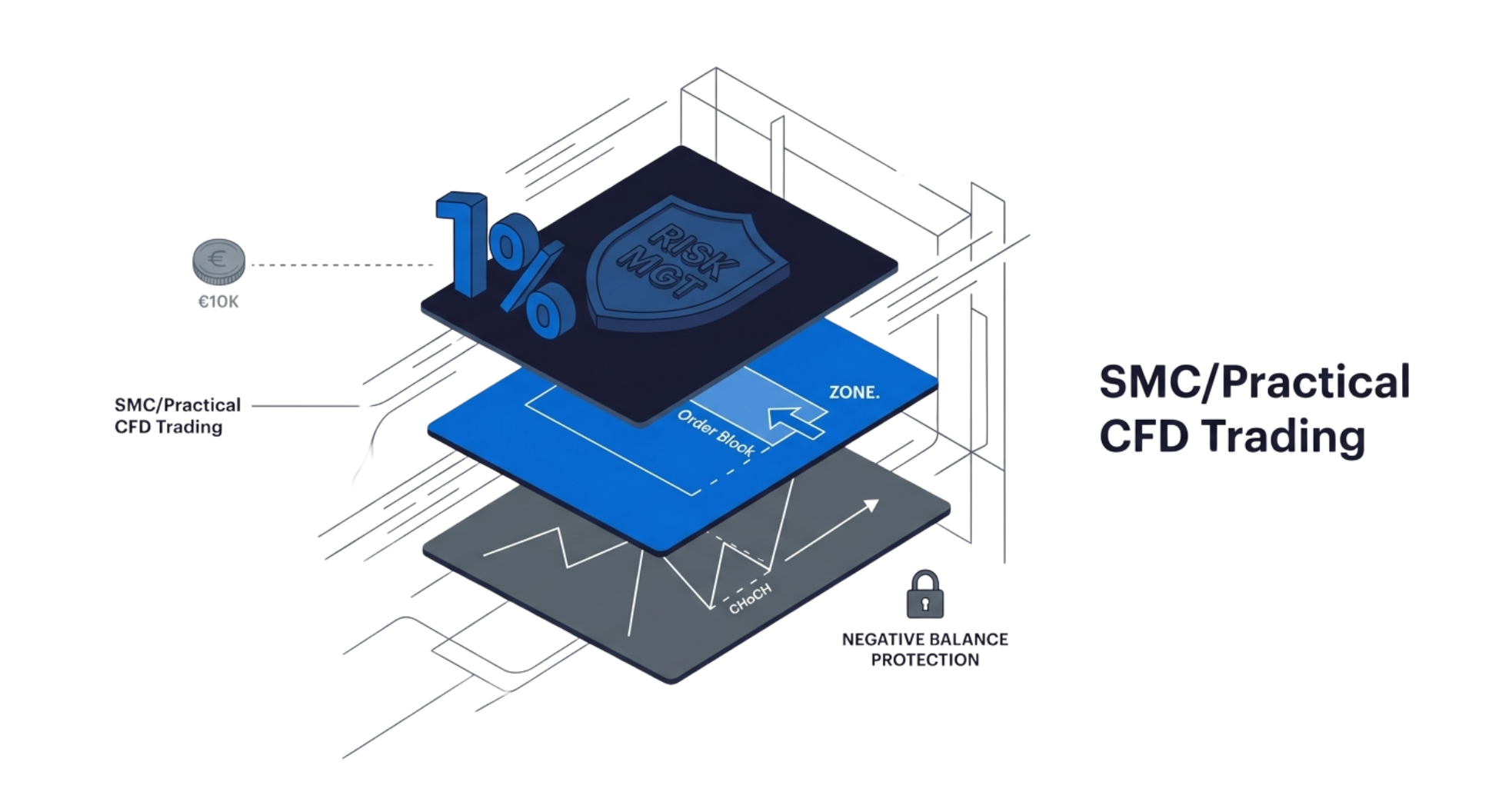
Practical CFD trading sits on three layers: technical (Smart Money Concepts — supply/demand zones, liquidity grabs, order blocks), procedural (pre-committed stop-loss, fixed fractional 1% sizing, daily loss cap) and behavioural (defending against loss aversion). ESMA broker disclosures show 74–89% of retail CFD accounts lose money over a one-year horizon in the EU — a number that mostly indexes execution architecture, not market difficulty. This article is a playbook from two years of trading on Plus500, mostly gold and indices, written from a European retail seat.
Why do 74–89% of retail CFD accounts lose money?
Under ESMA’s product intervention measures (Decision ESMA/2018/796, in force since 1 August 2018), every CFD broker serving retail clients in the EU must publish a “% of retail accounts losing money” disclosure on its website. The 74–89% range comes from ESMA’s original 2015–2017 dataset and has held in subsequent broker disclosures. Plus500’s own retail loss disclosure currently sits around 82%. The UK FCA adopted a permanent equivalent regime after Brexit (PS19/18), so the same statistical reality applies to UK retail traders. In the United States, retail CFDs are banned outright — the CFTC and SEC prohibit them, which is why Plus500, IG and similar venues do not accept US residents.
The important nuance: this is not “the market is unbeatable.” It is that the architecture of a typical retail account — high leverage, emotional exposure to every candle, no pre-committed stop-loss, frequent P&L checking — systematically shifts the outcome distribution to the left. Most retail losses on CFDs are not bad forecasts. They are bad execution procedure under loss aversion.
This article is not investment advice and not a recommendation to trade CFDs. It describes my own procedure from two years on Plus500, rebuilt after I blew up the first account. CFDs are a high-risk product regulated by ESMA in the EU and the FCA in the UK (retail leverage capped at 1:30 for FX majors, 1:20 for gold). They are unavailable to US retail clients. Read the warnings on the broker’s site and your local regulator’s investor pages before funding an account.
What are Smart Money Concepts (SMC)?
Smart Money Concepts is a price-action methodology popularised since around 2019 from Michael Huddleston’s “Inner Circle Trader” (ICT) materials. The core claim: prices in retail-accessible markets (FX, indices, gold) are driven by large participants — investment banks, hedge funds, market makers — who must enter and exit size without “pushing the tape.” They do this by accumulating in zones where retail stop-loss orders sit, then executing a directional move.
SMC replaces classic indicators (RSI, MACD, Bollinger Bands) with three structural concepts:
| SMC concept | What it means | Practical signal |
|---|---|---|
| Supply/demand zones | Areas where strong directional moves originated — large-player orders left unfilled | Price re-tagging the zone = potential entry setup |
| Liquidity grab | A short-term break of a level (e.g. swing high) to “sweep” retail stops, after which price reverses | Candle with long wick above prior high = potential reversal |
| Break of Structure (BOS) / Change of Character (CHoCH) | A break of the higher-highs / lower-lows sequence = trend change | BOS confirms continuation; CHoCH signals reversal |
In market-theory terms, SMC is a translation of what economists call market equilibrium — supply and demand zones are local equilibria where excess flow flips direction. The difference is timescale: macroeconomics looks at months, SMC at minutes and hours. There is no peer-reviewed evidence that SMC entries beat random entry on win rate alone — but the methodology forces discipline (only enter at a defined zone, exit beyond a defined liquidity sweep), which improves R:R and reduces overtrading. The edge comes from procedure, not prediction.
What leverage does ESMA allow on Plus500 and similar brokers?
Since 1 August 2018, ESMA (and the FCA after Brexit) have capped retail CFD leverage. The numbers are identical across the EU and the UK:
| Asset class | Max retail leverage | Margin per €1,000 of exposure |
|---|---|---|
| FX major pairs (EUR/USD, USD/JPY, GBP/USD) | 1:30 | ~€33 |
| FX minor pairs, major indices, gold | 1:20 | ~€50 |
| Other commodities, minor indices | 1:10 | €100 |
| Individual stocks | 1:5 | €200 |
| Cryptocurrencies | 1:2 | €500 |
For comparison — before 2018, many retail brokers offered 1:200 or 1:500. With gold’s typical daily range around 1%, one sideways session was enough to trigger a stop-out. ESMA’s 1:30 cap, together with mandatory negative-balance protection (you cannot lose more than your deposit), is currently one of the strongest consumer protections in European financial regulation.
“Professional client” status — requiring 2 of 3 criteria: a €500,000 portfolio, 10+ significant trades per quarter, or 1+ year of professional financial-services experience — unlocks higher leverage but removes negative-balance protection. In practice, for almost everyone reading this, that is a trap, not an upgrade.
What is the pre-trade procedure I run before opening a position?
The standard pre-trade checklist I have run on Plus500 since the second account (the first one I blew up without one):
Step 1 (macro context) is the one beginners most often skip. A US NFP print, a CPI release or an ECB / Fed rate decision is a window where Plus500 spreads can widen 5–10× within minutes. If the calendar shows an A-rank event in the next 30 minutes, I do not open a position at all — unless it is a deliberate news trade run on different rules.
Step 4 (position sizing) is where most retail traders get into trouble. They have €1,000 in the account, see a setup on gold, and enter with the full available margin. The actual arithmetic:
- Account capital: €10,000
- Max risk per trade: 1% = €100
- Distance from entry to stop-loss on gold: $5 (below a swing liquidity grab)
- Position size: €100 / ($5 × ~€0.92/$) ≈ 22 units, not 200
The math is boring. It is also the only thing standing between your account and a five-loss losing streak — which has roughly a 3% probability even in a system with 50% win rate, and which happens to every trader eventually.
How do I manage a position after it’s open?
The biggest sin of retail traders is active management of an open position — moving the stop-loss further out, closing early “to lock in gains,” adding to losing positions (“averaging down”). Each of those moves is a direct consequence of loss aversion and the disposition effect documented by Odean (1998).
My three rules after a position is open:
- No moving the SL further away. The stop-loss can only be tightened toward break-even or trailed in the direction of profit. Pulling the SL further from current price = immediate manual close of the position (the penalty for breaking the rule).
- No manual closes before TP. The take-profit is set at entry, anchored to an SMC zone. If price reaches it, we close automatically. The single exception: after 3 hours of no movement, or after a counter-direction BOS — break-even and exit.
- No averaging down. If the thesis is wrong, I take the full loss; I do not increase the position. Adding to a losing trade is a technique for professionals with 20 years of experience and tight risk controls. For retail it is a way to turn a 1R loss into a 3R loss.
What do I do after closing a position?
The most underrated phase. Winning trades write themselves up easily; losing trades you would prefer to forget. The trader’s journal is what protects you from myopic loss aversion (Benartzi & Thaler 1995) — if you do not write down why you entered, two weeks later you remember the P&L, not the process.
My journal (one Notion card per trade) holds:
- Entry thesis in 1–2 sentences (e.g. “gold M15 retest of H4 demand zone after liquidity grab below 2315”).
- Planned R:R (e.g. 1:2.4).
- Actual outcome in R (+R, −R, break-even).
- Weekly retrospective: was the thesis correct? Was the exit on plan? What would I do differently?
After about 100 such cards in 2023, the pattern was unambiguous: my biggest losses did not come from wrong theses. They came from broken execution discipline — oversizing after a winning streak, closing winners too early, fading the trend after a losing streak. That is consistent with Thaler’s Misbehaving (2015) and with Odean’s empirical work in the Journal of Finance (1998). See also our profile of Richard Thaler for the behavioural backbone.
Why trading should not be your primary income
A practical caveat you will not find in broker materials: if your monthly bills depend on trading P&L, you will trade under a pressure that destroys decision quality. This is not a willpower issue — it is the mechanics of loss aversion in real time. Every Sunday’s budget projection becomes a reference point against which deviations are scored by System 1.
I follow Thaler’s mental-accounting principle: trading capital sits in a separate bucket from “core finances.” By definition, the money on the CFD account is “money I can lose without changing my lifestyle.” Primary income comes from elsewhere (in my case, freelance AI / SEO writing on Upwork). If you cannot honestly draw that line, you are not in a position to trade CFDs yet — that is not a moral judgment, it is a structural one.
If you cannot fall asleep after opening a position, the position is too big. That is the simplest calibration test. Loss aversion with λ ≈ 2.25 (Tversky & Kahneman 1992) means 1% of capital at risk should be acceptable; 3% already triggers acute discomfort that lets System 1 take over.
The 6 rules that changed my results
The full playbook compressed into a printable checklist:
- Pre-commit to the stop-loss. Always set before entry. No exceptions.
- Fixed fractional 1%. Position size is derived from capital and SL distance, not from “how much margin do I have free.”
- Daily loss cap of −3%. After losing 3% of capital in a single day — done, platform closed until next session. Breaking this rule has always led to tilt and bigger losses.
- Maximum 3 trades per day. More opportunities do not exist; only more anxiety does. Quality > quantity.
- Journal the thesis, not the P&L. Written before entry, completed in retrospective.
- Check less often. A price alert on the phone instead of staring at the chart. Myopic loss aversion (Benartzi & Thaler 1995) is real and measurable.
What I deliberately don’t do, and why
- I don’t trade crypto CFDs. 1:2 leverage means a CFD on BTC has a worse cost-to-benefit ratio than buying spot crypto on a regulated exchange. Spreads are wider, overnight financing is more expensive, and you don’t actually own the asset.
- I don’t copy signals from Telegram or Discord. Most paid signal groups in retail markets sell marketing, not edge. Three groups tested in 2023: ~48% win rate, ~0.9 average R:R — negative expectancy after spreads. Selection bias does the rest of the marketing.
- I don’t use prop / funded trading without first verifying my own edge. Firms like FTMO, The Funded Trader and similar offer “capital for a fee.” A non-trivial slice of their economics comes from challenge fees, not profit splits. Pass a verification on demo and small live first; only then put real money into a challenge.
- I don’t run automated systems without a 500+ trade backtest. Every EA / bot needs at minimum a two-year backtest with a proper out-of-sample window. Most “free” MT4 / MT5 EAs on the internet contain look-ahead bias or curve-fitted parameters.
Regulatory context: ESMA, FCA, and the US carve-out
A retail CFD trader in the EU or UK has three layers of legal protection:
- ESMA Decision 2018/796 (made permanent at national level after the temporary measures expired) — leverage caps, mandatory loss-percentage warnings, negative-balance protection, ban on bonus incentives. In effect since 1 August 2018.
- FCA PS19/18 in the UK — substantively identical to ESMA, made permanent post-Brexit.
- MiFID II Article 30 — categorisation of clients into retail vs professional, with 2-of-3 criteria for professional status (€500k portfolio, 10+ significant trades per quarter, 1+ year of professional financial experience).
A broker that does not display its retail loss percentage, or that advertises leverage above 1:30 on FX majors to retail clients, is operating outside EU/UK law. For US residents the situation is simpler: retail CFDs are prohibited under CFTC and SEC rules, and offshore brokers offering them to US persons are unregulated and unsafe. Plus500 is listed on the LSE (PLUS) and licensed by the FCA + CySEC; it does not accept US clients for that reason.
Summary — CFD trading as an exercise in discipline
If I had to compress this entire article into one sentence: CFD trading is not a game of predicting the market — it is a game of executing a procedure under pressure from loss aversion. SMC provides a technical edge (a 30–40% win rate can be profitable at 1:2.5 R:R), risk management protects you from catastrophe, and the journal plus daily loss cap protect you from yourself.
The 74–89% retail-loss statistic is not magic. It is the predictable output of treating CFDs like a slot machine instead of a craft. If you feel the pull to “size up” after a winning streak, or to “win it back” after a loss — close the platform, re-read our piece on loss aversion, come back in 24 hours. Your real edge over other retail traders is not a better strategy — it is a better execution procedure.
For wider context see the disposition effect, anchoring, market equilibrium and cognitive biases.
Frequently asked questions
Can you make a living from CFD trading?
Statistically very hard. ESMA broker disclosures show 74–89% of retail CFD accounts in the EU lose money over a one-year horizon, and Plus500 reports its own ratio around 82%. The profitable minority skews heavily toward professionals with multi-year experience, custom systems and strict risk management. For a beginner, a separate primary income is not optional — it is a structural prerequisite.
Are Smart Money Concepts (SMC) actually an edge?
SMC is a price-action methodology built on supply/demand zones, liquidity grabs and structure breaks (BOS / CHoCH). There is no peer-reviewed evidence that SMC entries beat random entry on win rate alone. In practice, however, the methodology forces discipline (only enter at a defined zone, exit beyond a defined sweep), which improves R:R and reduces overtrading. The edge comes from procedure, not prediction.
What leverage does ESMA allow on Plus500 for retail clients?
Per ESMA 2018 (and FCA PS19/18 in the UK): 1:30 on major FX pairs, 1:20 on minor FX, major indices and gold, 1:10 on other commodities, 1:5 on individual stocks, 1:2 on cryptocurrencies. Professional clients can unlock higher leverage but lose negative-balance protection and other MiFID II safeguards.
Why are CFDs banned in the United States?
US securities and derivatives regulators (SEC, CFTC) prohibit CFDs for retail clients because they are over-the-counter contracts that are not exchange-traded and do not fit into the existing investor-protection framework. US residents wanting similar exposure use exchange-listed futures, options or leveraged ETFs. Offshore brokers offering CFDs to US persons are not regulated by US authorities and carry significant counterparty risk.
What position size should I use on CFDs?
Industry standard is fixed fractional 0.5–2% of account capital per trade, derived from the distance to stop-loss. Example: €10,000 account, 1% risk = €100, 5-point distance to SL — position is 20 units, not the maximum available. This arithmetic is what protects you from the 5–7 losing trades in a row that hit every trader eventually.
Can you move a stop-loss?
Only in the direction of profit (trailing SL or move to break-even after reaching 1R of profit). Pulling the SL further from current price to “give the position room” is a textbook disposition-effect mistake (Odean, 1998) — it converts 2–3 future trades into one losing one. In a disciplined procedure, breaking this rule = immediate manual close of the position.
What are the real costs of trading CFDs on Plus500?
Three components: (1) spread — bid/ask difference, typically 0.8–2 pips on EUR/USD and 30–50 cents on gold; (2) overnight financing — interest charged for holding a leveraged position to the next day, especially expensive in high-rate environments; (3) currency conversion fees — when the account currency differs from the instrument’s quote currency.
Is keeping a trader’s journal really necessary?
In practice, yes. Behavioural research shows that retrospective memory of trading decisions is heavily distorted by recency and by P&L — without a thesis written ex ante, you cannot tell whether your strategy is working or whether you are fitting it to outcomes after the fact. Minimum: entry thesis, planned R:R, result in R. Benartzi and Thaler (1995) showed that even the frequency of portfolio evaluation changes the subjective utility of outcomes.
Bibliography
- ESMA (2018). Decision on CFD leverage restrictions for retail clients, ESMA/2018/796. esma.europa.eu
- FCA (2019). PS19/18 — Restricting contract for difference products sold to retail clients. fca.org.uk
- Plus500 Ltd — Risk disclosure and retail accounts losing money statistics. plus500.com
- Odean, T. (1998). Are investors reluctant to realize their losses? Journal of Finance, 53(5), 1775–1798.
- Benartzi, S. & Thaler, R. H. (1995). Myopic loss aversion and the equity premium puzzle. Quarterly Journal of Economics, 110(1), 73–92.
- Kahneman, D. & Tversky, A. (1979). Prospect theory: An analysis of decision under risk. Econometrica, 47(2), 263–291.
- Tversky, A. & Kahneman, D. (1992). Advances in prospect theory: Cumulative representation of uncertainty. Journal of Risk and Uncertainty, 5(4), 297–323.
- Thaler, R. H. (2015). Misbehaving: The Making of Behavioral Economics. W. W. Norton.
- Barber, B. M., Lee, Y. T., Liu, Y. J. & Odean, T. (2014). The cross-section of speculator skill: Evidence from day trading. Journal of Financial Markets, 18, 1–24.
- Grinblatt, M. & Keloharju, M. (2001). What makes investors trade? Journal of Finance, 56(2), 589–616.
- Directive 2014/65/EU (MiFID II), Article 30 — categorisation of retail vs professional clients. eur-lex.europa.eu
- CFTC — Retail off-exchange forex and CFD framework, 17 CFR Part 5. cftc.gov
- Huddleston, M. (ICT) — Inner Circle Trader educational materials (SMC fundamentals: order blocks, liquidity grabs, fair value gaps).