

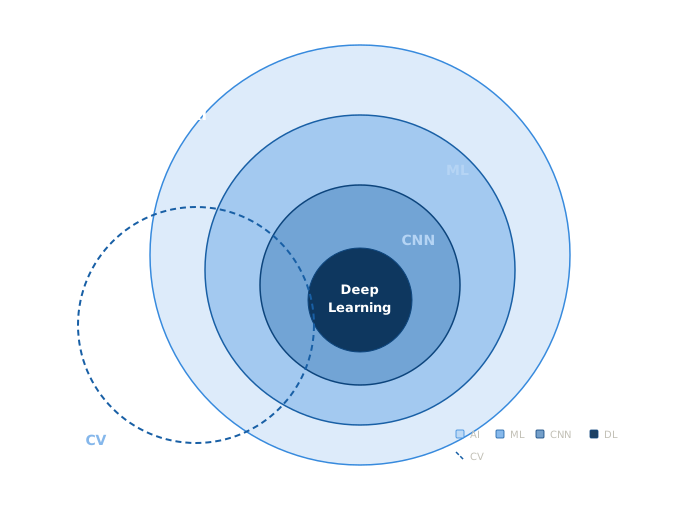

Computer vision is a field of artificial intelligence that enables machines to interpret, analyze, and extract meaning from visual data — images and video. It relies on deep learning architectures like convolutional neural networks (CNNs) and Vision Transformers (ViT) to perform tasks such as image classification, object detection, and semantic segmentation. In 2026, the computer vision market exceeds $24 billion, with edge AI, multimodal models, and the EU AI Act reshaping how the technology is built and deployed.
You unlock your phone with your face. A Tesla navigates a highway without your hands on the wheel. A radiologist catches a tumor that would have been missed five years ago. Behind all of these moments sits computer vision — the branch of artificial intelligence that gives machines the ability to see.
But “seeing” is the easy part. The hard part is understanding — recognizing that a cluster of pixels is a stop sign, distinguishing a pedestrian from a lamppost at night, or detecting a 2mm crack in a turbine blade moving at 60 frames per second. This article explains how computer vision works in 2026, what changed from simple CNNs to Vision Transformers, what the 7 core tasks are, and how the EU AI Act is redrawing the boundaries of what you can legally build with this technology.
How Does Computer Vision Work?
Computer vision follows a pipeline that mirrors — very roughly — how human visual perception works. Light hits a sensor (camera) instead of a retina. Raw pixel data gets preprocessed (adjusted for brightness, noise, resolution). Then a neural network extracts features — edges, textures, shapes — and maps them to meaningful outputs: a class label, a bounding box, a pixel mask.
The critical difference from traditional image processing (OpenCV filters, edge detection, thresholding) is that modern CV systems learn their own feature extractors from data. You don’t manually code rules for “what a cat looks like.” Instead, you feed a network millions of labeled images and let it discover the relevant patterns — a process made possible by deep learning.
The pipeline in practice looks like this:
What matters in 2026 is that step 3 — the backbone — is where the revolution happened. From 2012 to ~2020, convolutional neural networks (CNNs) dominated. Since 2020, Vision Transformers have been progressively replacing or hybridizing with CNNs. Understanding both architectures is essential for any practitioner.
From CNNs to Vision Transformers: The Architecture Shift
The CNN Era (2012–2020)
Convolutional neural networks powered virtually every computer vision breakthrough from AlexNet’s 2012 ImageNet victory through the rise of ResNet, VGG, and EfficientNet. CNNs work by sliding small filters (kernels) across an image, detecting local patterns — edges in early layers, textures in middle layers, object parts in deeper layers. This local inductive bias is both their strength and limitation: they’re data-efficient and train fast, but they struggle to capture long-range relationships between distant parts of an image without stacking many layers.
Key CNN architectures you should know: ResNet (2015) introduced skip connections that enabled training networks with 100+ layers. EfficientNet (2019) systematically scaled depth, width, and resolution for optimal performance-per-FLOP. YOLO (2015–present) unified object detection into a single-shot framework, enabling real-time detection — now in its YOLO26 iteration with sub-millisecond inference on NPU hardware.
The Vision Transformer Revolution (2020–present)
In October 2020, a Google Research team published a paper with an unforgettable title: “An Image is Worth 16×16 Words.” The Vision Transformer (ViT) proved that a pure transformer architecture — no convolutions at all — could match or exceed CNNs on image classification, as long as you trained it on enough data.
How ViT works: it splits an image into fixed-size patches (typically 16×16 pixels), flattens each patch into a vector, adds positional embeddings, and feeds the resulting sequence into a standard transformer encoder — exactly like feeding word tokens into a language model. Self-attention lets every patch “see” every other patch from the very first layer, capturing global context that CNNs can only approximate through deep stacking.
The tradeoff is clear: ViTs need much more training data (typically 30M–300M images) to match CNN accuracy on smaller datasets. But with sufficient data and compute, they scale better and capture richer representations. By 2026, the practical landscape has converged on hybrid approaches: architectures like Swin Transformer (shifted-window attention that mimics CNN-style local processing) and ConvNeXt (CNNs redesigned with transformer-era training recipes) blur the line between the two paradigms.
In 2026, the “CNN vs. ViT” debate is largely settled: use ViTs or hybrids when you have large datasets and need global reasoning (medical imaging, satellite analysis). Use efficient CNNs (YOLO26, EfficientNet) when you need real-time inference on edge hardware with limited data. The architecture matters less than the data quality and deployment constraints.
What Are the 7 Core Computer Vision Tasks?
Computer vision isn’t one thing — it’s a collection of distinct tasks, each with its own architecture, loss function, and evaluation metric. Here are the 7 tasks that define the field in 2026:
| Task | What it does | Output | Key models (2026) |
|---|---|---|---|
| Image Classification | Assigns a single label to an entire image | “cat” (97%) | ViT, EfficientNet, ConvNeXt |
| Object Detection | Locates and classifies multiple objects | Bounding boxes + class labels | YOLO26, DETR, RT-DETR |
| Semantic Segmentation | Classifies every pixel into a category | Pixel-wise mask (road, car, sky…) | SegFormer, Mask2Former |
| Instance Segmentation | Segmentation + distinguishing individual objects | Separate mask per object | Mask R-CNN, SAM 2 |
| Pose Estimation | Detects body keypoints (joints, skeleton) | Keypoint coordinates | ViTPose, RTMPose |
| Image Generation | Creates new images from text or other images | Synthetic image | Stable Diffusion 3, DALL-E 3, Flux |
| Video Understanding | Analyzes temporal sequences (action recognition, tracking) | Action labels, object tracks | VideoMAE, MViT v2, SlowFast |
These tasks are not isolated — production systems often chain them. An autonomous vehicle runs object detection to find other cars, semantic segmentation to understand the road surface, and pose estimation to predict pedestrian intent. A manufacturing quality control system combines classification (defect/no-defect) with segmentation (where exactly is the defect?) and generation (synthetic training data for rare defect types).
How to Build a Computer Vision Model: Code Examples
Theory matters, but practitioners need working code. Here are two examples — one for quick image processing with OpenCV, and one for training an image classifier with PyTorch and a pretrained ViT backbone.
Example 1: Edge Detection with OpenCV
import cv2
import numpy as np

# Load image and convert to grayscale
img = cv2.imread("factory_part.jpg")
gray = cv2.cvtColor(img, cv2.COLOR_BGR2GRAY)

# Apply Gaussian blur to reduce noise
blurred = cv2.GaussianBlur(gray, (5, 5), 1.4)

# Canny edge detection
edges = cv2.Canny(blurred, threshold1=50, threshold2=150)

# Find contours for defect localization
contours, _ = cv2.findContours(
    edges, cv2.RETR_EXTERNAL, cv2.CHAIN_APPROX_SIMPLE
)

# Filter small contours (noise) and draw remaining
for cnt in contours:
    if cv2.contourArea(cnt) > 100:  # min area threshold
        x, y, w, h = cv2.boundingRect(cnt)
        cv2.rectangle(img, (x, y), (x+w, y+h), (0, 0, 255), 2)

cv2.imwrite("detected_defects.jpg", img)
print(f"Found {len(contours)} potential defects")
This is classical computer vision — no neural networks, no training data. It works for simple, high-contrast inspection tasks but breaks down when backgrounds are complex or defects are subtle. That’s where deep learning takes over.
Example 2: Image Classification with PyTorch + ViT
import torch
import torchvision.transforms as T
from torchvision.models import vit_b_16, ViT_B_16_Weights

# Load pretrained Vision Transformer (ViT-B/16)
weights = ViT_B_16_Weights.IMAGENET1K_V1
model = vit_b_16(weights=weights)
model.eval()

# Preprocessing pipeline (matches training config)
preprocess = weights.transforms()

# Load and classify an image
from PIL import Image
img = Image.open("test_image.jpg")
input_tensor = preprocess(img).unsqueeze(0)  # add batch dim

with torch.no_grad():
    output = model(input_tensor)
    probabilities = torch.nn.functional.softmax(output[0], dim=0)

# Top-5 predictions
top5_prob, top5_idx = torch.topk(probabilities, 5)
categories = weights.meta["categories"]

for i in range(5):
    print(f"{categories[top5_idx[i]]}: {top5_prob[i].item():.2%}")
This loads a ViT-B/16 pretrained on ImageNet with ~86M parameters. For production use, you’d fine-tune with LoRA on your domain-specific dataset — medical images, satellite data, factory parts — which typically requires only 500–5,000 labeled examples to achieve strong performance.
Example 3: Real-Time Object Detection with YOLO
from ultralytics import YOLO

# Load a pretrained model
model = YOLO("yolo11n.pt")  # nano model for edge deployment

# Run inference on video stream
results = model.predict(
    source="rtsp://camera-feed:554/stream",
    stream=True,
    conf=0.5,        # confidence threshold
    device="0",       # GPU 0 (or "cpu" for CPU inference)
    show=True         # display live results
)

for result in results:
    boxes = result.boxes
    for box in boxes:
        cls = int(box.cls[0])
        conf = float(box.conf[0])
        label = model.names[cls]
        print(f"Detected: {label} ({conf:.1%})")
YOLO models are the workhorse of real-time CV. The nano variant runs at 100+ FPS on consumer GPUs and can be exported to TensorRT, ONNX, or OpenVINO for edge deployment on NVIDIA Jetson, Intel NUCs, or even smartphones.
Where Is Computer Vision Used in 2026?
The technology has moved far beyond academic benchmarks. Here are the sectors where computer vision delivers the highest production impact:
Autonomous vehicles and ADAS: Every major automaker now deploys multi-camera perception systems. Waymo reached approximately 450,000 paid robotaxi trips per week by late 2025 across five US cities, with plans to exceed one million weekly trips in 2026. The modern AV perception stack fuses 10–15 cameras with LiDAR and radar, processing everything through transformer-based models that predict not just what objects are present, but how they’ll behave in the next 2–3 seconds.
Medical imaging: CV models now assist with cancer detection (lung, breast, skin), diabetic retinopathy screening, and pathology slide analysis. Vision Transformers are especially effective here because they can correlate subtle patterns across an entire high-resolution scan that local CNN filters might miss. The FDA’s 2026 Clinical Decision Support guidance requires algorithm robustness across diverse demographics — a significant shift toward accountability.
Manufacturing and quality control: The “killer app” for enterprise CV. AI-powered visual inspection replaces statistical sampling with 100% automated checking. Pharmaceutical plants are installing hyperspectral cameras to detect contamination below 50 microns, driven by EU GMP Annex 1 compliance requirements. A typical deployment costs $100K–$300K but pays for itself by preventing a single major quality incident.
Retail and warehouse operations: Automated checkout systems, shelf monitoring, inventory tracking, and customer behavior analysis. Amazon’s Just Walk Out technology uses hundreds of ceiling cameras with pose estimation and tracking to create cashierless stores.
Agriculture: Drone-mounted cameras with multispectral sensors detect crop disease, water stress, and pest damage. Combined with GPS data, farmers can treat specific zones rather than entire fields — reducing pesticide use by 30–50% in documented deployments.
The EU AI Act and Computer Vision: What You Need to Know
If you’re building computer vision systems for the European market — or for users who might be in Europe — the EU AI Act is no longer theoretical. The high-risk system requirements become fully enforceable on August 2, 2026. Here’s what CV practitioners must understand:
Building facial recognition databases by scraping images from the internet or CCTV. Emotion recognition in workplaces or schools. Social scoring systems that classify people based on behavior or personal traits. Real-time remote biometric identification in public spaces (with narrow law enforcement exceptions).
High-risk classification (enforceable August 2026): Computer vision systems used for biometric identification (post-remote — analyzing recorded footage), employment decisions (CV screening, interview analysis), access to essential services (creditworthiness via facial analysis), law enforcement, and border control are classified as high-risk. This triggers mandatory requirements: risk management documentation, data governance protocols, human oversight mechanisms, bias testing across demographics, and registration in the EU database.
What’s NOT high-risk: Biometric verification (confirming you are who you claim to be — unlocking your phone with Face ID, for example) is explicitly excluded from high-risk classification. Standard industrial inspection, agricultural monitoring, and general object detection in non-sensitive contexts are minimal or no-risk under the Act.
Penalties: Up to €35 million or 7% of global annual turnover for prohibited practices. Up to €15 million or 3% for high-risk system violations. These are serious numbers — comparable to GDPR fines — and enforcement is expected to be active from day one.
The practical implication for developers: know your risk classification before you write the first line of code. Document your training data provenance, test for demographic bias, and build human oversight into your pipeline. This isn’t optional compliance theater — it’s the law, and it applies to anyone deploying CV systems that affect EU residents.
Computer Vision Trends Shaping 2026 and Beyond
The field is moving fast. Here are the trends that will define the next 2–3 years:
1. Multimodal vision-language models. The boundary between computer vision and large language models is dissolving. Models like GPT-4V, Gemini, and Claude can interpret images alongside text instructions. In manufacturing, this means an operator can describe a defect in words and the system generalizes — no labeling thousands of training images. This paradigm shift is the single biggest accelerator for CV adoption in enterprises that lack ML teams.
2. Edge AI and NPU hardware. Data sovereignty laws (EU, China) limit cloud transfers of visual data. The response: inference at the edge. Qualcomm, AMD, and Intel now embed neural processing units (NPUs) directly into consumer and industrial chips. Combined with model optimization (INT8 quantization, pruning, TensorRT compilation), you can run real-time object detection on a $50 single-board computer. This democratizes CV for agriculture, retail, and small manufacturing.
3. Foundation models for vision. DINOv2 (Meta), SigLIP (Google), and SAM 2 (Meta’s Segment Anything Model v2) are general-purpose vision backbones trained on massive datasets. They can be fine-tuned for specific tasks with minimal labeled data — 50–200 examples in some cases. This is analogous to how transfer learning transformed NLP, and it’s happening now in vision.
4. Synthetic data. Gartner projects that by 2028, 70% of computer vision models will depend on multimodal training data that cannot be achieved through real-world collection alone. Synthetic data — generated from 3D simulation engines — fills gaps for rare events (automotive crashes, medical anomalies) and edge cases (night fog, sensor noise). It’s especially critical for meeting EU AI Act requirements around demographic diversity in training data.
5. Video understanding beyond detection. The frontier has shifted from detecting objects in single frames to understanding temporal sequences: predicting what a pedestrian will do next, recognizing behavioral patterns that precede workplace accidents, and tracking objects across minutes of footage. Architectures like MViT and SlowFast networks process spatio-temporal data end-to-end, enabling proactive rather than reactive safety systems.
CNN vs. Vision Transformer: Which Should You Choose?
This is the question every practitioner faces when starting a new CV project. The answer depends on your constraints:
| Factor | CNN (ResNet, EfficientNet, YOLO) | Vision Transformer (ViT, Swin, DINOv2) |
|---|---|---|
| Training data needed | Works well with 1K–50K images | Best with 100K+ images (or pretrained backbone) |
| Inference speed | Optimized for real-time (YOLO: <1ms) | Slower; improving with FlashAttention |
| Global context | Limited — needs deep stacking | From layer 1 via self-attention |
| Edge deployment | Excellent (TensorRT, ONNX, TFLite) | Improving but still heavier |
| Best for | Real-time detection, embedded systems, limited data | Medical imaging, satellite, complex scene understanding |
| Scaling behavior | Plateaus with more data/compute | Keeps improving with scale |
The practical middle ground in 2026: start with a pretrained foundation model (DINOv2 or SigLIP), fine-tune on your domain data, and if you need edge deployment, distill into a smaller CNN-based student model. This “ViT-trains, CNN-deploys” pattern is becoming the industry default for production systems.
Getting Started: Tools and Frameworks
The computer vision ecosystem in 2026 is mature and well-documented. Here are the essential tools:
Training frameworks: PyTorch + torchvision remains the dominant choice for research and production. TensorFlow + Keras is still used in Google-adjacent ecosystems. Hugging Face Transformers now includes vision model support with consistent APIs across ViT, Swin, DINOv2, and DETR.
Classical CV: OpenCV (4.10+) for image processing, camera interfacing, and traditional algorithms. Still indispensable for preprocessing, augmentation, and non-ML components of the pipeline.
Edge inference: NVIDIA TensorRT for NVIDIA GPUs and Jetson hardware. Intel OpenVINO for Intel CPUs and VPUs. ONNX Runtime as a vendor-neutral option. Apple Core ML for iOS/macOS deployment.
Data labeling: CVAT (open-source, self-hosted), Label Studio, Roboflow. For segmentation tasks, Meta’s SAM 2 dramatically accelerates annotation — one click generates a high-quality mask that would take a human annotator minutes.
MLOps: Weights & Biases for experiment tracking. DVC for dataset versioning. MLflow for model registry and deployment pipelines. These are no longer optional — the EU AI Act’s documentation requirements make reproducible ML pipelines a compliance necessity.
From personal experience testing these tools: PyTorch + Ultralytics YOLO is the fastest path from idea to working prototype. For complex tasks requiring global understanding (medical, satellite), start with a Hugging Face ViT checkpoint and fine-tune. Always profile inference speed on your target hardware before committing to an architecture — what works on an A100 GPU may be unusable on an edge device.
FAQ
Bibliography & Sources
- Dosovitskiy, A. et al. (2020). An Image is Worth 16×16 Words: Transformers for Image Recognition at Scale. arXiv. arxiv.org/abs/2010.11929
- He, K. et al. (2015). Deep Residual Learning for Image Recognition. arXiv. arxiv.org/abs/1512.03385
- Redmon, J. et al. (2015). You Only Look Once: Unified, Real-Time Object Detection. arXiv. arxiv.org/abs/1506.02640
- Liu, Z. et al. (2021). Swin Transformer: Hierarchical Vision Transformer using Shifted Windows. arXiv. arxiv.org/abs/2103.14030
- European Parliament (2024). Regulation (EU) 2024/1689 — Artificial Intelligence Act. artificialintelligenceact.eu
- European Commission (2026). Navigating the AI Act — High-Risk System Requirements. digital-strategy.ec.europa.eu
- Fortune Business Insights (2025). Computer Vision Market Size, Trends | Forecast Analysis 2034. fortunebusinessinsights.com
- Mordor Intelligence (2025). Computer Vision Market Size, Share & Growth Trends, 2031. mordorintelligence.com
- OpenCV Team. OpenCV Documentation. docs.opencv.org
- PyTorch Team. TorchVision — Models and Datasets for Computer Vision. pytorch.org/vision
- Oquab, M. et al. (2023). DINOv2: Learning Robust Visual Features without Supervision. arXiv. arxiv.org/abs/2304.07193
- Kirillov, A. et al. (2023). Segment Anything. arXiv. arxiv.org/abs/2304.02643