Nudge Theory Explained: 7 Real-World Examples (2026)

Nudge Theory Explained: 7 Real-World Examples (2026)
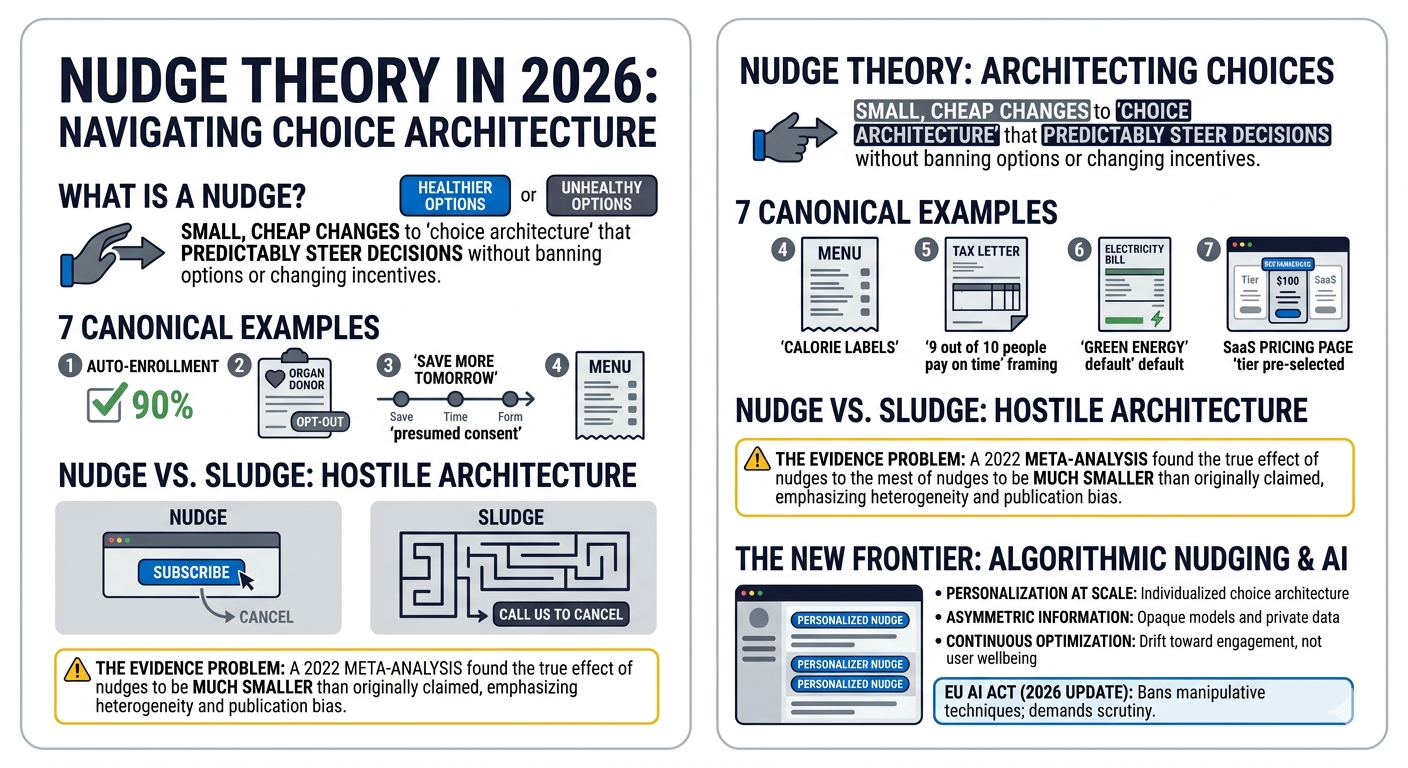
Last updated: April 2026 Nudge theory is a behavioral economics framework introduced by Richard Thaler and Cass Sunstein in 2008. It claims that small changes to choice architecture — the way options are presented — can predictably steer decisions without banning anything or changing economic incentives. Default enrollment, calorie labels and organ-donor opt-out systems are … Read more

12 Cognitive Biases That Distort Your Decisions in 2026

12 Cognitive Biases That Distort Your Decisions in 2026

Last updated: April 2026 Cognitive biases are systematic, predictable errors in human judgment that arise from mental shortcuts called heuristics. First mapped by psychologists Daniel Kahneman and Amos Tversky in the 1970s, researchers have since cataloged over 180 distinct biases affecting memory, perception, and decision-making. Understanding these biases is critical not only for personal choices … Read more

AI for Risk Management: 7 Frameworks, Code & 2026 Compliance

AI for risk management

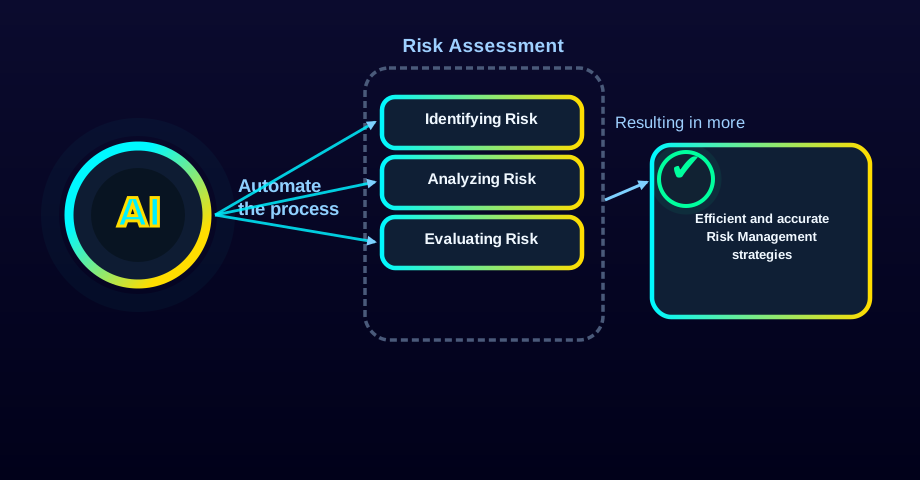
Last updated: April 2026 AI for risk management uses machine learning models, automated monitoring pipelines, and governance frameworks to identify, quantify, and mitigate risks across enterprise operations. In 2026, organizations must align with the NIST AI RMF and EU AI Act (most provisions effective August 2, 2026) while addressing new challenges from agentic AI, model … Read more

Prospect Theory: 7 Ways Loss Aversion Shapes Your Decisions

Last updated: March 2026 Prospect theory, developed by Daniel Kahneman and Amos Tversky in 1979, explains why losing $100 hurts roughly twice as much as gaining $100 feels good. The theory describes three core mechanisms that drive irrational decisions: reference-dependent evaluation (gains and losses measured from a starting point, not absolute wealth), loss aversion (losses … Read more

AI in Trading: 5 Types, Real Tools & Limits in 2026

Ai in trading

Last updated: March 2026 AI in trading refers to using machine learning, natural language processing, and reinforcement learning to analyze financial market data, generate trading signals, and optimize execution. Unlike traditional algorithmic trading that follows static rules, AI trading systems learn from data and adapt to changing market conditions — but they are not crystal … Read more