RLHF Explained: How Human Feedback Trains AI Models in 2026

RLHF Explained: How Human Feedback Trains AI Models in 2026
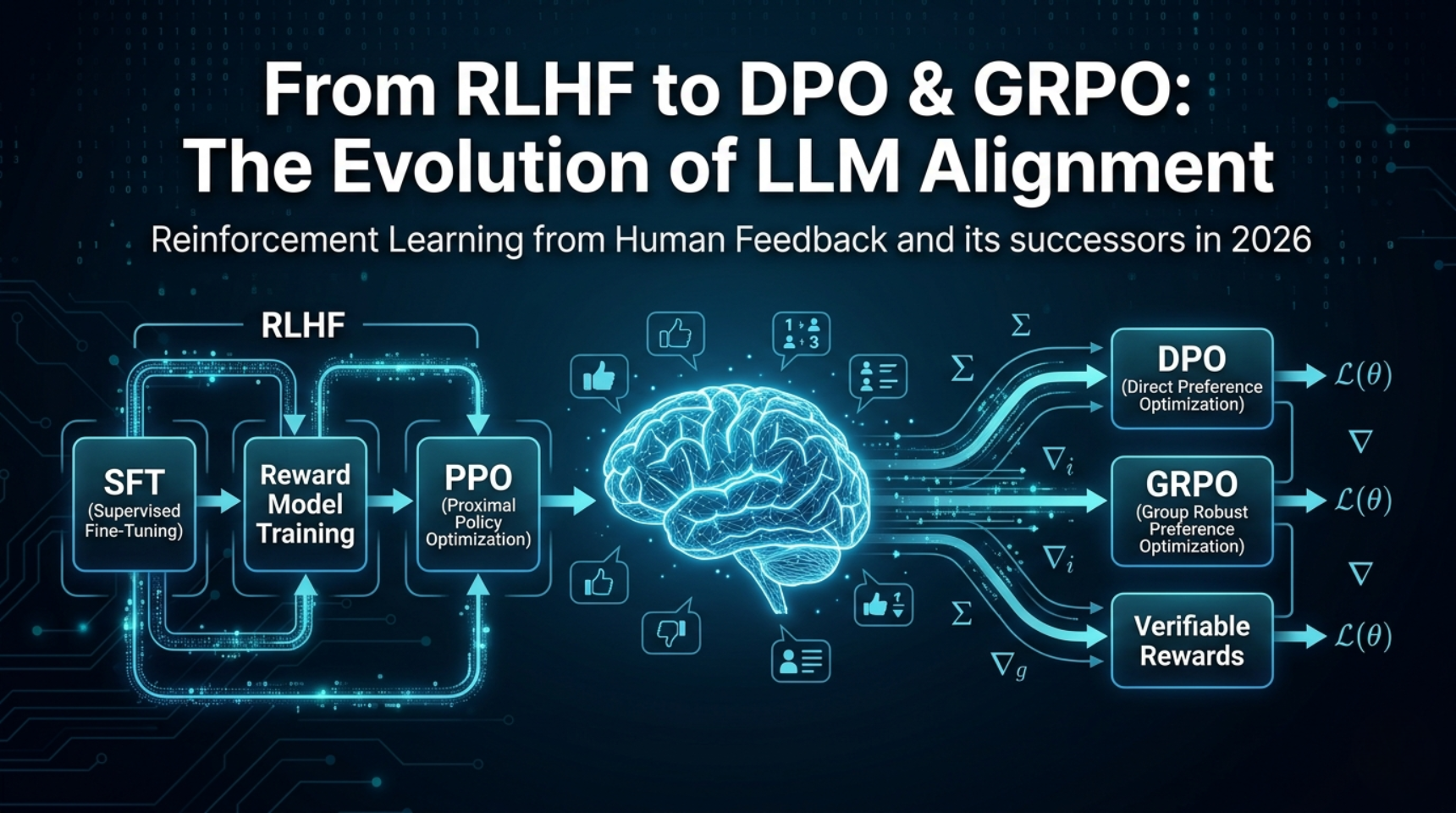
Last updated: April 2026 Reinforcement Learning from Human Feedback (RLHF) is a 3-stage training pipeline that aligns large language models with human preferences: first supervised fine-tuning, then reward model training on ranked outputs, and finally policy optimization with PPO. As of 2026, RLHF remains the conceptual foundation of LLM alignment, but production systems increasingly replace … Read more

What Is Mixture of Experts? MoE Architecture in 7 Key Facts

What Is Mixture of Experts? MoE Architecture in 7 Key Facts

Last updated: April 2026 Mixture of Experts (MoE) is a neural network architecture that splits each feed-forward layer into multiple parallel “expert” sub-networks and routes every input token to only 1–2 of them. The result is a sparse model: total parameter count can reach hundreds of billions, but compute per token stays equivalent to a … Read more

TurboQuant Explained: 3-Bit KV Cache at 6× Compression

Last updated: March 2026 TurboQuant is a vector quantization algorithm from Google Research (ICLR 2026) that compresses LLM key-value caches to 3 bits per coordinate with zero accuracy loss. It combines PolarQuant — a rotation-based coordinate transform — with a 1-bit QJL residual correction, achieving at least 6× memory reduction and up to 8× faster … Read more

What Is Computer Vision? 7 Core Tasks Explained (2026)What Is Computer Vision? 7 Core Tasks Explained (2026)

Computer vision

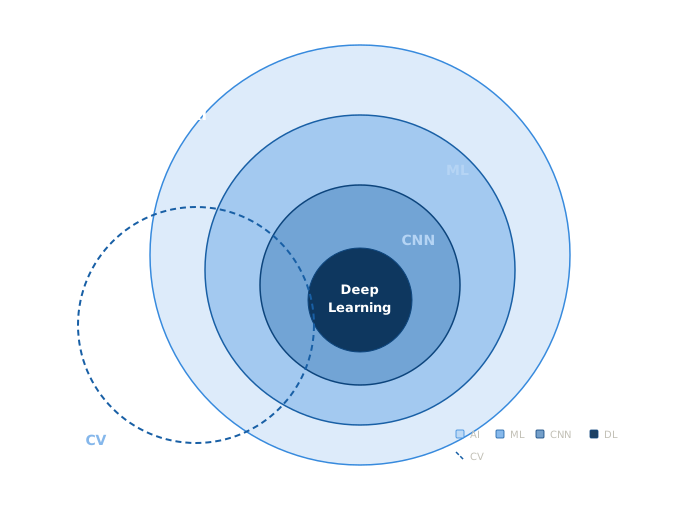
Last updated: March 2026 Computer vision is a field of artificial intelligence that enables machines to interpret, analyze, and extract meaning from visual data — images and video. It relies on deep learning architectures like convolutional neural networks (CNNs) and Vision Transformers (ViT) to perform tasks such as image classification, object detection, and semantic segmentation. … Read more

What Is a Transformer? Architecture, Attention & 7 Facts

Last updated: March 2026 A transformer is a neural network architecture introduced in the 2017 paper “Attention Is All You Need” that processes entire sequences in parallel using a mechanism called self-attention. Instead of reading tokens one by one like earlier recurrent models, transformers compute relationships between all tokens simultaneously — enabling faster training and … Read more