
Ten years ago, deep learning was a niche research topic discussed mainly at academic conferences. Today, it runs on your phone, generates the images you scroll past online, and helps doctors detect cancer in radiology scans. When you ask ChatGPT a question, dictate a message to Siri, or let your car’s lane-keeping system take over for a moment — deep learning is the engine underneath.
Yet the term itself is surrounded by confusion. Is it the same as AI? How does it differ from regular machine learning? And why does the word deep matter at all?
This guide breaks down six core concepts every technically curious person should understand in 2026 — without equations, but with real intuition for how these systems actually learn. If you have already read our primer on What Is Machine Learning, consider this the next chapter.
Deep Learning vs Machine Learning vs AI — The Hierarchy
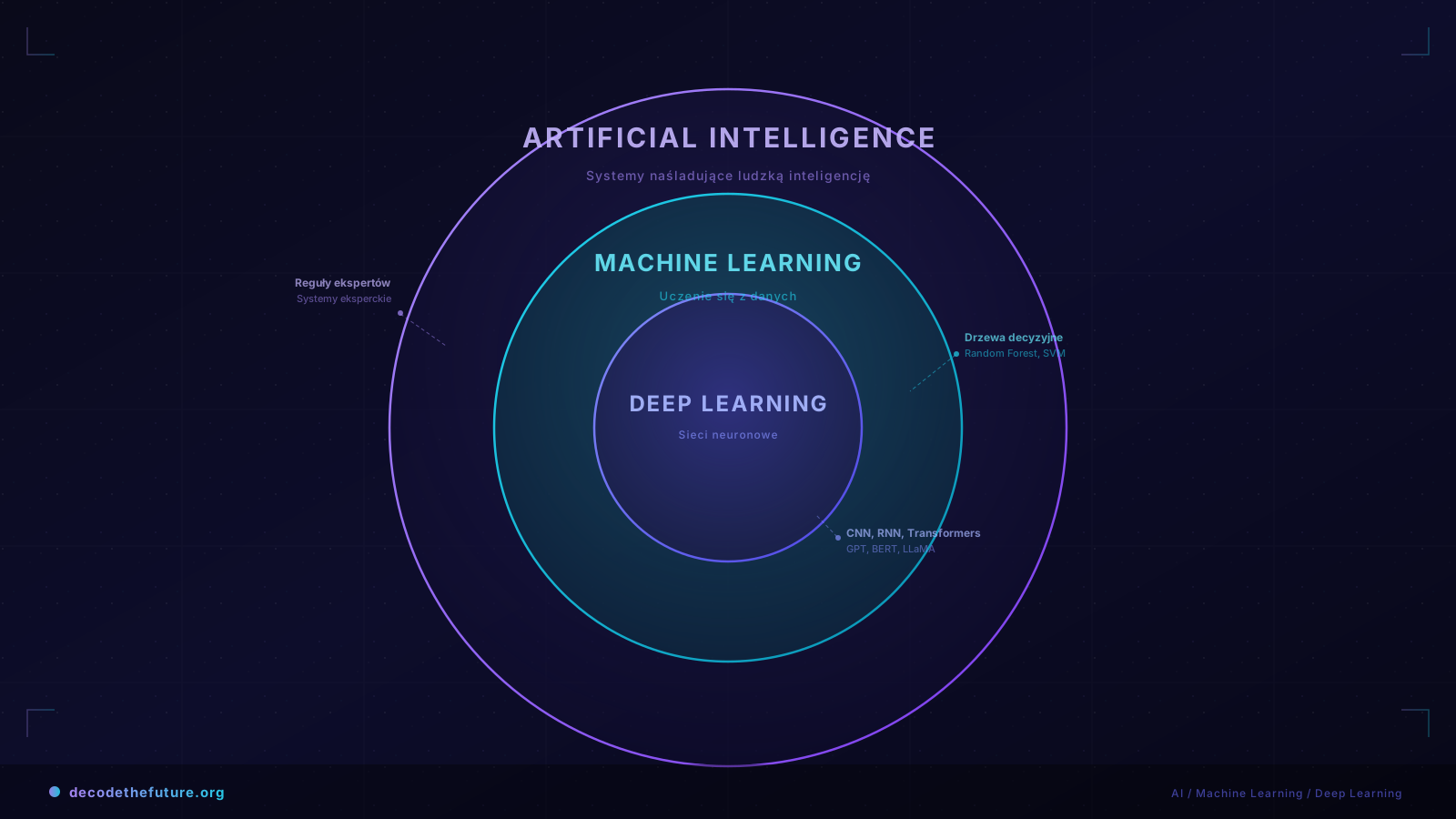
People use artificial intelligence, machine learning, and deep learning interchangeably, but they are three concentric circles — each fitting inside the one above it.
Artificial intelligence is the broadest category: any system designed to perform tasks that normally require human intelligence, from rule-based chess programs to modern chatbots. Machine learning is the subset of AI where systems learn from data instead of following explicit rules — think decision trees, random forests, or logistic regression. Deep learning sits inside machine learning. It uses neural networks with multiple hidden layers to learn directly from raw data, without requiring a human to hand-pick which features matter.
The practical difference? A traditional ML model for image classification might need an engineer to define features like edges, color histograms, or texture descriptors. A deep learning model skips that step entirely — you feed it millions of images with labels, and it figures out which features to extract on its own.
Why “Deep”? — The Layer Intuition
A neural network with a single hidden layer can, in theory, approximate any function — but it would need an impractically huge number of neurons to do so. Adding more layers is far more efficient because each layer builds on what the previous one learned.
Think of it like learning to read. A child doesn’t jump from seeing raw shapes to understanding Shakespeare. First, you learn to distinguish letter shapes. Then you recognize letters as parts of words. Then words combine into sentences, and sentences carry meaning. Deep learning works the same way — in literal layers:
- Early layers detect low-level features: edges, color gradients, basic tones in audio, or individual token embeddings in text.
- Middle layers combine those into mid-level patterns: textures, shapes, phonemes in speech, or short phrases in language.
- Deep layers assemble abstract, high-level concepts: faces, objects, speaker identity, or semantic meaning of a paragraph.
This hierarchical feature extraction is what makes deep networks so powerful. A model with 100 layers doesn’t need 100× more data than a model with 10 layers — each layer amplifies the representational capacity of the layers below it. The term “deep” became standard around 2006 when Geoffrey Hinton demonstrated that networks with many layers could be effectively trained using a technique called pre-training, launching the deep learning revolution.
The Three Core Architectures
Not all deep networks are built the same way. Over the past decade, three major architectural families have dominated — each designed for a different type of data. Understanding when to use which is one of the most practical skills in applied AI.
CNNs — Convolutional Neural Networks
CNNs are the workhorses of computer vision. Instead of connecting every neuron to every pixel (which would be absurdly expensive), they use small sliding filters called kernels that scan across the image, detecting local patterns like edges, corners, and textures. Pooling layers then compress spatial information, letting the network focus on what is in the image rather than where exactly it is.
Major milestones include AlexNet (2012), which won the ImageNet competition by a huge margin and kickstarted the modern deep learning era, and ResNet (2015), which introduced skip connections to train networks with 150+ layers. In 2026, CNNs remain the backbone of real-time computer vision systems like Tesla’s Autopilot cameras and industrial quality inspection.
RNNs and LSTMs — Recurrent Neural Networks
While CNNs process spatial data (images), RNNs are designed for sequential data — text, speech, time series — where the order of inputs matters. An RNN processes one element at a time, maintaining a hidden state that acts as a running summary of everything it has seen so far.
The classic problem? RNNs struggle with long sequences because information degrades as it passes through many time steps — the vanishing gradient problem. Long Short-Term Memory (LSTM) networks, introduced by Hochreiter and Schmidhuber in 1997, added gating mechanisms that let the network decide what to remember and what to forget. LSTMs powered Google Translate, Alexa’s speech recognition, and stock price prediction systems throughout the 2010s.
However, RNNs have a fundamental bottleneck: they process tokens one at a time, making them slow to train on modern GPUs that excel at parallel computation. This limitation opened the door for a new architecture that changed everything.
Transformers — The Architecture That Won
In 2017, a team at Google published a paper called “Attention Is All You Need” that introduced the Transformer architecture. Instead of processing sequences step by step, Transformers use a mechanism called self-attention to look at all tokens simultaneously, computing how much each token relates to every other token in the sequence.
This parallel approach solved the speed problem of RNNs and turned out to be even better at capturing long-range dependencies. The results were dramatic: within three years, Transformers replaced RNNs and LSTMs in nearly every NLP benchmark. They now power every major large language model — GPT-4, Claude, Gemini — and have expanded into computer vision (Vision Transformer / ViT), protein folding (AlphaFold), audio generation, and robotics.
Why did Transformers win? Three reasons: they parallelize perfectly on GPUs, the self-attention mechanism captures relationships across long sequences far better than recurrence, and the architecture scales predictably — bigger models trained on more data reliably produce better results (a phenomenon known as scaling laws). For a detailed breakdown, see our guide on What Is a Transformer.
| Architecture | Best for | Key mechanism | 2026 status |
|---|---|---|---|
| CNN | Images, video, spatial data | Convolutional filters + pooling | Still dominant in real-time vision and edge devices |
| RNN / LSTM | Sequences, time series | Recurrent hidden state + gating | Largely replaced by Transformers in NLP; niche use in streaming sensor data |
| Transformer | Text, code, multimodal | Self-attention (all-to-all) | Dominant in LLMs, increasingly used in vision and science |
How Deep Learning Actually Learns
The mechanics of deep learning can be boiled down to a four-step loop that repeats millions of times during training. No calculus required — just think of it as GPS navigation.
Step 1: Forward Pass — Make a Prediction
Data flows through the network from input to output. Each neuron multiplies its inputs by weights, adds a bias, and applies an activation function. The result at the end is the model’s current guess — for example, “This image is 72% likely to be a cat.”
Step 2: Loss — Measure How Wrong You Are
A loss function compares the model’s prediction to the correct answer and produces a single number representing the error. If the image actually shows a cat and the model said 72%, the loss is relatively low. If the model said 15%, the loss is high. The goal of training is to minimize this number.
Step 3: Backpropagation — Find Who Is Responsible
Here is where the “learning” happens. The algorithm traces backward through the network, calculating how much each individual weight contributed to the error. This is like a GPS recalculating your route after a wrong turn — it doesn’t just tell you that you are off course, it identifies exactly which turn went wrong and by how much.
Step 4: Gradient Descent — Adjust the Weights
Based on the backpropagation results, each weight gets nudged in the direction that reduces the error. The size of the nudge is controlled by the learning rate — too big and you overshoot, too small and training takes forever. Multiply this loop by millions of data points and thousands of iterations, and the network gradually converges on a set of weights that produce accurate predictions.
This loop — forward pass → loss → backpropagation → gradient descent — is universal across all deep learning architectures. Whether you’re training a CNN on medical images, an LSTM on stock data, or a Transformer on internet text, the learning mechanism is fundamentally the same. What changes is the architecture of the network and the type of data flowing through it.
Real-World Deep Learning Examples in 2026
Deep learning is no longer an academic curiosity. Here are five concrete systems running in production right now — each showcasing a different architecture and application domain.
Large Language Models (GPT-4o, Claude, Gemini)
All major LLMs are built on the Transformer architecture. They are trained on trillions of tokens of text and can generate coherent essays, write working code, summarize legal documents, and hold multi-turn conversations. When combined with Retrieval-Augmented Generation (RAG), they can access and reason over external knowledge bases in real time. Companies are now deploying AI agents — LLM-powered systems that can browse the web, execute code, and interact with APIs autonomously.
Image Generation (Stable Diffusion, DALL·E 3)
Diffusion models — a newer deep learning approach — learn to generate images by reversing a noise process. During training, the model learns how to gradually remove noise from a completely random image until a coherent picture emerges. Stable Diffusion and DALL·E 3 can produce photorealistic images, concept art, and product mockups from a text prompt in seconds. The underlying architecture combines U-Nets (a variant of CNNs) with Transformer-based text encoders.
Protein Structure Prediction (AlphaFold 3)
Google DeepMind’s AlphaFold 3 uses a deep learning architecture called the Pairformer — a modified Transformer — combined with a diffusion model to predict 3D structures of protein complexes, DNA, RNA, and small molecules. Its predecessor AlphaFold 2 won the Nobel Prize in Chemistry in 2024. Over 3 million researchers worldwide use AlphaFold predictions to accelerate drug discovery, study diseases, and design enzymes.
Self-Driving Vehicles (Tesla FSD, Waymo)
Tesla’s Full Self-Driving system processes video from eight cameras simultaneously using a deep neural network that fuses CNN-based feature extraction with Transformer-based temporal reasoning. The system must detect pedestrians, read traffic signs, predict other drivers’ behavior, and plan a safe path — all within milliseconds. Waymo uses a similar multi-modal deep learning stack combining LiDAR point clouds, camera images, and radar data.
Recommendation Systems (Spotify, YouTube, Netflix)
Spotify’s Discover Weekly and YouTube’s recommendation engine use deep learning models that process millions of user interactions — plays, skips, searches, watch times — to predict what you’ll enjoy next. These systems combine embedding layers (which convert items and users into numerical vectors) with deep neural networks that learn complex interaction patterns far beyond what simple collaborative filtering can achieve.
Deep Learning vs Machine Learning — When to Use Which
Deep learning is extraordinarily powerful, but it is not always the right tool. Choosing between classical ML and deep learning is a practical engineering decision that depends on four factors:
| Factor | Choose classical ML when… | Choose deep learning when… |
|---|---|---|
| Data volume | You have hundreds or thousands of samples | You have tens of thousands to billions of samples |
| Interpretability | Decisions must be explainable (medical diagnosis, credit scoring, regulatory compliance) | Accuracy matters more than explanation (image recognition, content recommendation) |
| Compute budget | Limited hardware — a laptop CPU is enough | Access to GPUs or cloud infrastructure |
| Data type | Structured tabular data (spreadsheets, databases) | Unstructured data (images, text, audio, video) |
A gradient-boosted tree (XGBoost, LightGBM) will often outperform a deep neural network on tabular data with fewer than 10,000 rows — while training in seconds instead of hours. On the other hand, no classical algorithm can match a Transformer on language understanding or a CNN on image classification at scale. The best practitioners in 2026 know both toolkits and choose based on the problem, not the hype. For a full comparison, revisit our guide on What Is Machine Learning.
Three Deep Learning Trends Shaping 2026
1. State Space Models — A Challenger to Transformers
Transformers have a fundamental limitation: self-attention scales quadratically with sequence length. Processing a 100,000-token document costs 100× more compute than processing a 10,000-token one. State Space Models (SSMs), particularly the Mamba architecture introduced by Albert Gu and Tri Dao, offer an alternative that scales linearly with sequence length while maintaining competitive accuracy.
Mamba uses a selective mechanism that decides which information to keep and which to discard as it processes a sequence — similar to an RNN, but with a much larger and more expressive hidden state. The result: up to 5× higher inference throughput than Transformers on long sequences. Mamba-3, published in March 2026, further closes the gap with Transformer quality. In practice, most production systems in 2026 still use Transformers, but hybrid Transformer-SSM architectures (like Jamba from AI21 Labs) are emerging as a pragmatic middle ground.
2. Edge Deep Learning — NPUs in Every Phone
Running deep learning models no longer requires a data center. Apple’s Neural Engine, Qualcomm’s Hexagon NPU, and Google’s Tensor chips now include dedicated hardware for neural network inference directly on-device. This enables real-time image processing, on-device language models, speech recognition, and AR features without sending data to the cloud — a major win for privacy and latency.
The trend toward edge AI is also being driven by regulation. The EU AI Act, which began enforcement in 2025, imposes transparency and data protection requirements that make on-device processing increasingly attractive for European companies. Running a model locally means user data never leaves the device, simplifying compliance with both the AI Act and GDPR.
3. Small, Specialized Models Beat General-Purpose Giants
The “bigger is always better” era of deep learning is evolving. In 2026, small models fine-tuned on domain-specific data frequently outperform general-purpose models that are 10–100× larger. Techniques like LoRA (Low-Rank Adaptation) allow practitioners to customize a foundation model for a specific task — medical coding, legal document review, semiconductor defect detection — using a fraction of the compute required for full training.
This trend is converging with EU AI Act compliance requirements: organizations can more easily audit, document, and explain the behavior of a small, focused model than a 400-billion-parameter general-purpose system. The result is a growing ecosystem of “expert” models that are cheaper to run, faster to deploy, and easier to govern.
Frequently Asked Questions
What is deep learning in simple terms?
Deep learning is a type of artificial intelligence where software learns to recognize patterns by processing data through many layers of interconnected nodes, called a neural network. Instead of being programmed with explicit rules, the system discovers patterns on its own — much like how a child learns to recognize animals by seeing many examples rather than reading definitions.
What is the difference between deep learning and machine learning?
Machine learning is the broader field; deep learning is a specialized subset. Classical ML algorithms (decision trees, SVMs, linear regression) require humans to select and engineer features from the data. Deep learning automates this process using multi-layered neural networks that learn features directly from raw inputs like images, text, or audio. Deep learning requires more data and compute but handles unstructured data far better.
Why is deep learning called “deep”?
The “deep” refers to the number of hidden layers in the neural network. A shallow network might have one or two hidden layers; a deep network typically has dozens to hundreds. Each additional layer allows the network to learn more abstract and complex representations of the data.
Does deep learning require a lot of data?
Generally, yes. Deep learning models have millions or billions of parameters that need to be trained, which requires large datasets to avoid overfitting. However, techniques like transfer learning and LoRA fine-tuning allow practitioners to adapt pre-trained models to new tasks with relatively small datasets — sometimes just a few hundred examples.
What hardware do I need for deep learning?
For training large models, you need GPUs (NVIDIA A100, H100) or TPUs (Google). For inference and experimentation, modern laptops with discrete GPUs or even NPU-equipped phones can run smaller models. Cloud services like AWS, Google Cloud, and Lambda Labs offer pay-as-you-go GPU access starting at roughly $1–3 per hour.
Will Transformers remain the dominant architecture?
In 2026, Transformers still dominate most production systems, especially for language and multimodal tasks. However, State Space Models (Mamba) and hybrid architectures are emerging as alternatives that handle very long sequences more efficiently. The trend is toward architectures that combine Transformer-style attention with SSM-style linear scaling, rather than a complete replacement.
How does deep learning relate to generative AI?
Generative AI — systems that create text, images, music, or code — is powered almost entirely by deep learning. Large language models use deep Transformer networks, image generators use diffusion models built on deep CNNs and Transformers, and music generation systems use deep autoregressive models. In short, deep learning is the engine; generative AI is one of its most visible applications.
Bibliography
- LeCun, Y., Bengio, Y., & Hinton, G. (2015). Deep learning. Nature, 521(7553), 436–444. https://doi.org/10.1038/nature14539
- Goodfellow, I., Bengio, Y., & Courville, A. (2016). Deep Learning. MIT Press. https://www.deeplearningbook.org/
- Vaswani, A., Shazeer, N., Parmar, N., Uszkoreit, J., Jones, L., Gomez, A. N., Kaiser, Ł., & Polosukhin, I. (2017). Attention Is All You Need. Advances in Neural Information Processing Systems, 30. https://arxiv.org/abs/1706.03762
- He, K., Zhang, X., Ren, S., & Sun, J. (2016). Deep Residual Learning for Image Recognition. Proceedings of the IEEE Conference on Computer Vision and Pattern Recognition, 770–778. https://arxiv.org/abs/1512.03385
- Hochreiter, S., & Schmidhuber, J. (1997). Long Short-Term Memory. Neural Computation, 9(8), 1735–1780. https://doi.org/10.1162/neco.1997.9.8.1735
- Krizhevsky, A., Sutskever, I., & Hinton, G. E. (2012). ImageNet Classification with Deep Convolutional Neural Networks. Advances in Neural Information Processing Systems, 25. https://papers.nips.cc/paper/2012
- Gu, A., & Dao, T. (2023). Mamba: Linear-Time Sequence Modeling with Selective State Spaces. arXiv preprint arXiv:2312.00752. https://arxiv.org/abs/2312.00752
- Lahoti, A., Li, K. Y., Chen, B., Wang, C., Bick, A., Kolter, J. Z., Dao, T., & Gu, A. (2026). Mamba-3: Improved Sequence Modeling using State Space Principles. arXiv preprint arXiv:2603.15569. https://arxiv.org/abs/2603.15569
- Abramson, J., Adler, J., Dunbar, J., Evans, R., Green, T., Pritzel, A., … & Jumper, J. (2024). Accurate structure prediction of biomolecular interactions with AlphaFold 3. Nature, 630, 493–500. https://doi.org/10.1038/s41586-024-07487-w
- European Parliament. (2024). Regulation (EU) 2024/1689 — Artificial Intelligence Act. Official Journal of the European Union. https://eur-lex.europa.eu/eli/reg/2024/1689/oj
- PyTorch Contributors. (2024). PyTorch Documentation. https://pytorch.org/docs/stable/
- Dao, T., & Gu, A. (2024). Transformers are SSMs: Generalized Models and Efficient Algorithms Through Structured State Space Duality. Proceedings of ICML 2024. https://arxiv.org/abs/2405.21060