
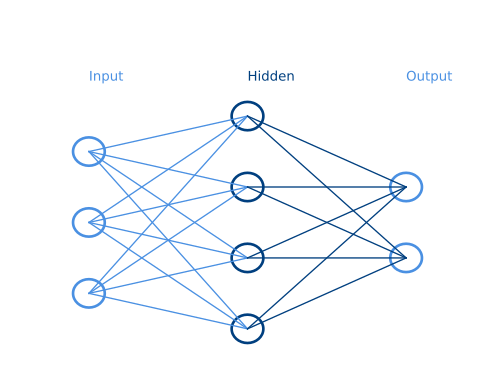
A neural network is a machine-learning model composed of layers of interconnected nodes (neurons) that learn to map inputs to outputs by adjusting numerical weights and biases during training. Each neuron computes a weighted sum of its inputs, adds a bias, and passes the result through a non-linear activation function.
Modern neural networks range from simple feedforward architectures with a few layers to deep networks with hundreds of layers — including convolutional neural networks (CNNs) for vision, recurrent neural networks (RNNs) for sequences, and transformers that power today’s large language models. Under the EU AI Act (fully applicable August 2026), high-risk neural-network systems require lifecycle risk management, technical documentation, and transparency.
Neural networks are the computational backbone of virtually every breakthrough in artificial intelligence. Whether you interact with a voice assistant, scroll through algorithmically curated content, or use an AI coding tool, a neural network is doing the heavy lifting behind the scenes. In this guide you will learn what neural networks actually compute, how they learn, and which architecture to choose for a given task — all framed around what matters to practitioners in 2026.
How a Single Neuron Works
A biological neuron receives electrical signals through dendrites, processes them in the cell body, and sends an output through the axon. An artificial neuron mirrors this idea in purely mathematical terms. It takes a vector of numerical inputs, multiplies each input by a learnable weight, sums the products, adds a bias term, and finally passes the result through an activation function to produce output.
Formally, a single neuron computes:
z = w₁x₁ + w₂x₂ + ... + wₙxₙ + b
y = σ(z)
Here w represents weights, x represents inputs, b is the bias, and σ is the activation function. Weights control how strongly each input influences the output. Bias shifts the activation threshold, allowing the neuron to fire even when inputs are weak. Together, they form the learnable parameters of the model — the values that training adjusts to make the network accurate.
A single neuron can only model linear relationships. The real power of neural networks comes from stacking many neurons into layers and introducing non-linear activation functions — which is exactly what we examine next.
Neural Network Architecture: Layers and Depth
Every neural network, regardless of its complexity, consists of three types of layers: the input layer (which receives raw data), one or more hidden layers (which transform representations), and the output layer (which produces predictions). When a network has two or more hidden layers, it is called a deep neural network — the foundation of machine learning’s most capable subfield, deep learning.
Information flows from left to right through the network. During forward propagation, each neuron in a layer receives every output from the previous layer, computes its weighted sum plus bias, applies an activation function, and passes the result forward. The input layer has as many neurons as there are features in the data (for instance, 784 neurons for a 28×28 pixel grayscale image). The output layer has as many neurons as there are prediction targets — two for binary classification, ten for digit recognition, or one for regression.
The hidden layers are where abstraction happens. Early layers learn simple patterns (edges, basic frequency components), while deeper layers combine those patterns into complex representations (facial features, sentence meaning). This hierarchical feature extraction is what gives deep networks their power — and it is also why depth matters more than width for most practical tasks.
Activation Functions: Why Non-Linearity Matters
Without activation functions, a neural network — no matter how many layers — would reduce to a single linear transformation. Activation functions introduce non-linearity, allowing the network to learn decision boundaries of arbitrary complexity.
| Function | Formula | Range | When to Use |
|---|---|---|---|
| ReLU | max(0, z) | [0, ∞) | Default for hidden layers in CNNs and feedforward networks. Fast to compute, avoids vanishing gradient for positive values. |
| Sigmoid | 1 / (1 + e⁻ᶻ) | (0, 1) | Binary classification output layer. Outputs interpretable as probabilities. |
| Tanh | (eᶻ − e⁻ᶻ) / (eᶻ + e⁻ᶻ) | (−1, 1) | Zero-centered alternative to sigmoid. Common in RNN hidden states. |
| Softmax | eᶻⁱ / Σ eᶻʲ | (0, 1), sums to 1 | Multi-class classification output layer. Produces probability distribution. |
| GELU | z · Φ(z) | ≈ (−0.17, ∞) | Default in transformer architectures (GPT, BERT). Smooth approximation of ReLU. |
| SiLU / Swish | z · σ(z) | ≈ (−0.28, ∞) | Used in vision models (EfficientNet, ConvNeXt). Self-gated, smooth. |
In practice, the choice of activation function is one of the first architectural decisions. For most feedforward and convolutional networks, ReLU (Rectified Linear Unit) remains the standard for hidden layers. For large language models based on the transformer architecture, GELU has become the default since the BERT paper (Devlin et al., 2019). The output layer activation depends on the task: sigmoid for binary classification, softmax for multi-class, and typically no activation (linear) for regression.
Training: Backpropagation and Gradient Descent
A neural network learns by iteratively adjusting its weights and biases to minimize a loss function — a mathematical measure of how far the network’s predictions are from the true values. The training process has two phases that repeat for thousands or millions of iterations.
Forward pass: Input data flows through the network, producing a prediction. The loss function (for example, cross-entropy for classification or mean squared error for regression) quantifies the prediction error.
Backward pass (backpropagation): The gradient of the loss with respect to every weight in the network is computed using the chain rule of calculus. These gradients tell the optimizer which direction to adjust each weight to reduce the error.
Weight update: An optimization algorithm — most commonly a variant of stochastic gradient descent (SGD) such as Adam — updates each weight by a small step in the direction that decreases the loss:
w_new = w_old − learning_rate × ∂Loss/∂wThe learning rate is a critical hyperparameter. Too large and the network overshoots optimal values; too small and training takes excessively long or gets stuck in local minima. Modern practice typically uses learning-rate schedulers (cosine annealing, warm-up) and adaptive optimizers like Adam or AdamW that adjust the effective learning rate per-parameter.
Overfitting and Regularization
When a network memorizes training data instead of learning generalizable patterns, it overfits. Common regularization techniques include dropout (randomly zeroing a fraction of neurons during training), weight decay (L2 penalty on weight magnitudes), data augmentation, and early stopping. For very large models, the trend in 2026 is toward compute-optimal training (the “Chinchilla scaling laws”) where the dataset size is scaled proportionally to model size, making explicit regularization less critical.
5 Neural Network Architectures You Need to Know
Different tasks demand different architectures. Below are the five families that cover the vast majority of production use cases in 2026.
1. Feedforward Neural Networks (FNNs)
The simplest architecture: information flows in one direction from input to output with no loops. Fully-connected (dense) layers are still the workhorse for tabular data — customer churn prediction, credit scoring, demand forecasting. For tabular tasks, gradient-boosted trees (XGBoost, LightGBM) often match or beat FNNs, but neural approaches gain an edge when the dataset exceeds roughly 10,000 rows and contains high-cardinality categorical features.
2. Convolutional Neural Networks (CNNs)
CNNs use convolutional filters that slide across input data, detecting spatial patterns like edges, textures, and shapes. They achieve translational invariance — the network recognizes a cat regardless of its position in the image. Key applications: image classification, object detection (YOLO, Faster R-CNN), medical imaging (tumor detection in radiology), and autonomous-vehicle perception. In 2026, architectures like ConvNeXt v2 and EfficientNet v2 remain competitive with vision transformers for many tasks while being more parameter-efficient.
3. Recurrent Neural Networks (RNNs) and LSTMs
RNNs process sequential data by maintaining a hidden state that carries information across time steps. Vanilla RNNs suffer from the vanishing-gradient problem over long sequences, which LSTMs (Long Short-Term Memory) and GRUs (Gated Recurrent Units) address through gating mechanisms. While largely superseded by transformers for NLP, LSTMs remain relevant in edge-device deployment (on-device keyboard prediction), real-time signal processing, and time-series forecasting with strict latency constraints.
4. Transformers
The transformer architecture (Vaswani et al., 2017) replaced recurrence with a self-attention mechanism that processes all positions in a sequence in parallel. This enables massively parallel training on GPUs and captures long-range dependencies far better than RNNs. Transformers are the engine behind large language models (GPT-4, Claude, Llama 3), vision transformers (ViT, DINOv2), and multi-modal models. The EU AI Act classifies general-purpose AI models (GPAI) — nearly all of which are transformer-based — under specific transparency and documentation obligations that took effect in August 2025 (European Commission, 2024).
5. State Space Models (SSMs) and Mamba
The newest challenger to the transformer. SSMs like Mamba (Gu & Dao, 2023) model sequences through continuous-state equations discretized for efficient computation. Their key advantage is linear scaling with sequence length (versus quadratic for standard attention), making them attractive for genomics, long-document processing, and real-time audio. In 2026, SSM-transformer hybrids (like Jamba from AI21 Labs) combine the strengths of both approaches, using SSM layers for efficiency on long sequences and attention layers for tasks requiring precise token-to-token reasoning.
Building Your First Neural Network: A PyTorch Example
Theory becomes concrete when you write code. Below is a minimal feedforward classifier in PyTorch — the most popular deep learning framework in research and increasingly in production (PyTorch, 2024). This network classifies handwritten digits from the MNIST dataset.
import torch
import torch.nn as nn
import torch.optim as optim
from torchvision import datasets, transforms
from torch.utils.data import DataLoader

# 1. Data pipeline
transform = transforms.Compose([
    transforms.ToTensor(),
    transforms.Normalize((0.1307,), (0.3081,))
])
train_data = datasets.MNIST('./data', train=True,
                            download=True, transform=transform)
train_loader = DataLoader(train_data, batch_size=64, shuffle=True)

# 2. Model: 784 → 256 → 128 → 10
class DigitClassifier(nn.Module):
    def __init__(self):
        super().__init__()
        self.network = nn.Sequential(
            nn.Flatten(),
            nn.Linear(784, 256),
            nn.ReLU(),
            nn.Dropout(0.2),
            nn.Linear(256, 128),
            nn.ReLU(),
            nn.Dropout(0.2),
            nn.Linear(128, 10)
        )

    def forward(self, x):
        return self.network(x)

model = DigitClassifier()
optimizer = optim.Adam(model.parameters(), lr=3e-4)
criterion = nn.CrossEntropyLoss()

# 3. Training loop
for epoch in range(5):
    model.train()
    total_loss = 0
    for images, labels in train_loader:
        optimizer.zero_grad()
        outputs = model(images)
        loss = criterion(outputs, labels)
        loss.backward()          # backpropagation
        optimizer.step()         # weight update
        total_loss += loss.item()
    print(f"Epoch {epoch+1} | Loss: {total_loss/len(train_loader):.4f}")
This 14-line model definition achieves around 97.5 % accuracy on MNIST after 5 epochs — about 30 seconds on a modern laptop CPU. Replacing the feedforward layers with convolutional layers (Conv2d → ReLU → MaxPool2d) pushes accuracy above 99 %, demonstrating how architectural choices directly impact performance. For a deeper dive into adapting pre-trained models to new tasks, see our guide on LoRA fine-tuning.
Real-World Applications in 2026
Neural networks are no longer a research curiosity — they are infrastructure. Here are the domains where their impact is most measurable today.
Healthcare. CNNs detect diabetic retinopathy in retinal scans with sensitivity matching specialist ophthalmologists. Transformer-based models analyze electronic health records to predict patient deterioration 48 hours before clinical signs appear. The FDA has cleared over 950 AI-enabled medical devices as of early 2026, the vast majority powered by neural networks (FDA, 2026).
Finance. Recurrent and attention-based architectures process tick-level market data for high-frequency trading, fraud detection, and credit risk assessment. Neural networks excel here because financial data contains non-linear dependencies that classical statistical models miss.
Natural language processing. Transformer-based LLMs power conversational assistants, code generation, document summarization, and translation. Retrieval-augmented generation (RAG) pipelines combine neural search with neural generation to produce grounded, factual responses — a pattern that has become standard for enterprise AI agent deployments.
Autonomous systems. Self-driving vehicles fuse CNN-based perception (object detection, lane segmentation) with transformer-based planning modules. Robotics relies on reinforcement learning with neural-network policy functions to learn manipulation tasks from simulation before transferring to physical hardware.
Neural Networks and the EU AI Act (2026)
The EU AI Act — the world’s first comprehensive legal framework for artificial intelligence — becomes fully applicable on 2 August 2026. For teams building or deploying neural-network systems in the EU market, several provisions are directly relevant.
High-risk classification. Neural networks used in HR screening, credit scoring, medical diagnosis, law enforcement, and critical infrastructure are classified as high-risk AI systems. Providers must implement lifecycle risk management, maintain technical documentation, ensure human oversight, and register the system in the EU database before deployment (European Commission, 2024).
GPAI transparency. Providers of general-purpose AI models — nearly all transformer-based LLMs — must disclose model architecture, training procedures, performance metrics, and a summary of training data to the EU AI Office. Models trained with more than 10²⁵ FLOPs are presumed to carry systemic risk and face additional obligations including adversarial testing and incident reporting.
Transparency for end-users. From August 2026, deployers must inform users when they interact with an AI system, and AI-generated content (including deepfakes) must be machine-readably labeled. This directly impacts neural-network-based chatbots, content generators, and synthetic media tools.
Common Pitfalls and How to Avoid Them
Years of production deployments have surfaced recurring failure modes. Knowing them upfront saves significant debugging time.
Vanishing/exploding gradients. In very deep networks, gradients can shrink to near-zero (vanishing) or blow up to infinity (exploding) during backpropagation. Solutions include batch normalization, residual connections (skip connections), gradient clipping, and careful weight initialization (He or Xavier initialization).
Overfitting on small datasets. When training data is limited, the network memorizes examples instead of learning patterns. Use transfer learning — take a pre-trained model (e.g., ResNet-50, BERT) and fine-tune it on your specific dataset. This exploits the general features already learned and is the standard approach for any dataset under ~50,000 samples.
Data leakage. Information from the test set inadvertently leaks into training, producing artificially inflated metrics. Always split data before any preprocessing (normalization, feature engineering) and use time-based splits for sequential data.
Ignoring inference cost. A model that takes 500 ms per prediction may be useless for real-time applications. Profile latency early, consider model distillation (training a smaller student network to mimic a larger teacher), quantization (INT8/INT4), and hardware-aware architecture search.
What Is Next for Neural Networks?
Several trends are shaping the next phase of neural network development. SSM-transformer hybrids are reducing the quadratic attention bottleneck for long-context applications. Neuromorphic hardware (Intel Loihi 2, IBM NorthPole) is bringing spiking neural networks closer to practical deployment for always-on, low-power edge inference. Mechanistic interpretability — the systematic study of what individual neurons and circuits learn — is advancing rapidly, driven partly by EU AI Act transparency requirements and partly by the AI safety research agenda. And mixture-of-experts (MoE) architectures, where only a fraction of parameters activate per input, are enabling models with trillions of parameters to run at the cost of much smaller networks.
For practitioners, the most actionable trend is the convergence of techniques: pre-trained foundation models + RAG + LoRA fine-tuning + agentic orchestration form the default stack for building production AI systems in 2026. Understanding neural network fundamentals is what lets you make informed decisions at every layer of that stack.
Frequently Asked Questions
What is the difference between a neural network and deep learning?
A neural network is a model architecture. Deep learning is the practice of training neural networks with multiple hidden layers (typically three or more) on large datasets. All deep learning uses neural networks, but not every neural network qualifies as deep learning — a single-layer perceptron, for example, is a neural network but not a deep learning model.
How many layers does a neural network need?
It depends on the task. For tabular data, 2–4 hidden layers often suffice. Image classification models like ResNet use 50–152 layers. Large language models use 32–120+ transformer layers. More layers increase representational capacity but also computational cost and the risk of overfitting on small datasets.
Can neural networks work with small datasets?
Yes, through transfer learning. Pre-trained models (ResNet, BERT, GPT) have already learned general features from millions of examples. Fine-tuning the final layers on as few as a few hundred domain-specific samples can yield strong results. Techniques like LoRA reduce trainable parameters to make fine-tuning even more efficient.
What hardware do I need to train a neural network?
For small feedforward or CNN models, a modern laptop CPU or a free-tier GPU (Google Colab) is sufficient. Training LLMs or large vision models requires clusters of GPUs or TPUs — a single GPT-4-scale training run is estimated at $50–100 million in compute cost. For most practitioners, fine-tuning existing models on a single GPU (16–24 GB VRAM) is the practical path.
Are neural networks affected by the EU AI Act?
Yes. Any AI system deployed in the EU that uses neural networks and falls into a high-risk use case (hiring, credit, medical devices, law enforcement) must comply with lifecycle risk management, documentation, human oversight, and transparency requirements. General-purpose AI models based on neural networks have additional obligations including training-data disclosure. Full enforcement begins August 2, 2026.
What is the best framework for building neural networks in 2026?
PyTorch dominates research and is increasingly the production standard (used by Meta, Tesla, OpenAI). TensorFlow remains strong in mobile and edge deployment via TensorFlow Lite. JAX (Google DeepMind) is growing for research requiring advanced automatic differentiation. For beginners, PyTorch’s imperative style and extensive ecosystem make it the recommended starting point.
Bibliography
Devlin, J., Chang, M.-W., Lee, K., & Toutanova, K. (2019). BERT: Pre-training of deep bidirectional transformers for language understanding. Proceedings of NAACL-HLT 2019, 4171–4186. https://aclanthology.org/N19-1423/
European Commission. (2024). Regulation (EU) 2024/1689 laying down harmonised rules on artificial intelligence (AI Act). Official Journal of the European Union, L 2024/1689. https://eur-lex.europa.eu/eli/reg/2024/1689/oj
Goodfellow, I., Bengio, Y., & Courville, A. (2016). Deep learning. MIT Press. https://www.deeplearningbook.org/
Gu, A., & Dao, T. (2023). Mamba: Linear-time sequence modeling with selective state spaces. arXiv preprint arXiv:2312.00752. https://arxiv.org/abs/2312.00752
He, K., Zhang, X., Ren, S., & Sun, J. (2016). Deep residual learning for image recognition. Proceedings of the IEEE Conference on Computer Vision and Pattern Recognition (CVPR), 770–778. https://arxiv.org/abs/1512.03385
Hoffmann, J., Borgeaud, S., Mensch, A., Buchatskaya, E., Cai, T., Rutherford, E., … & Sifre, L. (2022). Training compute-optimal large language models. arXiv preprint arXiv:2203.15556. https://arxiv.org/abs/2203.15556
Kingma, D. P., & Ba, J. (2015). Adam: A method for stochastic optimization. Proceedings of the 3rd International Conference on Learning Representations (ICLR 2015). https://arxiv.org/abs/1412.6980
LeCun, Y., Bengio, Y., & Hinton, G. (2015). Deep learning. Nature, 521(7553), 436–444. https://doi.org/10.1038/nature14539
McCulloch, W. S., & Pitts, W. (1943). A logical calculus of the ideas immanent in nervous activity. Bulletin of Mathematical Biophysics, 5(4), 115–133. https://doi.org/10.1007/BF02478259
PyTorch. (2024). PyTorch 2.x documentation. https://pytorch.org/docs/stable/
Rosenblatt, F. (1958). The perceptron: A probabilistic model for information storage and organization in the brain. Psychological Review, 65(6), 386–408. https://doi.org/10.1037/h0042519
Vaswani, A., Shazeer, N., Parmar, N., Uszkoreit, J., Jones, L., Gomez, A. N., Kaiser, Ł., & Polosukhin, I. (2017). Attention is all you need. Advances in Neural Information Processing Systems, 30, 5998–6008. https://arxiv.org/abs/1706.03762