


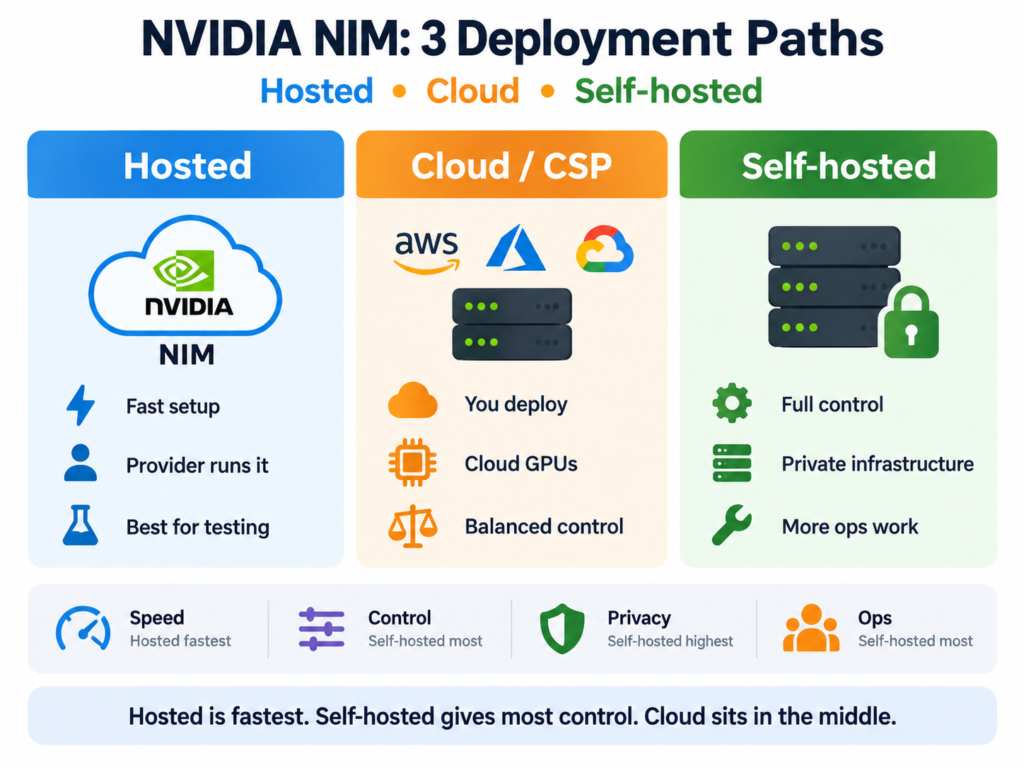
Short answer: choose hosted NVIDIA NIM when you want a fast API integration without operating GPUs, containers and model infrastructure. Choose self-hosted NIM when data control, network isolation, predictable capacity or on-premises deployment justify owning the runtime. A cloud service provider or Kubernetes deployment sits between those options: you still operate the NIM workload, but the underlying GPU capacity is rented.
NVIDIA NIM is not one single hosting product. It is a set of containerized inference microservices and a hosted API path in NVIDIA’s API Catalog. That distinction matters because the same model family can have different operational, security and cost consequences depending on where the endpoint runs.
This guide owns the deployment decision. Use the separate NVIDIA NIM API overview for the API surface, the NIM pricing and limits guide for current hosted access details, and the NVIDIA API key tutorial for account setup.
Hosted NVIDIA NIM vs self-hosted NIM at a glance
| Decision factor | Hosted NIM endpoint | Self-hosted NIM | Cloud / CSP deployment |
|---|---|---|---|
| Who operates the model runtime? | NVIDIA or the endpoint provider | Your team or a managed platform you control | Your team, while the CSP supplies cloud infrastructure |
| Fastest path to a prototype | Usually yes: call the documented endpoint with an API key | No: select a model, pull the container and provision a compatible GPU | Moderate: infrastructure can be provisioned quickly, but deployment remains yours |
| Data boundary | Request and response cross the provider’s service boundary | Can stay inside your network, subject to your telemetry and egress configuration | Inside your cloud account or network design, subject to CSP and platform controls |
| Capacity control | Defined by endpoint availability, quotas and service terms | You control capacity, queueing and scaling policy | You control workload capacity, but GPU availability and quota are CSP constraints |
| Main cost shape | Usage, entitlement and service terms | GPU, power, storage, software entitlement and operations | GPU instances, storage, network, orchestration and operations |
Interpretation: this is a decision matrix, not a promise that one route is always cheaper or more private. Confirm the model’s current availability, license, support matrix and endpoint terms before committing.
What does hosted NVIDIA NIM mean?
With a hosted NIM endpoint, the inference service runs outside your application infrastructure. Your application sends a request to the provider’s documented API endpoint, authenticates with the required credential, and receives the generated response. You do not provision the NIM container or manage the serving GPU.
NVIDIA’s Run NIM Anywhere documentation describes hosted endpoints alongside downloadable NIM microservices. The hosted route is therefore best understood as an access and operations choice, not as a different model-behavior guarantee.
Hosted is strongest when the problem is time-to-value
- the team is validating product demand or API integration;
- traffic is uncertain and buying reserved GPU capacity would be premature;
- the organization does not want to operate CUDA, drivers, containers, health checks and GPU scheduling;
- the data classification permits the chosen hosted service under its terms; and
- the endpoint’s model, quota, region and latency are adequate for the use case.
The trade-off is less control. Treat the model catalog, quotas, pricing, regions and availability as provider-controlled dependencies; verify the current terms and record the endpoint, model identifier and fallback behavior in your application documentation.
What does self-hosted NVIDIA NIM mean?
Self-hosting means running a supported NIM container on infrastructure selected and operated for your workload. That infrastructure can be on-premises, in a private environment or in a public cloud account. NVIDIA’s deployment documentation covers obtaining the container, configuring the runtime and exposing the service through an API; the exact requirements vary by NIM release, model and GPU profile.
Self-hosted does not mean “zero provider dependency.” You still need to validate NVIDIA licensing or entitlement, obtain the right NGC credentials, follow the model’s support matrix, and maintain the host, container, drivers, networking and security controls. “The data stays in our VPC” is an architectural property to verify, not a synonym for compliance.
Where do cloud service providers fit?
A CSP deployment uses a cloud provider’s GPU instances, storage and networking while your team deploys and operates the NIM workload. This is different from a fully hosted endpoint: the cloud provider supplies infrastructure, but your team typically remains responsible for image pulls, secrets, scaling, upgrades, observability and incident response unless a separate managed service takes those tasks on. Confirm the responsibility split with the provider.
Kubernetes can make the deployment repeatable, but it does not remove the hard parts of inference operations. Schedule the right GPU, keep model artifacts available, expose health and metrics safely, control egress, and test rolling upgrades against actual load. NVIDIA documents Kubernetes and other deployment paths in its NIM Deployment FAQ and the version-specific NIM LLM documentation.
Infrastructure requirements and operational complexity
Hosted NIM reduces infrastructure work to application integration and service-level monitoring. Self-hosted and CSP routes add a runtime ownership layer. Before choosing them, answer these questions:
- Model and release: which exact NIM image, model variant and version will be deployed?
- GPU profile: does the supported profile provide enough memory and throughput for the model, context length and concurrency?
- Runtime: are NVIDIA drivers, container runtime, Kubernetes scheduling and storage configured and patchable?
- Network: can the service reach required registries and can clients reach the API without exposing an unnecessary public surface?
- Observability: can you see request rate, queue time, time to first token, tokens per second, error rate and GPU utilization?
- Recovery: what happens when the GPU, container, model download, provider or region fails?
NVIDIA’s deployment material also describes metrics and model-serving configuration. Build monitoring around the actual deployment version rather than assuming that a generic web uptime check proves inference health.
Latency, scaling and reliability
Hosted endpoints can be the fastest route to a useful median latency because capacity is already provisioned, but network distance, provider queueing and quota behavior still affect the result. Self-hosting can reduce network distance and give you direct control over batching, concurrency and capacity, but a poorly sized or overloaded GPU will be slower than a well-run hosted service.
Measure at least p50, p95 and p99 latency separately for time to first token and total completion time. Also record input and output tokens, queue time, HTTP failures, model errors, retries and fallback activations. Average latency alone hides the production experience.
For the telemetry layer, connect these measurements to DTF’s guide to AI agent observability and the broader production AI architecture map. This page stays focused on deployment choice; those pages own tracing and system-wide architecture.
For scaling, hosted systems exchange infrastructure ownership for service limits. Self-hosted systems exchange service limits for a capacity-planning problem. CSP deployments give you elastic infrastructure, but autoscaling GPU workloads can be slow, expensive and subject to quota. Load-test the ramp-up path before promising a response-time objective.
Security, privacy and data handling
Hosted and self-hosted architectures create different control points. With a hosted endpoint, review the provider’s data handling, retention, region, logging, subprocessors and contractual terms for the data you plan to send. With self-hosting, keep the model boundary inside the intended network, but also inspect application logs, traces, prompt stores, backups, support access and outbound telemetry.
Self-hosting can make network isolation and retention policies easier to implement; it does not automatically make the deployment secure. Protect NGC and API credentials, avoid putting prompts in debug logs, restrict the inference endpoint, patch the host and container, and separate model-pull credentials from runtime request credentials where the platform allows it.
If your use case has strict residency or regulated-data requirements, involve security and legal owners before sending production data to a hosted endpoint. The deployment diagram should show where prompts, outputs, logs and model artifacts travel.
How to think about NVIDIA NIM cost
There is no universal “NIM cost” that makes hosted or self-hosted the winner. Hosted cost depends on the selected endpoint, usage terms, quotas and commercial arrangement. Self-hosted cost depends on capacity and utilization as well as software entitlement. CSP cost adds instance, storage, network and orchestration charges.
| Cost bucket | Hosted | Self-hosted / CSP |
|---|---|---|
| Inference usage | Endpoint-specific usage or service pricing; confirm in the current NVIDIA catalog or agreement | Indirect: GPU time and capacity purchased whether fully utilized or not |
| Hardware | Included in the service abstraction | GPU purchase or cloud rental, plus host and power costs |
| Software entitlement | Included or defined by the endpoint terms | Check NIM and NVIDIA AI Enterprise entitlement for the exact deployment |
| Operations | Lower platform burden, but integration and monitoring remain yours | Higher: SRE, upgrades, security, capacity planning and incident response |
| Utilization risk | Usually transferred into service pricing and limits | You carry idle-GPU and overprovisioning risk |
For a defensible comparison, calculate cost per successful request or per million input/output tokens at the expected traffic distribution, then add the cost of failures, retries, fallbacks and idle capacity. Keep the assumptions dated; model prices, license terms and GPU economics change.
For surrounding API and inference economics, see DTF’s LLM inference cost comparison and inference API comparison. Those pages are context, not a substitute for current NVIDIA commercial terms.
When should you choose each deployment?
Choose hosted NIM when
- you need a working integration quickly;
- your data policy allows the provider path;
- traffic is volatile or still being validated;
- your team wants to focus on product behavior rather than GPU operations; and
- the endpoint’s region, model, quota and latency pass a production test.
Choose self-hosted NIM when
- network isolation, data residency or retention control is a hard requirement;
- you have sustained utilization that justifies dedicated capacity;
- you need control over concurrency, scaling, model rollout or latency tuning;
- your team can support GPUs, drivers, containers and on-call operations; and
- the model’s support matrix and entitlement are confirmed.
Choose a CSP / Kubernetes path when
- you need cloud elasticity or a region close to users;
- you already operate Kubernetes and GPU workloads;
- you need private networking without buying hardware; and
- you accept the extra work of capacity quotas, autoscaling and cloud cost control.
Migration checklist: hosted to self-hosted
Do not treat migration as changing one base URL. A safe migration is a compatibility and operations exercise.
- Pin the model identifier, NIM release, request parameters and expected output behavior.
- Compare the hosted and self-hosted API surfaces; test streaming, tool calls, structured output and error formats that your client uses.
- Provision the supported GPU profile and confirm cold-start, warm-up and model-loading times.
- Run a representative evaluation set for quality, safety, latency and cost at realistic concurrency.
- Instrument both paths with the same request IDs, latency percentiles, token counts and error taxonomy.
- Release behind a feature flag or weighted router; keep hosted fallback available until the new path is stable.
- Document rollback, credential rotation, model updates, capacity alarms and the owner for each component.
The reverse migration needs the same discipline. A hosted endpoint may simplify operations but can change the data boundary, quota model or failure modes. Treat provider failover as a tested architecture, not a last-minute DNS change.
FAQ
Is hosted NVIDIA NIM the same as self-hosted NIM?
No. Hosted NIM gives you an API endpoint operated by a provider. Self-hosted NIM runs a supported NIM container on infrastructure you or your cloud operations team control. The model and API family may be related, but availability, configuration, latency and commercial terms must be verified separately.
Can NVIDIA NIM run on-premises?
Supported NIM containers can run on selected NVIDIA-accelerated infrastructure, including private or on-premises environments, subject to the current release, model support matrix, licensing and hardware requirements. Confirm the exact model and release before procurement.
Is self-hosted NIM always cheaper?
No. Self-hosting can be economical at sustained utilization, but GPU capacity, software entitlement, storage, power, operations and idle time can outweigh hosted usage pricing. Compare cost per successful request using your actual traffic and utilization assumptions.
Does self-hosting guarantee privacy?
No. It can give you more control over network location and retention, but logs, traces, backups, telemetry, support access and application-level data handling still matter. Verify the complete data flow.
Do I need an NVIDIA API key for self-hosted NIM?
NVIDIA documentation describes an NGC API key for downloading or accessing NIM resources. Runtime authentication and hosted endpoint credentials are separate questions; follow the current setup guide and keep credentials out of images, source code and logs.
Update log
- First publication-ready comparison built from current NVIDIA NIM hosted, self-hosted and deployment documentation. Pricing is expressed as a dated decision model because endpoint terms and infrastructure economics vary.
Sources and further reading
NVIDIA deployment and product facts were checked against NVIDIA-owned documentation on September 10, 2026. Availability, supported profiles, entitlement and pricing can change; use the linked current documentation before deployment.
- NVIDIA, NIM overview.
- NVIDIA, Run NIM Anywhere.
- NVIDIA, NIM Deployment FAQ.
- NVIDIA, NVIDIA API Catalog quickstart.
- NVIDIA, NIM for Large Language Models introduction.
- NVIDIA, NIM LLM getting started.
- NVIDIA, NIM LLM API reference.
- NVIDIA, NIM LLM architecture.
- NVIDIA, NIM LLM support matrix.
- NVIDIA, NIM Kubernetes deployment.
- NVIDIA, NVIDIA NIM microservices.
- DecodeTheFuture, NVIDIA NIM API overview.