


Last updated: 28 July 2026. Rules checked: 28 July 2026. Scope: FAA / United States / airplane category.
If you search how many hours private pilot USA, you will often see a single number presented as if it were the answer. It is not. The legal minimum, the typical student total and the number you personally need to demonstrate safe, repeatable performance are three different quantities.
This article uses the formal FAA term Private Pilot Certificate for the airplane category. It is not an EASA PPL(A) article and it does not discuss commercial or airline-pilot hour requirements. The FAA rules, school syllabus, instructor endorsements and designated pilot examiner determine the actual path.
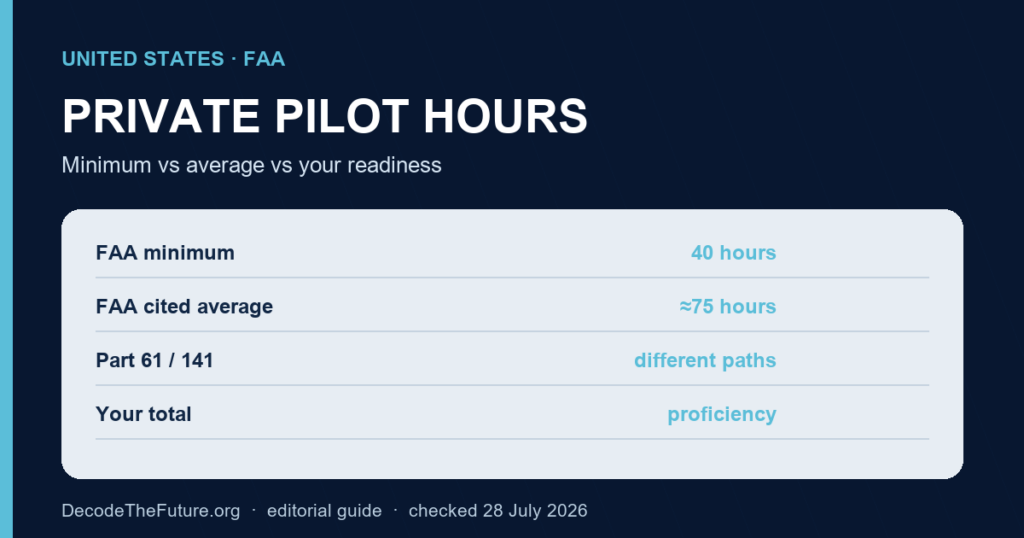
The three numbers you should know
| Number | What it means | What it does not mean |
|---|---|---|
| 40 hours | The FAA Part 61 minimum flight time for an airplane private pilot applicant, with required dual, solo and operating experience. | It is not a guaranteed completion time or price. |
| Approximately 75 hours | The average figure cited by the FAA for people completing the private pilot certification requirements. | It is not an individual requirement and not a promise that every student will be ready at 75. |
| Your total | The amount needed to meet the experience rules and demonstrate proficiency for instructor endorsement and practical test. | It cannot be predicted precisely from a national average. |
The distinction is important for both safety and money. A school that promises every student a checkride at exactly 40 hours is making a claim that the FAA minimum alone cannot support. A school that says 75 hours is mandatory is making the opposite mistake. The right question is how the school monitors progress and how it explains the likely range for your schedule, aircraft and starting experience.
What the FAA minimum includes
The FAA hourly-requirements page says that a private pilot applicant in airplanes must log at least 40 hours, including at least 20 hours of flight training from an authorized instructor and at least 10 hours of solo flight training in the required areas of operation. The required experience also includes cross-country, night and instrument components. The remaining time is not a free pass: it still has to support the required experience and the applicant must be ready for the knowledge and practical tests.
Training hours are not interchangeable blocks. One hour of pattern work does not automatically replace a cross-country requirement. One flight in good weather does not prove that you can make a safe decision when conditions change. The logbook records experience, but the instructor endorsement depends on demonstrated competence.
Before counting hours, ask the school which activities are included in its syllabus and which must be completed before solo, cross-country and checkride recommendation. The FAA rules are the legal framework; your instructor turns them into a training plan.
Part 61 versus Part 141
Part 61 and Part 141 are different ways of organising flight training. A Part 61 school or instructor can provide a flexible path that works for a student with an irregular schedule. A Part 141 pilot school follows an approved course structure with a syllabus and stage-check framework. An approved Part 141 airplane course can use a lower regulatory minimum for the private pilot certificate, but that does not mean every student completes in that minimum.
| Question | Part 61 | Part 141 |
|---|---|---|
| Structure | Often more flexible and instructor-led. | Approved syllabus, stages and school procedures. |
| Minimum | Common private-airplane framework uses 40 hours. | Approved course may use a lower minimum, subject to the applicable curriculum. |
| Best fit | Students who need flexible scheduling or pay as they go. | Students who want a structured program and can follow its schedule. |
| What still matters | Availability, instructor quality, aircraft serviceability, consistency and practical-test readiness. | |
Do not choose Part 141 solely because a lower number appears in an advertisement. Ask whether the school has enough serviceable aircraft, how stage checks work, how often lessons are available and what happens when you need extra dual instruction. A flexible Part 61 plan can be faster for one student and a structured Part 141 plan can be faster for another.
Where the hours usually go
The following phases are an editorial planning model, not an FAA allocation. Your school may combine them or use different stage names.
- Orientation and fundamentals: preflight, taxi, climbs, descents, turns, stalls, landings and aircraft control.
- Dual consolidation: circuits, emergency procedures, weather decisions, radio work and repeatable standards with an instructor.
- First solo: the instructor decides when you are ready and gives the required endorsements and limitations. There is no universal FAA hour number that makes every student ready to solo.
- Cross-country: navigation, fuel planning, weather, alternates, airspace and diversion decisions. The task is planning and judgement, not simply covering distance.
- Night and instrument experience: the required elements must be completed and logged according to the applicable rules and syllabus.
- Review and checkride preparation: mock oral questions, manoeuvre standards, paperwork, aircraft documents and repeatability under workload.
This model explains why two students can have the same number of total hours but different readiness. One may have flown consistently in varied conditions; another may have many short lessons separated by weeks. One may be confident with navigation but need more landings; another may need more radio practice. The total alone does not describe proficiency.
Why students need more than the minimum
- Infrequent lessons: skills fade between flights and the next lesson begins with review.
- Weather: wind, visibility, ceilings and density altitude can reduce useful training opportunities.
- Aircraft availability: maintenance or a full schedule can interrupt continuity.
- Different learning pace: students vary in coordination, radio confidence, planning and workload management.
- Training gaps: a change of instructor or aircraft can require a standardisation period.
- Checkride preparation: meeting the logged-hour requirement is different from performing consistently under test conditions.
- Administrative delays: knowledge test, medical or endorsement issues can push the practical test later and create more review time.
Needing extra hours is not evidence of failure. It is a normal part of learning a safety-critical skill. The useful warning sign is not a particular number; it is a school that cannot explain what you are practising, what remains and how the next stage will be measured.
How to plan a realistic hour budget
Use three columns in your plan: regulatory minimum, school estimate and personal reserve. Put 40 hours in the first column only if your path is the relevant Part 61 airplane framework. In the second column, ask the instructor for a range based on your schedule and the school’s experience. In the third, reserve hours for weather, review, aircraft changes and checkride preparation. Do not borrow the FAA average as if it were your personal forecast.
Also plan by month. A student who flies two or three times a week may build continuity faster than a student who flies twice a month, even when the hourly rate is the same. Ask what happens if you miss three weeks. The answer should include a review plan rather than a vague promise.
Track each lesson with three notes: what you can now do consistently, what needs another lesson, and what must be prepared before the next flight. This makes the budget dynamic. If you are progressing faster, you can adjust; if a skill is not stabilising, you see it early and can change instructor, aircraft or study routine.
What does checkride readiness look like?
Readiness is repeatable performance, not one perfect flight. You should be able to prepare the aircraft, explain the plan, manage the flight while communicating, recognise changing risks and make a conservative decision when the original plan no longer works. The practical test also includes oral knowledge and documents, not just manoeuvres.
Ask your instructor for a mock oral and a clear list of remaining standards. Review weather interpretation, weight and balance, aircraft performance, fuel, airspace, emergency actions, endorsements and required documents. If you can fly the manoeuvre but cannot explain the risk or the decision behind it, more preparation may be appropriate.
How hours affect the total cost
Each extra hour usually has at least two components: aircraft rental and instructor time. Some schools also add fuel, landing or briefing charges. When comparing schools, ask for the total price at 40, 55 and 75 hours, then ask which line items change. The exercise does not predict your personal total; it shows how sensitive your budget is to the number of lessons.
A low hourly rate can be offset by long travel, poor aircraft availability or repeated review after gaps. A higher rate can be reasonable if the fleet is available and the instructor gives you a coherent plan. Cost and hours are connected, but the safest way to reduce cost is usually better continuity and preparation, not rushing through the minimum.
Questions to ask a flight school
- Which framework and syllabus will my training use?
- How many serviceable airplanes and instructors are available?
- What is your typical range at the first solo, cross-country and checkride stages?
- How are stage checks, endorsements and extra dual hours handled?
- Which fees are separate from the aircraft and instructor rate?
- What happens when weather or maintenance cancels a lesson?
- How do you transfer my records if my instructor leaves?
- Can I see a sample budget at 40, 55 and 75 hours?
How long does the calendar process take?
Hours and calendar time are related but not identical. A student who flies two or three times a week may complete the same number of hours in a shorter calendar period than someone who flies twice a month. A longer calendar plan can also increase the total hours because skills need to be refreshed after gaps.
Ask the flight school how it would schedule you if you work full time, attend college or can fly only on weekends. Find out whether your instructor is available for recurring slots and whether the fleet has enough serviceable aircraft. A plan that looks efficient on paper is not useful if most lessons are cancelled or moved several weeks later.
Weather and maintenance are part of the planning problem. Good scheduling does not mean flying in unsafe conditions; it means leaving enough calendar and financial room for conditions that are unsuitable. If you have a fixed deadline, such as a move to another state, tell the school before choosing a package.
What happens in the first phase of training?
Early dual lessons build aircraft control, preflight habits, taxiing, take-offs, landings, climbs, descents, turns and radio routines. The goal is not to collect hours quickly. It is to make the basic tasks repeatable enough that you can manage the aircraft while thinking about weather, traffic and procedures.
Before solo, the instructor considers your performance, judgement, paperwork and endorsements. There is no universal FAA hour number that makes every student ready to fly solo. One student may be ready earlier in calm conditions; another may need more work on landings, radio or emergency procedures. The endorsement reflects a specific student, aircraft and set of limitations.
Why cross-country and checkride phases add time
Cross-country training introduces planning beyond the local pattern. You must calculate fuel, review weather, identify airspace and alternates, communicate with different facilities and make a diversion decision if the route changes. A flight can meet a distance requirement and still reveal planning skills that need more practice.
Near the practical test, the aircraft has to be prepared, the logbook and endorsements reviewed, and the oral topics practised. Manoeuvres should be repeatable while you manage workload and communicate. If a mock checkride reveals gaps, another lesson is usually cheaper and safer than scheduling a test before you are ready.
How to tell whether extra hours are useful
Extra hours are useful when they have a defined purpose. Ask the instructor to name the skill, standard or decision that the next lesson will address. Examples include crosswind landings, radio workload, navigation, fuel planning, emergency checklists or consistent altitude and airspeed control.
Be cautious if a school gives only a vague number without describing progress. A national average cannot explain why you need more hours. A good progress conversation includes what is complete, what is not consistent, how it will be practised and what evidence will show readiness.
Students should also be cautious about a school that pushes the minimum for every person. A certificate is not safer because the logbook contains the smallest legal number. The target is proficiency with a margin, not a record-breaking hour count.
How hours connect to a training budget
When you compare schools, ask for three estimates: the regulatory minimum path, the school’s typical planning range and a delayed plan with additional dual and review time. Separate aircraft rental, instructor, fuel, landing charges, medical, knowledge test, practical test and equipment. Then calculate how each additional ten hours changes the total.
Consistency can reduce waste, but it should not be confused with rushing. Studying between lessons, preparing the next flight and maintaining a short debrief log can make each hour more productive. So can choosing a school with reliable aircraft and an instructor who gives specific feedback. Do not cut safety training or fly outside your experience to protect a budget.
Part 61 or Part 141: questions beyond the hour number
If a Part 141 school advertises a lower minimum, ask which approved course applies and whether you can realistically follow its stage schedule. Ask about stage checks, progress standards, aircraft availability and what happens if you need extra dual. If a Part 61 instructor offers flexibility, ask how the syllabus is tracked and how records are transferred if the instructor becomes unavailable.
The best path depends on your schedule, learning style, location and future goals. A lower regulatory minimum is not a guarantee of fewer personal hours. A flexible path is not automatically less organised. Compare the school’s actual process, not only the label.
Personal hour-planning worksheet
- Write down the applicable regulatory minimum for your training framework.
- Ask your instructor for a range at the first-solo, cross-country and checkride stages.
- Add a separate reserve for weather, maintenance and gaps.
- Track each lesson’s completed skill and next objective.
- Review the total monthly, not only at the end of the course.
- Recalculate after a long break or aircraft/instructor change.
This worksheet is not an FAA form. It is a way to avoid using a national average as if it were a personal promise. The instructor and examiner remain responsible for the training decisions and endorsements within the applicable rules.
How to review a school’s hour estimate
Ask the school to show the assumptions behind its estimate. Does it assume two or three lessons every week, a particular aircraft, one instructor and no long breaks? Does it include the knowledge test, practical-test preparation and the examiner’s aircraft time? A number without assumptions cannot tell you whether the plan fits your life.
Request milestones rather than only a final total. You should know what the instructor expects before first solo, cross-country, night and checkride preparation. If the forecast changes, ask which skill or requirement caused the change. The objective is not to force the instructor to predict the future; it is to make progress visible enough that you can plan.
Compare the estimate at 40, 55 and approximately 75 hours, but label the columns correctly. Forty is the regulatory reference in the common Part 61 route. Approximately 75 is the FAA’s cited average. The third column is a sensitivity test for the budget, not a promise that you personally need that exact total.
A good school will talk about readiness, not only the logbook. It will explain how stage checks, endorsements, mock oral questions and practical-test standards are handled. That conversation is more useful than a guarantee that a student can finish at the lowest permitted number.
FAQ
How many hours are required for a private pilot certificate in the USA?
The FAA commonly states a 40-hour minimum for the Part 61 airplane route, with required instructor, solo, cross-country, night and instrument experience.
How many hours does the average student need?
The FAA cites approximately 75 hours as the average for applicants completing the private-pilot certification requirements. It is not an individual requirement.
Can I finish in 40 hours?
It is possible to meet a regulatory minimum, but the number does not guarantee readiness. You also need the required experience, endorsements and repeatable performance for the practical test.
Does Part 141 always mean fewer hours?
An approved Part 141 course can use a lower minimum in the applicable curriculum, but students still need to meet the course and proficiency standards. The school’s structure and availability matter.
Why do students need extra hours?
Weather, breaks, aircraft availability, learning pace, radio and navigation practice and checkride preparation all affect the personal total.
How can I lower the number of hours safely?
Fly consistently, prepare before each lesson, study between flights, track specific weaknesses and choose a school with reliable aircraft and clear progress checks. Never treat safety margins as a cost to remove.
Bibliography
- FAA — hourly requirements
- FAA — Become a Pilot
- FAA — Private Pilot Certificate
- FAA — practical tests
- FAA — pilot schools
- FAA — Pilot’s Handbook
- eCFR — 14 CFR Part 61
- eCFR — 14 CFR Part 141
- AOPA — learn to fly
- EAA — becoming a private pilot
- PlanesChat — hour planning context
- Indeed — time planning context
- FAA — knowledge test
- FAA — student pilot certificate
Educational material only. It does not replace current FAA rules, an aviation medical examiner, instructor endorsements or a designated pilot examiner’s decision.