


Last updated: November 12, 2026 · Fable 5.2 prices added; Sonnet 5.5 prices and API behavior rechecked against Anthropic’s documentation on November 7, 2026 (first published September 29, 2026)
Updated November 12, 2026: Claude Fable 5.2, released on November 9, 2026, replaces Fable 5.1 in the price and cost-per-turn tables at $8/$40 per million tokens (down from $10/$50), which lowers the example turn from $1.440 to $1.152; see our Claude Fable 5.2 guide.
Updated November 7, 2026: Corrected the Sonnet 5.5 cache-read price to $0.10 per million tokens (Anthropic prices cache hits on Sonnet 5.5 at 0.05x the input price; an earlier version of this page said $0.20), recalculated the cost-per-turn table, and added Claude Haiku 5.5, which was released on October 7, 2026.
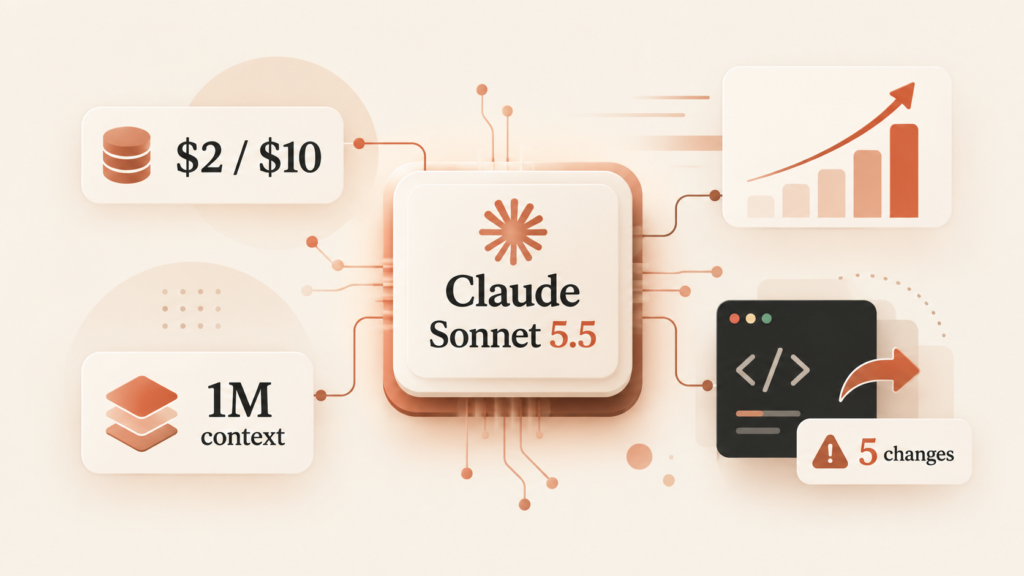
Claude Sonnet 5.5 (model ID claude-sonnet-5-5) was released on September 28, 2026 at the same price as Sonnet 5: $2 per million input tokens and $10 per million output tokens. Anthropic says it generates output 30%+ faster and costs up to 30% less per task because it uses fewer tokens and tool calls, not because input or output tokens got cheaper. Switching is not a drop-in model swap: five API behaviors now return 400 errors, including thinking: disabled and forced tool_choice.
Anthropic shipped Sonnet 5.5 six days after Opus 5.5. The headline sounds like a routine point release, but two things make it worth more than a model-ID swap. First, the benchmark jump over Sonnet 5 is large enough that Sonnet 5.5 now trades blows with Opus 5.5 on agentic coding at half the list price. Second, the API contract changed: code that worked yesterday on claude-sonnet-5 can fail today on claude-sonnet-5-5.
This guide covers the verified numbers, a cost-per-task comparison you can reproduce, and a migration checklist with before-and-after code. If you need the wider model lineup first, start with our Claude models overview.
What is Claude Sonnet 5.5 and what changed?
Sonnet 5.5 is Anthropic’s new mid-tier model, described in the docs as “the best combination of speed and intelligence”. It replaces Sonnet 5 as Anthropic’s current Sonnet model. The core specs from the model page and what’s-new notes:
| Spec | Claude Sonnet 5.5 |
|---|---|
| Model ID | claude-sonnet-5-5 (Bedrock: anthropic.claude-sonnet-5-5) |
| Released | September 28, 2026 |
| Price | $2 input / $10 output per MTok; cache read $0.10; Batch $1 / $5 |
| Context / max output | 1M tokens / 128K (300K on Batch with a beta header) |
| Thinking | Adaptive by default; API default effort high |
| Tokenizer | Same as Sonnet 5, so identical text gives identical token counts |
| Min. cacheable prompt | 512 tokens (Sonnet 5: 1,024) |
| Platforms | Claude API, Amazon Bedrock, Claude Platform on AWS, Google Cloud, Microsoft Foundry |
In Claude Code and Anthropic’s consumer apps, Sonnet 5.5 defaults to Medium effort, while the API defaults to High, according to the launch announcement. The announcement does not say which claude.ai plans (Free, Pro, Max) get the model or whether it is the default there. Treat any claim about the free plan as unconfirmed until Anthropic’s help center says so.
How much does Claude Sonnet 5.5 cost?
Input and output cost exactly as much as on Sonnet 5. Cache reads are cheaper: $0.10 per million tokens versus $0.20 on Sonnet 5, because Anthropic prices cache hits on Sonnet 5.5 and Opus 5.5 at 0.05x the base input price instead of the usual 0.1x. Anthropic’s pricing page also confirms that Sonnet 5’s $2/$10 launch price, originally announced as introductory, is now permanent: the planned increase to $3/$15 on September 1, 2026 will not happen.
| Model | Input | Output | Cache read | Batch in / out |
|---|---|---|---|---|
| Fable 5.2 | $8 | $40 | $0.20 | $4 / $20 |
| Opus 5.5 | $4 | $20 | $0.20 | $2 / $10 |
| Sonnet 5.5 | $2 | $10 | $0.10 | $1 / $5 |
| Sonnet 5 | $2 | $10 | $0.20 | $1 / $5 |
| Haiku 5.5 (prompts up to 100K tokens) | $0.10 | $0.50 | $0.01 | $0.05 / $0.25 |
| Haiku 5.5 (prompts over 100K tokens) | $0.50 | $2.50 | $0.05 | $0.25 / $1.25 |
| Haiku 4.5 (legacy) | $1 | $5 | $0.10 | $0.50 / $2.50 |
All prices in USD per million tokens, from Anthropic’s pricing page, rechecked November 7, 2026 (Fable 5.2 row updated November 12, 2026). The full 1M context is billed at standard rates, with no long-context surcharge on Sonnet 5.5; Haiku 5.5 charges a higher rate for prompts over 100,000 tokens.
One small, easy-to-miss saving: when tools are present, the hidden tool-use system prompt is 286 tokens on Sonnet 5.5 versus 354 on Sonnet 5. That’s negligible per call but it adds up at millions of agent steps.
Is Sonnet 5.5 really cheaper per task? A cost model you can check
“Up to 30% lower cost per task” is a vendor claim about fewer tokens and fewer tool calls. The only way to know what it means for you is to model your own token profile. Here’s a typical agentic-coding turn: 200K input tokens, 80% served from cache, plus 20K output tokens (cache-write costs left out for simplicity):
| Model | 40K fresh input | 160K cache reads | 20K output | Cost per turn | vs Sonnet 5.5 |
|---|---|---|---|---|---|
| Haiku 5.5 (over-100K tier) | $0.020 | $0.008 | $0.050 | $0.078 | 0.3× |
| Haiku 4.5 (legacy) | $0.040 | $0.016 | $0.100 | $0.156 | 0.5× |
| Sonnet 5.5 | $0.080 | $0.016 | $0.200 | $0.296 | 1.0× |
| Sonnet 5 | $0.080 | $0.032 | $0.200 | $0.312 | 1.1× |
| Opus 5.5 | $0.160 | $0.032 | $0.400 | $0.592 | 2.0× |
| Fable 5.2 | $0.320 | $0.032 | $0.800 | $1.152 | 3.9× |
Because the example prompt is 200K tokens, Haiku 5.5 is priced at its over-100K-token rate. Two conclusions follow. First, on an identical token profile Sonnet 5.5 costs $0.296 a turn versus $0.312 on Sonnet 5, about 5% less, entirely from the cheaper cache reads. Bigger savings need the model to produce fewer tokens. If output drops by 14% (17.2K instead of 20K tokens), the turn costs $0.268, about 14% less than Sonnet 5. Reaching Anthropic’s “up to 30%” also needs fewer turns and tool calls per finished task, which is what early customers reported to VentureBeat.
Second, output tokens dominate the bill for agents. In every row above, output is at least 64% of the cost. That’s why effort level matters more than the input price: a lower effort setting that finishes the task with fewer thinking tokens beats any caching trick. For a broader comparison across providers, see our LLM inference cost comparison.
Sonnet 5.5 vs Sonnet 5 vs Opus 5.5: benchmarks
The table below is Anthropic’s own, from the announcement. These are vendor-run results; independent evaluations will take a few weeks.
| Benchmark | Sonnet 5.5 | Sonnet 5 | Opus 5.5 |
|---|---|---|---|
| Terminal-Bench 4.0 | 70.6% | 10.3% | 66.4% |
| CursorBench 4.0 | 55.5% | 34.1% | 57.8% |
| FrontierCode 1.1 (Main) | 46.2% | 42.4% | 54.4% |
| OSWorld 2.1 | 80.1% | 57.0% | 81.8% |
| Humanity’s Last Exam | 64.5% | 54.9% | 67.7% |
| GDPval-AA v2.1 (Elo) | 1844 | 1449 | 1846 |
The Terminal-Bench gap looks implausible at first glance, but it’s what the announcement shows. Anthropic adds that at Medium effort Sonnet 5.5 “far exceeds Sonnet 5’s best score for less than a tenth of the cost per task”. Our reading: Sonnet 5.5 is now the obvious default for terminal-heavy coding agents, while Opus 5.5 keeps a clear lead only on the hardest open-ended coding (FrontierCode) and a small edge elsewhere. If you pay for Opus 5.5 to run well-specified agent tasks, test Sonnet 5.5 first. It’s half the price per token.
What breaks when you switch to claude-sonnet-5-5?
Anthropic lists five breaking changes against Sonnet 5, plus one silent behavior change. Each of the five returns a 400 invalid_request_error, so you’ll find them fast in testing, but not if you flip the model ID straight in production.
1. thinking: disabled is rejected; use between_tools
The lowest thinking setting is now between_tools. It works at low, medium and high effort; at xhigh or max it returns a 400. Manual budget_tokens also returns a 400.
client.messages.create(
    model="claude-sonnet-5",
    max_tokens=4096,
    thinking={"type": "disabled"},
    messages=messages,
)client.messages.create(
model="claude-sonnet-5-5",
max_tokens=4096,
thinking={"type": "between_tools"}, # no display / budget_tokens allowed
output_config={"effort": "medium"}, # low, medium or high only
messages=messages,
)2. Forced tool use is gone
tool_choice of type any or tool returns: tool_choice: type “tool” and “any” are not supported for this model. Keep auto and add strict: true to the tool definition, or move the schema to structured outputs. If you need the model to call a tool, say so in the prompt.
tools = [{
    "name": "extract_invoice",
    "description": "Extract invoice fields. Always call this for invoice documents.",
    "strict": True,
    "input_schema": invoice_schema,
}]
client.messages.create(
    model="claude-sonnet-5-5",
    max_tokens=2048,
    tools=tools,
    tool_choice={"type": "auto"},
    messages=messages,
)
3. Thinking blocks are tied to the model and the conversation
Sonnet 5.5 reads thinking blocks from Sonnet 5, Opus 4.8, Haiku 4.5 and older, but not from Opus 5, Opus 5.5, Fable or Mythos, and no other model reads Sonnet 5.5 blocks. More important for agent frameworks: for accounts created on or after August 31, 2026, replaying a Sonnet 5.5 thinking block after you edited anything earlier in the history (system prompt, tools or a message) returns a 400. Keep conversations append-only. Change instructions with mid-conversation system messages instead of rewriting history, or send the thinking-binding-controls-2026-08-01 beta header with prefix_mismatch_behavior: "drop_block".
4. computer_20251124 is rejected on the Claude API and Google Cloud
Computer use now requires the computer_toolset_20260801 toolset there. Bedrock still accepts the old tool. Budget for the toolset overhead: about 4,500 input tokens per request with default members.
5. Older advisors are rejected
With the advisor tool (beta), a Sonnet 5.5 executor rejects Opus 4.8, Opus 4.7 and Sonnet 5 as advisors. Use Opus 5 or later, Fable, Mythos or Sonnet 5.5 itself.
The silent one: text the model writes between tool calls now comes back as thinking progress-update blocks. At the default display: "omitted" their text is empty, so a UI that streams those notes simply goes quiet, with no error. Set a display value with adaptive thinking, or use between_tools, which returns the text.
Which effort level should you use on Sonnet 5.5?
Anthropic says effort levels were recalibrated, so settings carried over from Sonnet 5 won’t behave the same. Its effort guidance for Sonnet 5.5:
- Agentic coding and multistep tool use: start at
mediumfor well-specified tasks, move tohighfor harder or longer ones. - Chat and latency-sensitive work: start at
mediumorlow. - Everything else: start at
high, the API default.
A practical approach is to re-run a small effort sweep (low, medium, high) on 20–50 real tasks and compare cost per completed task, not cost per call. Since output tokens drive most of the bill, the cheapest effort that still finishes the task usually wins.
Should you switch now?
- Switch now if you run Sonnet 5 in simple request/response apps without disabled thinking, forced tools or computer use. The only change you need is the model ID.
- Switch after a test pass if you run agents. Grep your codebase for
"disabled",tool_choice,computer_20251124and any code that edits conversation history before replaying it. - Test against Opus 5.5 if you pay Opus prices for well-scoped coding agents. Per the benchmark table, Sonnet 5.5 is close on most tasks at roughly half the cost per turn.
- Stay on Opus 5.5 for the hardest open-ended engineering work, where it still leads.
For coding-tool subscriptions rather than raw API use, compare plans in our Claude Code pricing guide, our explainer on the Claude Ultra plan and its weekly limits, and the best AI coding agents in 2026.
What we don’t know yet
- Which claude.ai plans get Sonnet 5.5 and whether it’s the default on the Free plan. The announcement doesn’t say.
- Resolved: Haiku 5.5 arrived on October 7, 2026 as
claude-haiku-5-5, at $0.10/$0.50 per million tokens for prompts up to 100,000 tokens and $0.50/$2.50 above that, with a 1M-token context window. It replaces Haiku 4.5 as the budget tier; see our Claude models guide for the full lineup. - Independent benchmark results. Everything above is vendor-reported.
Frequently asked questions
How much does Claude Sonnet 5.5 cost?
$2 per million input tokens and $10 per million output tokens, with cache reads at $0.10 and Batch API pricing of $1/$5. Input, output and batch prices match Sonnet 5; cache reads cost half of Sonnet 5’s $0.20.
Is Sonnet 5.5 cheaper than Sonnet 5?
Barely per token: input and output prices are identical, and only cache reads are cheaper ($0.10 vs $0.20). Anthropic says it costs up to 30% less per task because it finishes with fewer tokens and tool calls. On an identical, heavily cached token profile the saving is about 5%.
Sonnet 5.5 or Opus 5.5 — which should I use?
Sonnet 5.5 costs half as much per token ($2/$10 vs $4/$20) and matches or beats Opus 5.5 on several agentic benchmarks, including Terminal-Bench 4.0. Opus 5.5 still leads on the hardest open-ended coding tasks.
Why does my code return a 400 error after switching to claude-sonnet-5-5?
The most common causes are thinking set to disabled (use between_tools), tool_choice of type any or tool (use auto with strict tools), the old computer_20251124 tool, replaying thinking blocks after editing history, and an unsupported advisor model.
What is the context window of Claude Sonnet 5.5?
1 million tokens, with up to 128K output tokens, or 300K on the Batch API with the output-300k beta header. The full context is billed at standard rates.
Is Claude Haiku 5.5 available?
Yes. Claude Haiku 5.5 was released on October 7, 2026 as claude-haiku-5-5. It costs $0.10/$0.50 per million tokens for prompts up to 100,000 tokens and $0.50/$2.50 above that, with a 1M-token context window.
What effort level does Claude Code use for Sonnet 5.5?
According to Anthropic’s announcement, Claude Code and the consumer apps default Sonnet 5.5 to Medium effort, while the Claude API defaults to High.
Polish readers can find a shorter version in Claude Sonnet 5.5 po polsku.
Sources & methodology
- Anthropic — Claude Sonnet 5.5 announcement (benchmarks, speed and cost claims, default effort).
- Claude Docs — Claude Sonnet 5.5 model page.
- Claude Docs — What’s new in Claude Sonnet 5.5 (breaking changes, behavior differences).
- Claude Docs — Sonnet 5.5 migration guide.
- Claude Docs — Pricing (model, batch, long-context and tool-use pricing).
- Claude Docs — Models overview.
- Claude Docs — Claude Haiku 5.5 model page (release date, tiered pricing).
- Claude Docs — Effort parameter.
- Anthropic — Claude Sonnet 5.5 system card.
- Anthropic — Claude Opus 5.5 announcement.
- TechCrunch — Anthropic releases Sonnet 5.5 (September 28, 2026).
- SiliconANGLE — Anthropic debuts Claude Sonnet 5.5.
- The New Stack — Claude Sonnet 5.5 launch.
- VentureBeat — early customer figures on token and tool-call reductions.
Cost-per-turn figures are DecodeTheFuture’s own arithmetic on Anthropic’s list prices for an illustrative token profile, not measurements. Benchmarks are vendor-reported. Checked September 29, 2026; prices rechecked November 7, 2026; Fable 5.2 prices added November 12, 2026.